
ZYPLC Blog
Allen-Bradley ControlLogix vs PLC-5 vs SLC 500: How to Prepare a Replacement RFQ
Compare Allen-Bradley ControlLogix, PLC-5, and SLC 500 replacement RFQ requirements, including model suffix, firmware, rack, and photo checks.
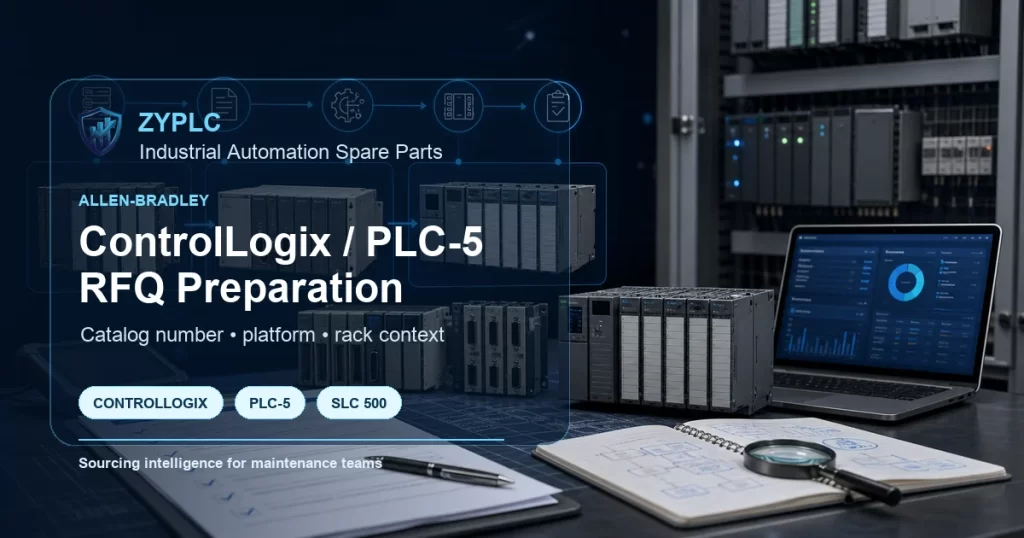
Allen-Bradley spare part requests often arrive with one urgent question: can this module be replaced quickly without creating a new compatibility problem? For maintenance teams working with ControlLogix, PLC-5, or SLC 500, the answer depends on the exact part number, installed rack context, firmware expectations, and how much information is included in the RFQ.
ZYPLC supports sourcing for industrial automation spare parts, including Allen-Bradley PLC, I/O, communication, power, and HMI-related items. This guide explains how to prepare a replacement RFQ that can be checked faster and more accurately.
Do not mix platform families
ControlLogix, PLC-5, and SLC 500 are different installed-base families. A buyer should not treat them as interchangeable just because they are all associated with Rockwell Automation or Allen-Bradley control systems. Each platform has its own rack, module, communication, and replacement considerations.
When requesting a quote, state the installed platform clearly. If you are unsure, send photos of the controller rack, the front module label, and the surrounding modules. The visual context helps the sourcing team identify whether the part belongs to a PLC processor, I/O chassis, communication layer, power supply path, or operator interface system.
ControlLogix RFQ details
For ControlLogix requests, provide the full catalog number, visible revision, module role, and any known firmware or project constraints. Communication modules, processor modules, and I/O cards may have similar naming patterns but different use cases. If the replacement is going into a running production environment, include the installed rack context and whether the buyer requires an exact match.
PLC-5 and SLC 500 RFQ details
Legacy systems such as PLC-5 and SLC 500 often require extra caution because installed bases may be old, documentation may be incomplete, and replacement stock may vary by condition and availability. For these requests, photos are not optional decoration; they are part of the verification process.
If the original module label is difficult to read, include cabinet photos, wiring connector details, and any spare list from the maintenance team. This helps distinguish between similar modules and reduces the chance of quoting an item that is close but not appropriate.
What photos should buyers send?
- Front label showing the full catalog number.
- Side label with revision, series, or barcode where visible.
- Rack/chassis photo showing module position.
- Connector or terminal block photo for I/O modules.
- Existing spare list, BOM, or previous purchase record if available.
Common mistakes that slow quotations
The most common mistake is sending a shortened model or a generic description such as “Allen-Bradley communication card.” Another common issue is omitting the platform family. A third is assuming that a module listed online is automatically suitable for the installed system. ZYPLC can check sourcing and availability, but final compatibility should be verified against the site’s installed system and maintenance documentation.
For broader browsing, start with the PLC Systems category, the Allen-Bradley brand page, or the specific series pages for ControlLogix, PLC-5, and SLC 500.
RFQ checklist
- Full Allen-Bradley catalog number.
- Platform family: ControlLogix, PLC-5, SLC 500, CompactLogix, or other.
- Revision or series information if visible.
- Photos of module label and installed rack.
- Quantity, condition preference, target country, and urgency.
- Whether exact match is required or compatible replacement may be reviewed.
To request a quote, send the model number and photos through the ZYPLC RFQ page. The more complete the RFQ, the easier it is to check stock, sourcing route, and replacement risk before dispatch.
Continue reading
Related sourcing guides
 Jun 29, 2026
Spare Lead Time Planning After ICS Advisories: Build the Kit Before the Window
The latest CISA industrial control advisories are useful for a reason beyond cybersecurity. They show how quickly a plant can move from “we should review this” to “we need a maintenance window and a usable spare.” When the affected asset is a controller, relay, gateway, server, or engineering tool, lead time planning becomes part of […]
 Jun 25, 2026
Bently Nevada 3500 Series Spare Parts: Probe, Proximitor, and Monitor Sourcing Checklist
A buyer checklist for Bently Nevada 3500 Series spare parts, including probes, cables, proximitor modules, monitor cards, and compatibility details.
 Jun 25, 2026
Siemens SIMATIC Spare Parts Sourcing Guide: What Buyers Should Verify Before Quoting
A practical sourcing checklist for Siemens SIMATIC PLC spare parts, covering model numbers, revisions, photos, compatibility checks, and RFQ details.