
ZYPLC Blog
M340 Spares: What Simulation Cannot Prove
Separate M340 logic simulation from physical spare acceptance. Define CPU, I/O and test-rack evidence, then request a focused hardware quotation.
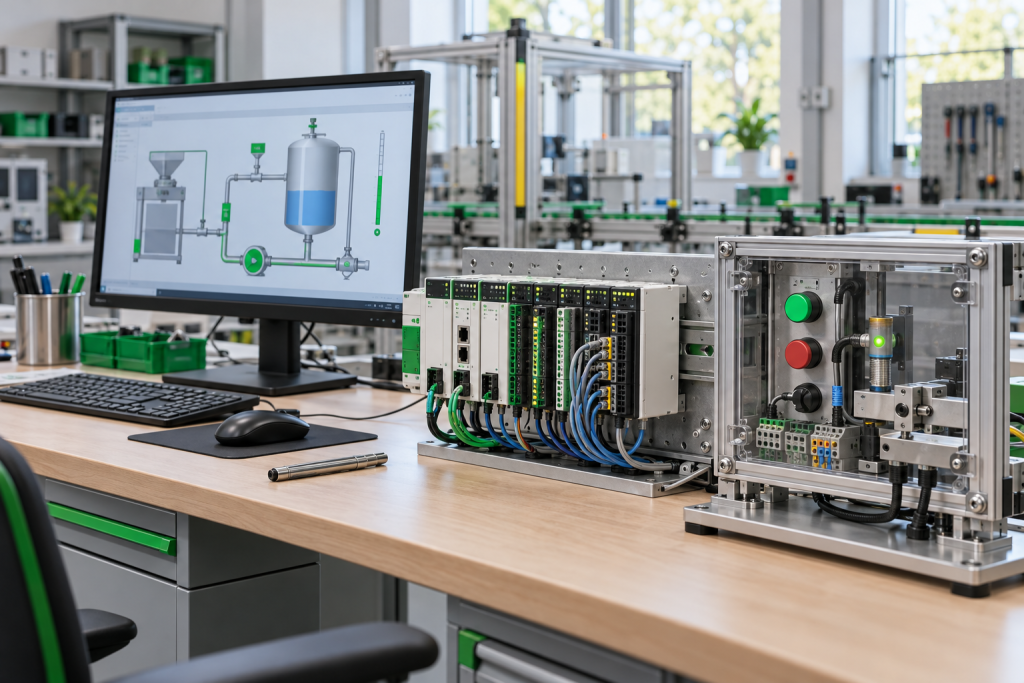
The simulated sequence finishes correctly. Every permissive turns green, the virtual actuator reaches its target, and the demonstration looks convincing. Yet none of those observations proves that a replacement input module will recognize the real field signal when the machine returns to service. For an M340 maintenance team, that distinction should shape the acceptance plan before a spare is purchased.
Schneider Electric’s October 15, 2026 discussion of operator expertise and autonomous operations describes the role of a controlled digital environment in evaluating decisions. The practical implication for legacy hardware is not that simulation makes physical spares unnecessary. It is that the team must identify which questions a model answers and which require actual equipment.
Give each test a question
Separate three kinds of evidence. Logic evidence asks whether the program produces the intended response to defined inputs. Hardware evidence asks whether the selected device performs its documented function. Installation evidence asks whether that device works correctly in the real machine, with the actual wiring, loads, communications and operating constraints.
These categories can support one another without being interchangeable. A simulated permissive can help examine a sequence branch. A bench test can examine a physical input. Neither automatically proves the final wiring or the process behavior at the plant. Write the question beside every proposed test so a passed checkbox does not acquire a broader meaning than intended.
The current Control Expert PLC Simulator guide documents capabilities and differences from real controllers. Use the guide applicable to the software version in the project. Do not assume that a remembered limitation from an older release or an attractive third-party demonstration describes the environment being used today.
Build a small acceptance matrix
Consider a hypothetical packaging machine with a maintained M340 controller. The test matrix might contain a sequence-start condition, a missing-sensor condition and a communication interruption. For each row, record the stimulus, expected response, test environment and evidence retained. Add a column showing what remains unproven.
In a software simulation, the missing-sensor condition may be represented by changing a variable. That can exercise the program’s decision branch. It does not measure the physical sensor, terminal wiring or input electronics. The remaining evidence should therefore include the real input path under an approved test procedure, not another screenshot of the same variable.
Timing deserves its own row. A sequence that completes on a computer may behave differently under the controller’s actual task scheduling and connected devices. Treat time-sensitive acceptance as a defined hardware or installation test where required. Do not use a simulation’s apparent speed as a performance guarantee for the production machine.
Make the spare reproduce the relevant boundary
An available CPU is useful only if it supports the test question. A Schneider BMXP341000 M340 processor can be identified as a specific hardware requirement, but its family name alone does not establish equivalence to another processor in the project. Check the required interfaces, application capacity and supported configuration against the exact controller documentation.
The same discipline applies to I/O. If the installed arrangement calls for a BMXDDI6402K discrete input module, specify the matching connection accessories and approved test arrangement. A virtual input bit cannot establish the condition of the physical channels or connectors. A quotation for the module should also make clear whether the required accessories are included.
A representative test rack does not need to copy every aspect of a factory to be useful. It does need an honest boundary. List what is physically present, what is simulated, and what has been omitted. This makes a modest test rig more valuable than an elaborate demonstration whose assumptions no one can explain.
Keep test assets out of the emergency count
Once a spare is committed to development or simulation support, it may be unavailable for immediate production recovery. Its firmware, application or accessory set may have changed. Record that reservation rather than continuing to count it as a ready replacement on the shelf.
Before returning the item to the spare pool, review its identity, approved configuration state and assessment record. Remove temporary project associations through the authorized process, not by casually deleting files or resetting a device that may contain the only useful copy of something. Preserve project evidence before changing the hardware’s role.
Establish an owner for the test environment as well. When a virtual model changes, the acceptance record should identify which revision produced the result. Otherwise, a later engineer may believe a test covered a fault condition that was added only after the original run.
Turn findings into a purchasing scope
A useful RFQ separates the production replacement from any extra test hardware. State the processor model, module references, connection requirements and required condition. Explain whether the hardware must match an existing installation exactly or support a limited bench evaluation. This avoids purchasing an affordable demonstration unit that cannot serve the intended production role.
Ask suppliers to identify the unit and describe the checks actually performed. Keep supplier hardware assessment separate from plant application validation. The supplier may provide valuable evidence of condition without having the machine, process knowledge or approved test procedure needed to validate the final application.
Questions before accepting the spare
Can a successful simulation replace a physical input test?
No. It may validate a defined logic response, but it cannot by itself establish the condition of the real input electronics, wiring or field device. Retain a separate hardware and installation acceptance scope.
Must the test rack be identical to the entire production system?
Not for every question. It must represent the features being evaluated, and any differences must be explicit. Use the actual installation where the decision depends on behavior that the bench cannot reproduce.
Can a spare CPU used for testing go straight back into stock?
Only after its status and configuration are reviewed. A physically present unit is not automatically ready for emergency use after experimental firmware, application or accessory changes.
What evidence should be retained from the model?
Keep the model and project revisions, software version, test cases, expected and actual outcomes, and a clear list of untested hardware assumptions. That record makes the result reusable without overstating it.
Send ZYPLC the production hardware list and the separate bench-test scope for a focused spare quotation. Clear boundaries help source useful equipment while preserving the engineering responsibility for final acceptance.
Image: AI-generated editorial illustration, not an exact product photograph or installation reference.
© 2026 ZYPLC. All rights reserved. Official Website: https://zyplc.com Inquiry: plc.sales@zyplc.com | WhatsApp/Tel: +86 19859288691