
ZYPLC Blog
VersaMax: CPU or Remote I/O Head?
Identify VersaMax CPUs and remote I/O heads before choosing a spare. Match the installed code and recovery scope, then request a verified quotation.
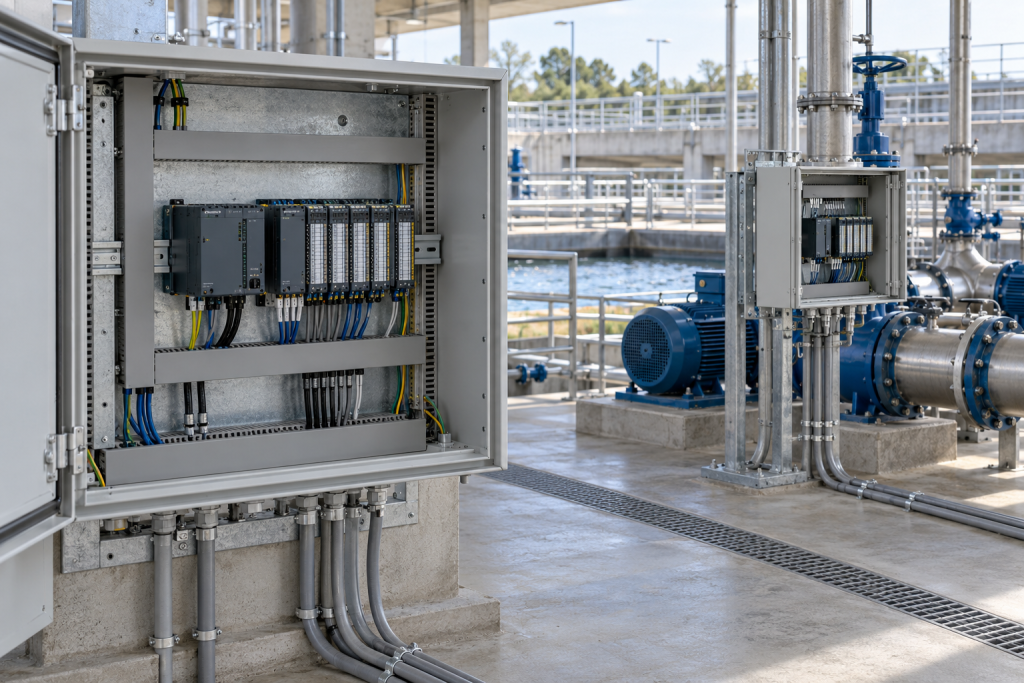
A small VersaMax station beside a pump can look like a self-contained controller even when its job is to exchange I/O with a controller elsewhere. That visual similarity creates an expensive spare-parts mistake: ordering a CPU for a station whose head is a network interface unit, or treating a CPU replacement as though it only needs a network address.
The quickest useful question is not how many modules are attached. It is where the application logic runs. That answer determines who owns the program backup, which configuration has to be restored, and which hardware reference belongs on the purchase request. A shared VersaMax family name does not resolve those responsibilities.
Trace the decision-making path through the installation
Emerson’s VersaMax modular I/O and control brochure distinguishes controller CPUs from network interface units. It lists CPU references such as IC200CPU001 and IC200CPUE05 separately from network heads such as the PROFINET IC200PNS001 and PROFIBUS IC200PBI001. The distinction is architectural, not merely a difference in connector shape.
For a CPU-based station, the recovery scope includes the application running in that controller and its associated configuration. For a remote I/O station, the controlling application may live in an upstream PLC, while the local head exchanges field data over its specified network. Both can stop production, but they do not necessarily require the same archive, software or replacement procedure.
Use the electrical drawings, hardware configuration and actual nameplate together. Do not infer the station’s role from an Ethernet socket, a green indicator or the presence of nearby I/O slices. Those observations are useful evidence, but they cannot establish where a pump sequence or interlock is evaluated.
Read the exact reference before discussing alternatives
An enquiry for a VersaMax IC200CPU001 CPU should identify the installed controller and its application recovery requirements. Emerson’s IC200CPU001 product entry identifies it as a CPU with built-in serial communications. That is a different equipment role from a network interface unit, even when both appear at the left of an I/O station.
The IC200CPUE05 VersaMax CPU is another controller reference that can appear in a plant’s inventory. Its existence does not make it an automatic replacement for CPU001. Any change between references needs an application-specific review of the supported configuration, software, communications and installed equipment. This article is not a conversion procedure.
Old catalog descriptions sometimes use “controller,” “interface” and “module” loosely. Make the complete order code the stable identity, and use manufacturer documentation to resolve the function. If the listed title and the documented model role disagree, request clarification instead of incorporating the ambiguity into the material master.
Three recovery records that should agree
First, maintain a hardware record showing the head reference, local module arrangement and relevant carrier or terminal details. Second, keep the application and configuration archive that applies to that station. Third, record the network relationship: which equipment communicates with it, which engineering project describes that relationship, and who can restore it.
These records do not have to be elaborate, but they must agree. A cabinet photograph from commissioning can become misleading after a later modification. A backup file with an unexplained name may belong to another machine. An IP address list cannot substitute for the configuration that defines how field signals are interpreted.
For remote I/O, ask the upstream-controller owner to confirm the recoverable hardware configuration and the documented response to communication loss. For a local CPU, ask the application owner to confirm the program baseline and restoration method. Keep any field-specific retained values or commissioning data under the site’s established change-control process rather than assuming a generic archive contains everything.
Use the failure evidence to choose the spare boundary
Consider a pump station that loses indication at the control room. A head-module failure is one possibility. So are a communication interruption, local power trouble, a configuration discrepancy or a fault elsewhere in the control chain. The maintenance record should distinguish observations from conclusions before a replacement is authorized.
Capture relevant diagnostics through the approved tools and procedures. Identify whether the local station is powered, whether the controller reports a communication or configuration problem, and which signals are affected. Do not disconnect equipment or alter addressing on a running process simply to test a theory. Production and safety constraints govern how evidence can be collected.
A spare request should state whether it is an exact recovery item for a diagnosed component or a stock-risk reduction purchase. Those are both legitimate purposes, but they lead to different acceptance questions. The first needs confidence that the failed function has been identified. The second needs confidence that the spare covers the intended installed population.
What to confirm before accepting delivery
Compare the offered label and condition with the request, establish the agreed test scope, and confirm any included accessories. Preserve the serial or traceability information in the receipt record. If commissioning support is needed, arrange it before the outage rather than assuming the delivered hardware will provide the missing application knowledge.
Plan recovery verification around the process, not just the module LEDs. The authorized commissioning team should confirm the intended I/O interpretation, communication behavior and operational sequence using the approved test plan. A station that exchanges data is not necessarily a station whose signals have been mapped correctly.
Frequently asked questions
Does an Ethernet connection mean the unit is only remote I/O?
No. A network connection does not identify where the application executes. Read the exact hardware reference and confirm the engineering configuration. Controller CPUs and network interface units can both participate in networked installations while serving different roles.
Can a CPU be ordered instead of a network head?
Not as an assumed spare substitution. Changing the station role can require a different control architecture and engineering work. Use the installed reference for recovery, or treat the proposed change as a separately approved redesign.
Is the program backup enough for a remote I/O replacement?
It may not describe every required setting or physical arrangement. Confirm the upstream hardware configuration, station identity, module order and relevant network documentation. The responsible engineer should identify the complete recovery package before the replacement is scheduled.
What should I send when the station identity is unclear?
Provide clear nameplate photographs, the complete station layout and an authorized configuration extract with sensitive details removed. Include the equipment function and observed symptoms. These allow the enquiry to be narrowed without guessing from the general family appearance.
Send ZYPLC the exact VersaMax head reference, quantity, required condition and destination. State whether the requirement is for a CPU-based station or remote I/O, and flag any unresolved identification. A correctly scoped quotation starts with that distinction.
Image: AI-generated editorial illustration, not an exact product photograph or installation reference.
© 2026 ZYPLC. All rights reserved. Official Website: https://zyplc.com Inquiry: plc.sales@zyplc.com | WhatsApp/Tel: +86 19859288691