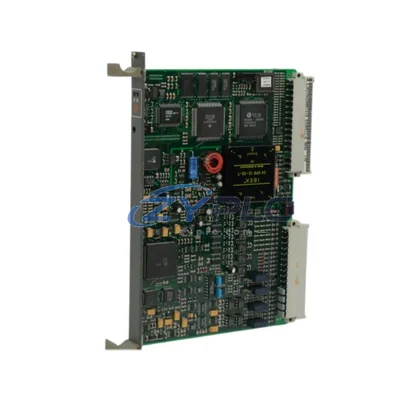
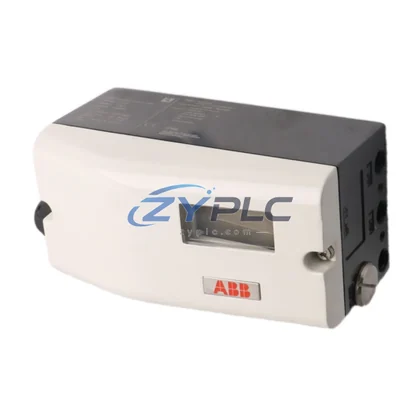
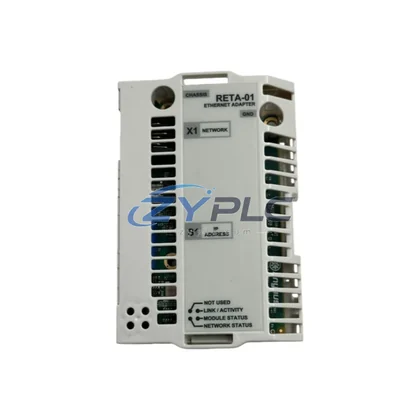
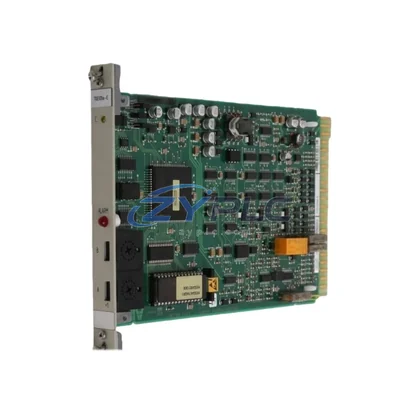
ABB 3HNA011913-001 Industrial Servo Drive Motor for IRB5510: availability, compatibility, and sourcing support for Other series
In modern smart factory environments, the integrity of the data link between field-level actuators and upper-level control systems determines the efficiency of the entire production line. The ABB 3HNA011913-001 servo drive motor — engineered for the IRB5510 robot series — sits at the heart of this data chain, translating mechanical motion commands into precise, feedback-rich execution that feeds real-time status data back through the automation network. Whether integrated into a robotic welding cell, a material handling station, or a precision assembly line, this unit ensures that every motion cycle is both mechanically accurate and digitally transparent.
The ABB IRB5510 platform is built around a tightly coupled servo architecture where the drive motor, encoder feedback, and controller communicate over ABB’s proprietary SREA (Serial Robot Encoder Architecture) protocol. The 3HNA011913-001 is fully compatible with this communication framework, enabling the ABB IRC5 controller to receive continuous position, velocity, and torque feedback without latency gaps. This closed-loop data flow is what allows the IRC5 to execute sub-millimeter path corrections in real time — a capability that directly supports production line rhythm optimization and reduces cycle time variance.
From a network integration perspective, the 3HNA011913-001 does not operate in isolation. It functions as a node within a broader automation data architecture. The ABB DSQC679 teach pendant provides the operator interface layer, while the ABB DSQC688 fieldbus adapter bridges the IRC5 controller to plant-level networks such as PROFIBUS-DP or DeviceNet. This means that motion data generated by the 3HNA011913-001 — including torque load curves, thermal status, and fault codes — can be surfaced directly in a SCADA system or Wonderware InTouch HMI dashboard without additional protocol conversion hardware.
For facilities running mixed-vendor environments, the ABB 3HNA014906-001 (a compatible variant within the same IRB5510 drive family) can be deployed alongside the 3HNA011913-001 to extend axis coverage without disrupting the existing network topology. Both units share the same encoder interface standard, simplifying spare parts management and reducing the risk of configuration errors during maintenance windows.
The servo drive motor’s integration with the ABB SafeMove2 safety module further enhances its role in connected factory architectures. SafeMove2 monitors speed, position, and standstill status over the internal robot network, and any deviation triggers a controlled stop signal that propagates through the ABB DSQC643 I/O board to connected safety PLCs or emergency stop circuits. This safety data loop is essential for facilities that require IEC 62061 or ISO 13849 compliance documentation as part of their digital factory audit trail.
Remote diagnostics represent another critical dimension of the 3HNA011913-001’s network value. When paired with the ABB Ability™ Connected Services platform, the IRC5 controller can transmit drive motor health data — including bearing temperature trends, encoder signal quality, and cumulative load cycles — to a cloud-based monitoring dashboard. Maintenance teams can set threshold alerts and receive predictive maintenance notifications before a fault condition develops, reducing downtime and extending mean time between failures (MTBF).
On the power supply side, the ABB DSQC609 power supply unit provides stable DC bus voltage to the servo drive chain, ensuring that voltage fluctuations at the plant distribution level do not propagate into the motion control loop. Stable power delivery is a prerequisite for consistent encoder signal integrity, and any instability here would manifest as position jitter or communication timeouts in the IRC5 log — both of which are detectable through the SCADA integration described above.
Every ABB 3HNA011913-001 unit supplied by ZYPLC undergoes a full functional test prior to shipment, including encoder signal verification, winding resistance measurement, and insulation resistance testing. Units are shipped with test records and are covered by a warranty and support terms confirmed before quote. Stock is maintained in our warehouse to support urgent replacement orders, with global logistics coordination available for time-critical production recovery scenarios.
Compatibility & Integration Notes
| Parameter |
Specification |
| SKU |
3HNA011913-001 |
| Compatible Variants |
3HNA014906-001, IRB5510 3HAC026114-010 |
| Communication Protocol |
ABB SREA (Serial Robot Encoder Architecture) |
| Controller Interface |
ABB IRC5 (DSQC series) |
| Fieldbus Compatibility |
PROFIBUS-DP, DeviceNet (via DSQC688 adapter) |
| Safety Network |
ABB SafeMove2 (IEC 62061 / ISO 13849) |
| Remote Monitoring |
ABB Ability™ Connected Services |
| Application Environment |
Robotic welding, assembly, material handling |
| Origin |
Sweden |
| Warranty |
Warranty and support terms confirmed before quote — All units tested before shipment |
Connected Automation Data Flow
The data flow within an IRB5510 cell begins at the encoder embedded in the ABB 3HNA011913-001 servo motor. Position pulses are transmitted over the SREA link to the ABB IRC5 controller, where the motion planner processes feedback at the servo cycle rate. The IRC5 then communicates with the ABB DSQC679 FlexPendant for operator-level program management and with the ABB DSQC688 fieldbus adapter for plant network integration.
At the plant network layer, the fieldbus adapter connects the robot cell to a Siemens S7-300 PLC or equivalent controller managing the broader production line sequence. The PLC aggregates status signals from multiple robot cells and forwards production KPIs to a SCADA gateway — such as an Advantech WISE-4000 series edge gateway — which normalizes data formats and publishes them to the MES or cloud analytics platform.
Simultaneously, the ABB DSQC643 digital I/O board within the IRC5 cabinet handles discrete signal exchange with conveyor PLCs, vision system triggers, and safety relay modules. The ABB DSQC609 power supply maintains DC bus stability across all drive axes, while the ABB SafeMove2 module monitors the 3HNA011913-001’s motion envelope and feeds safety status back to the plant safety PLC over a hardwired safety bus. This multi-layer data architecture ensures that every motion event is logged, every fault is traceable, and every maintenance action is data-driven.
Solving Data Isolation in Industrial Sites
One of the most persistent challenges in industrial automation is the fragmentation of data across incompatible protocols and vendor-specific communication stacks. A robot cell running ABB’s SREA protocol cannot natively share data with a Modbus RTU sensor network or an OPC-UA-based SCADA system without deliberate integration work. The ABB 3HNA011913-001, when deployed within a properly architected IRC5 system, addresses this challenge by serving as the motion data source in a layered integration model.
By connecting the IRC5 to a fieldbus adapter such as the DSQC688, plant engineers can bridge the robot’s internal network to standard industrial protocols, eliminating the data silo that would otherwise exist between the robot cell and the rest of the factory floor. This connectivity enables production line transparency — operators can monitor robot cycle times, fault histories, and energy consumption from a centralized HMI without physically accessing the robot cabinet.
Remote diagnostics further reduce the cost of data isolation. Instead of dispatching a technician to read fault logs from the FlexPendant, maintenance teams can access IRC5 event logs remotely through ABB Ability™ Connected Services, correlating drive motor behavior with upstream process variables. This capability is particularly valuable in multi-site manufacturing environments where engineering resources are centralized but production assets are geographically distributed.
System expansion is also simplified by the 3HNA011913-001’s compatibility with the broader ABB IRB5510 drive family. Adding a new robot axis or replacing a failed unit does not require reconfiguration of the network topology — the replacement unit adopts the same encoder interface and communication parameters, minimizing commissioning time and reducing the risk of network disruption during the changeover.
Industrial Connectivity FAQ
Q1: Does the ABB 3HNA011913-001 support standard industrial fieldbus protocols such as PROFIBUS or EtherNet/IP?
The 3HNA011913-001 communicates natively over ABB’s SREA protocol within the IRC5 controller architecture. Integration with PROFIBUS-DP, DeviceNet, or EtherNet/IP is achieved through the ABB DSQC688 fieldbus adapter module, which acts as a protocol gateway between the robot controller and the plant network. This approach is standard in ABB IRB5510 installations and does not require third-party conversion hardware.
Q2: How is network stability maintained during high-cycle production operations?
The IRC5 controller manages servo communication at a fixed cycle rate, with the DSQC609 power supply ensuring stable DC bus voltage across all drive axes. The SafeMove2 module provides an independent safety monitoring channel that does not share bandwidth with the production data network, ensuring that safety-critical signals are never delayed by production traffic. ZYPLC recommends periodic encoder signal quality checks as part of a preventive maintenance schedule to maintain network stability over the product lifecycle.
Q3: Can the 3HNA011913-001 be integrated into an existing SCADA or MES system?
Yes. Through the IRC5 fieldbus adapter and an edge gateway such as the Advantech WISE-4000 series, data from the 3HNA011913-001 — including position feedback, torque data, and fault codes — can be published to OPC-UA, MQTT, or REST API endpoints compatible with most SCADA and MES platforms. ABB Ability™ Connected Services provides an additional cloud-based monitoring layer for facilities that require remote access without on-premises server infrastructure.
Q4: What does the warranty and support terms confirmed before quote cover, and what is the pre-shipment testing process?
Every ABB 3HNA011913-001 unit supplied by ZYPLC undergoes encoder signal verification, winding resistance measurement, and insulation resistance testing before shipment. The warranty and support terms confirmed before quote covers manufacturing defects and functional failures under normal operating conditions. Test records are provided with each unit. For urgent replacement requirements, ZYPLC maintains warehouse stock and can coordinate expedited global shipping to minimize production downtime.