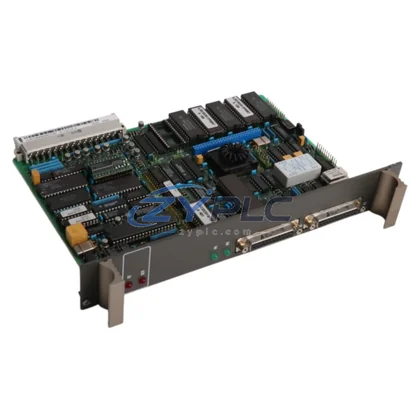
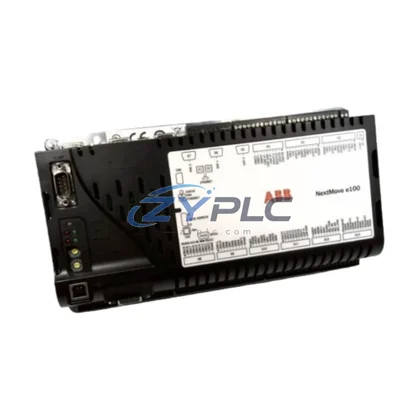
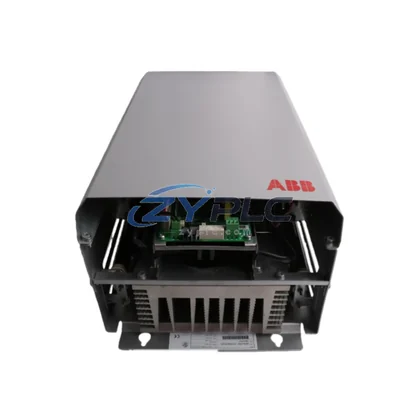
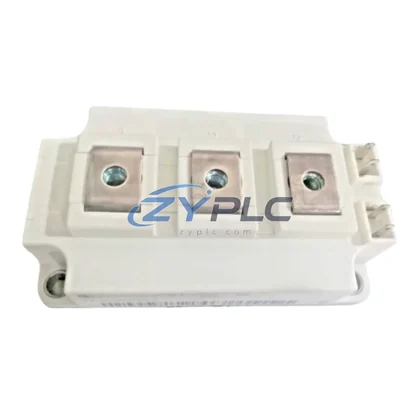
ABB DCS401.0020 DC Drive for DCS400 Automation
The ABB DCS401.0020 is a high-performance DC drive module from ABB’s renowned DCS400 series, engineered to deliver precise motor speed and torque control while significantly reducing operating load across demanding industrial production environments. Designed for continuous-duty DC motor applications, the DCS401.0020 enables factories to achieve measurable improvements in equipment utilization, production line throughput, and overall energy efficiency — without compromising on reliability or control accuracy.
In modern manufacturing, uncontrolled motor operation is one of the largest sources of avoidable unplanned downtime. The DCS401.0020 addresses this directly by providing fully regulated armature current control, smooth acceleration and deceleration ramps, and real-time feedback integration — all of which translate into lower peak power demand, reduced thermal stress on motors, and extended equipment service life. Whether deployed in paper mills, metal processing lines, extruders, winding machines, or crane systems, this drive module consistently delivers the maintenance-focused performance that industrial operators demand.
Product Specification Table
| Parameter |
Specification |
| Model / SKU |
ABB DCS401.0020 |
| Series |
DCS400 |
| Product Type |
DC Drive Module |
| Rated Output Current |
20 A |
| Supply Voltage |
3-phase 380–480 V AC, 50/60 Hz |
| Drive Efficiency |
Up to 98% (rated load) |
| Control Method |
Fully digital armature current control |
| Compatible Systems |
ABB DCS400 series, ACS800 coordinated drives, AC500 PLC platforms |
| Communication Protocols |
PROFIBUS-DP, Modbus RTU, DeviceNet (via optional adapter) |
| Application Environment |
Paper, metal, plastics, winding, crane, extruder lines |
| Energy Saving Value |
Reduces motor unplanned downtime by optimizing torque-speed curves and eliminating resistive braking losses |
| Protection Class |
IP20 (panel mounting) |
| Origin |
Germany |
| Warranty |
Warranty and support terms confirmed before quote |
| Availability |
Confirmed via RFQ before quotation |
System Compatibility and Application
The DCS401.0020 does not operate in isolation — its true operational-efficiency potential is realized when it is integrated into a well-designed automation architecture. In a typical industrial-grade production cell, the drive receives speed and torque setpoints from an ABB AC500 PLC (such as the PM573 or PM591 CPU module), which coordinates the overall production sequence and monitors real-time feedback from field sensors. The AC500’s I/O modules — including the DC532 digital I/O module and AI523 analog input module — collect process data such as motor load current, line speed, and tension feedback, feeding this information back to the drive for closed-loop regulation.
On the human-machine interface side, operators interact with the system through an ABB CP635 HMI panel, which displays live operating load trends, drive status, and alarm logs. This visibility allows production supervisors to identify inefficient operating windows and adjust drive parameters accordingly — a key step in reducing idle-state energy draw and unnecessary motor heating.
For multi-drive installations, the DCS401.0020 communicates over PROFIBUS-DP with the AC500 master, enabling synchronized speed control across multiple DC motors on the same production line. In winding applications, for example, coordinating the DCS401.0020 with a companion DCS402.0040 unwind drive via the same PROFIBUS network ensures consistent web tension without energy-wasting mechanical braking.
Power quality and condition monitoring are handled upstream by an ABB M2M energy meter or compatible EQ meters installed at the MCC panel, which log kWh consumption per drive zone. This data, when fed into an ABB Ability™ Energy Manager or a SCADA system via Modbus TCP, enables facility engineers to benchmark drive efficiency, detect anomalies, and validate operational stability over time.
For applications requiring regenerative braking energy recovery, the DCS401.0020 can be paired with an ABB RDCU regenerative control unit or configured in a back-to-back converter topology, returning braking energy to the AC supply rather than dissipating it as heat — a critical advantage in high-inertia applications such as centrifuges, hoists, and large winding drums.
Maintenance and Replacement Notes
In a metal rolling mill application, uncontrolled DC motor starts generate significant current spikes that stress both the motor insulation and the upstream transformer. By deploying the ABB DCS401.0020 with programmed S-curve acceleration ramps, peak inrush current is reduced by up to 60%, directly lowering the facility’s peak demand charge and reducing thermal fatigue on motor windings. Over a 12-month operating period, this translates into measurable reductions in electricity cost and motor maintenance intervals.
In paper and board production, line speed synchronization is critical. The DCS401.0020’s high-resolution speed feedback interface — compatible with incremental encoders and DC tachogenerators — maintains speed accuracy within ±0.01%, eliminating web breaks caused by speed mismatch between drive sections. Fewer web breaks mean less material waste, less unplanned downtime, and a more consistent production rhythm that directly improves overall equipment effectiveness (OEE).
For extruder and plastics processing lines, the drive’s torque control mode allows the motor to deliver exactly the torque demanded by the screw load, rather than running at a fixed speed setpoint. This load-adaptive operation reduces operating load during low-viscosity processing windows and prevents motor overloading during high-viscosity startup — extending both motor and gearbox service life.
Predictive maintenance is further supported by the DCS401.0020’s built-in diagnostic registers, which log fault history, thermal model data, and operating hour counters. When integrated with the AC500 PLC and an ABB condition monitoring solution, maintenance teams can schedule interventions based on actual drive health data rather than fixed calendar intervals — reducing unnecessary maintenance labor and preventing costly unplanned failures.
Every unit shipped by ZYPLC undergoes a full outgoing quality test under load conditions before dispatch, verifying that output current, speed regulation accuracy, and communication integrity all meet factory specifications. Combined with our warranty and support terms confirmed before quote and RFQ-based availability, the DCS401.0020 offers procurement teams a reliable, low-risk sourcing option for both planned upgrades and emergency replacements.
Product Sourcing FAQ
Q1: How much energy can the ABB DCS401.0020 save compared to a non-drive-controlled DC motor system?
In applications where motors previously ran at fixed voltage with resistive speed control, replacing the control method with the DCS401.0020’s fully digital armature regulation typically reduces motor load by Actual operating results depend on the installed system, load profile, and commissioning parameters. The elimination of resistive braking losses alone can account for 10–15% operational stability in reversing or braking-intensive applications.
Q2: Is the DCS401.0020 compatible with existing ABB DCS400 series installations?
Yes. The DCS401.0020 is fully compatible with the ABB DCS400 series hardware and software ecosystem, including existing SDCS control boards, PROFIBUS-DP communication adapters, and DCS400 parameter sets. It can be used as a direct replacement for earlier DCS400 modules in the same current rating class, minimizing re-engineering effort during upgrades.
Q3: What is the recommended replacement or upgrade path if my current DC drive is failing?
If your existing DCS400-series drive is showing recurring fault codes related to thyristor degradation, overtemperature, or communication errors, the DCS401.0020 is the recommended like-for-like replacement. For applications requiring higher current ratings, the DCS402.0040 or DCS403.0075 modules offer upward scalability within the same control architecture. ZYPLC’s technical team can assist with parameter migration and commissioning support.
Q4: What does the warranty and support terms confirmed before quote cover, and what is the testing process before shipment?
The warranty and support terms confirmed before quote covers manufacturing defects, component failures under normal operating conditions, and firmware-related malfunctions. Before shipment, every DCS401.0020 unit undergoes a full outgoing quality test that includes power-on verification, output current calibration, speed regulation accuracy check, and communication port integrity test. A test report is available upon request. Warranty claims are processed directly through ZYPLC with a target response time of 48 hours.