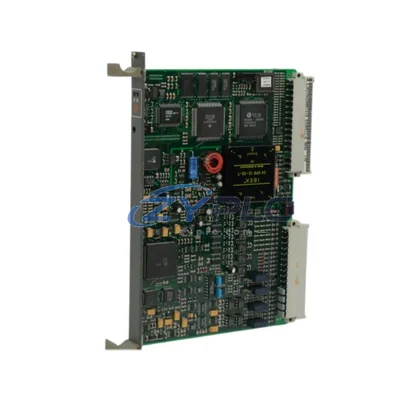
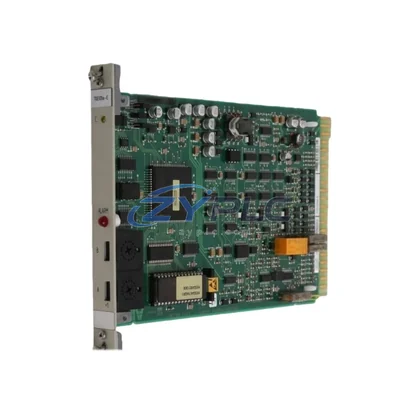
ABB DSQC345C 3HAB8101-3 Industrial Network Interface for IRC5 Systems: Powering the Smart Factory Data Link
The ABB DSQC345C 3HAB8101-3 is a high-performance Drive Rectifier Unit engineered for seamless integration within ABB’s IRC5 robot controller architecture. Far beyond its role as a power conversion component, this module serves as a critical node in the industrial data chain — bridging field-level drive signals with upper-layer control, monitoring, and diagnostic systems. In modern smart factory environments where every millisecond of downtime carries a cost, the DSQC345C 3HAB8101-3 delivers the electrical stability and communication reliability that production lines demand.
Designed and manufactured in Sweden to ABB’s exacting industrial standards, this drive rectifier unit supports the high-current DC bus requirements of IRC5 multi-axis robot systems. It operates in concert with the IRC5 controller’s modular architecture, ensuring that servo drives, axis computers, and I/O modules receive clean, regulated power — a prerequisite for deterministic motion control and accurate data acquisition across the automation network.
Compatibility & Integration Notes
| Attribute |
Specification |
| SKU / Part Number |
DSQC345C / 3HAB8101-3 |
| Brand |
ABB Robotics |
| Series / Platform |
IRC5 Robot Controller |
| Product Type |
Drive Rectifier Unit |
| Communication Protocol |
DeviceNet, PROFIBUS-DP (via IRC5 fieldbus adapter) |
| Interface Type |
DC Bus Interface, Drive Power Link |
| Transmission Capability |
High-current rectified DC output for multi-axis servo drives |
| Network Compatibility |
ABB IRC5 Single / Dual Cabinet, FlexController |
| System Application |
Robot Motion Control, SCADA Integration, Remote Diagnostics, Smart Factory Automation |
| Origin |
Sweden (SE) |
| Warranty |
Warranty and support terms confirmed before quote — Tested & Verified Before Shipment |
Connected Automation Data Flow
In a fully connected IRC5-based production cell, the DSQC345C 3HAB8101-3 anchors the power and signal integrity that makes real-time data flow possible. The process begins at the field level: sensors and encoders mounted on robot joints feed positional and torque data back through the axis computer modules — such as the ABB DSQC400 and DSQC401 drive units — which depend on the stable DC bus that the DSQC345C rectifier provides. Without clean, regulated power at this layer, servo response times degrade and data integrity across the motion network is compromised.
Moving up the communication stack, the IRC5 controller’s main computer — typically the ABB DSQC639 or DSQC643 main computer board — aggregates axis feedback and I/O status, then transmits structured data packets over the fieldbus backbone. Where DeviceNet or PROFIBUS-DP fieldbus adapter modules such as the ABB DSQC378B are installed, the IRC5 system can communicate directly with plant-level PLCs — including Siemens S7-300/S7-400 or Allen-Bradley ControlLogix platforms — enabling coordinated multi-robot cell management and synchronized conveyor or fixture control.
At the I/O layer, distributed remote I/O units and safety modules connected via the IRC5’s internal DSQC652 digital I/O board relay discrete signals — gripper states, part-present confirmations, safety gate status — back to the SCADA layer. Industrial SCADA platforms such as Wonderware System Platform or Ignition by Inductive Automation subscribe to these data streams via OPC-UA gateways or Modbus TCP bridges, providing operators with real-time dashboards of robot cycle times, fault codes, and energy consumption. The DSQC345C’s role in maintaining DC bus stability directly supports the uninterrupted data acquisition that these upper-layer systems require.
For facilities deploying edge computing architectures, an industrial edge gateway — such as an ABB Ability™ Edge node or a third-party IIoT gateway — can be positioned between the IRC5 controller and the cloud analytics platform. This gateway buffers and pre-processes robot telemetry, enabling predictive maintenance algorithms to flag anomalies in drive current draw or rectifier thermal performance before a fault occurs. The DSQC345C’s consistent output characteristics make it a reliable data source for such condition-monitoring pipelines.
HMI terminals — whether panel-mounted ABB CP600 series displays or third-party Weintek/Weinview units — connected to the IRC5 via Ethernet/IP or serial RS-232 links provide operators with local visibility into robot status and alarm states. When the drive rectifier unit is operating within normal parameters, these HMIs display green-state confirmations; any deviation in rectifier output triggers alarm propagation through the fieldbus to both the local HMI and the remote SCADA console, enabling rapid response without requiring physical presence on the factory floor.
Solving Data Isolation in Industrial Sites
One of the most persistent challenges in legacy robot installations is protocol fragmentation: IRC5 controllers communicating over DeviceNet may sit alongside older S4C+ systems using PROFIBUS, while newer collaborative robot cells operate on EtherNet/IP or PROFINET. The DSQC345C 3HAB8101-3, as part of a fully configured IRC5 system with the appropriate fieldbus adapter, supports protocol bridging that eliminates these data silos. By standardizing the power and communication infrastructure within the IRC5 cabinet, integrators can deploy a single SCADA namespace that spans multiple robot generations and communication standards.
Remote monitoring and diagnostics represent another area where this module’s reliability pays dividends. In multi-site manufacturing operations, maintenance engineers rely on remote access to IRC5 diagnostic data — fault logs, drive temperatures, cycle counters — to plan preventive maintenance without costly site visits. The stable DC bus provided by the DSQC345C ensures that the IRC5’s internal logging and communication functions remain active even during high-load production cycles, preserving the data continuity that remote diagnostic tools depend on.
Production line transparency is further enhanced when the IRC5 system’s data is integrated into MES (Manufacturing Execution System) platforms. OEE (Overall Equipment Effectiveness) calculations require accurate uptime, cycle time, and fault frequency data — all of which originate from the robot controller’s internal monitoring. The DSQC345C’s role in maintaining system stability directly contributes to the accuracy and completeness of this production intelligence. System expansion is equally straightforward: additional IRC5 drive modules can be added to the cabinet as robot payload or axis count increases, with the rectifier unit scaled accordingly to match the expanded DC bus demand.
All units supplied by ZYPLC undergo pre-shipment functional testing, verifying rectifier output voltage, ripple characteristics, and communication interface integrity before dispatch. This ensures that replacement or expansion units integrate into live production environments without commissioning delays.
Industrial Connectivity FAQ
Q1: What communication protocols does the ABB DSQC345C 3HAB8101-3 support within the IRC5 system?
The DSQC345C itself is a drive rectifier unit focused on DC bus power delivery. Within the IRC5 controller architecture, protocol support — including DeviceNet, PROFIBUS-DP, EtherNet/IP, and Modbus TCP — is provided by dedicated fieldbus adapter modules such as the DSQC378B or DSQC688. The rectifier unit’s stable output is a prerequisite for reliable fieldbus communication across all supported protocols.
Q2: How does this unit contribute to network stability in high-cycle robot applications?
In high-cycle applications — automotive welding, palletizing, machine tending — voltage ripple on the DC bus can introduce noise into encoder feedback signals and fieldbus transceivers, causing communication retries and cycle time variability. The DSQC345C’s regulated rectifier output minimizes this ripple, maintaining the signal integrity that deterministic fieldbus protocols require for consistent sub-millisecond cycle times.
Q3: Can the DSQC345C 3HAB8101-3 be integrated into SCADA and remote monitoring systems?
Yes. While the rectifier unit does not directly interface with SCADA systems, its operational data — including drive current, thermal status, and fault flags — is accessible through the IRC5 controller’s diagnostic interface. SCADA platforms connected via OPC-UA or Modbus TCP can subscribe to these data points, enabling real-time monitoring and alarm management without additional hardware.
Q4: What warranty and testing does ZYPLC provide for this unit?
Every ABB DSQC345C 3HAB8101-3 supplied by ZYPLC is covered by a warranty and support terms confirmed before quote and undergoes pre-shipment functional testing to verify electrical performance and interface integrity. Units are dispatched via DHL or FedEx with full tracking, and our technical team is available to support installation and commissioning queries.