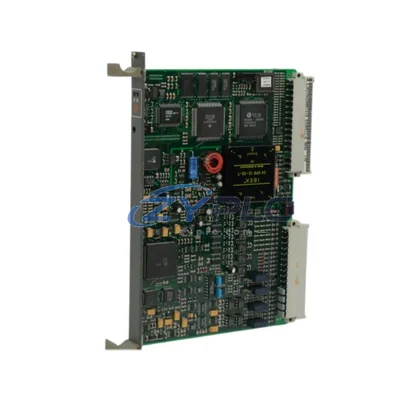
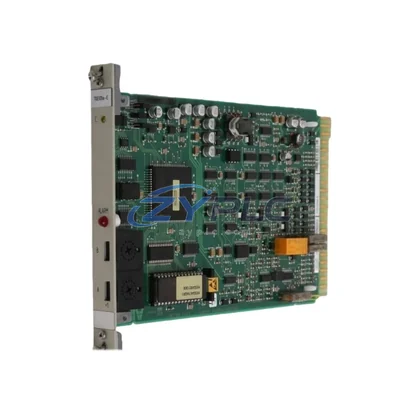
ABB DSQC363 Axis Computer for IRB Series
The ABB DSQC363 is a dedicated axis computer module engineered for deployment within the IRC5 robot controller platform, serving as the computational backbone for multi-axis servo coordination across the full IRB series of industrial robots. In a layered automation architecture, the DSQC363 occupies a critical position at the motion control layer, receiving trajectory commands from the main computer unit and translating them into precise, real-time drive signals for each robot joint. Its role is not isolated — it functions as an integral node within a tightly coupled system where every upstream and downstream component depends on its timing accuracy, signal integrity, and communication reliability.
Understanding the DSQC363 requires understanding the IRC5 controller architecture as a whole. The IRC5 cabinet houses a structured hierarchy of modules: the main computer (DSQC639 or DSQC1000) handles task execution and program logic, while the axis computer (DSQC363) manages the real-time servo loop. Below the axis computer, drive units such as the DSQC374 or DSQC508 receive the processed motion commands and convert them into motor current. The DSQC363 communicates with these drive modules over the internal drive bus, ensuring synchronized torque and velocity control across all six axes simultaneously. This architecture guarantees deterministic motion performance even under complex path interpolation demands.
At the I/O layer, the IRC5 system integrates digital and analog I/O modules — including the DSQC651 digital I/O board and DSQC652 analog I/O board — which feed process signals into the controller. The DSQC363 does not directly interface with field I/O, but its stable operation is a prerequisite for the entire motion sequence that these I/O signals trigger. A fault at the axis computer level will cascade upward to the main computer and outward to the I/O and safety layers, halting production. This interdependency underscores why sourcing a verified, tested DSQC363 with a Warranty and support terms confirmed before quote is a non-negotiable requirement for system integrators and maintenance engineers.
The network and communication layer of the IRC5 platform typically includes fieldbus adapters such as the DSQC688 (DeviceNet) or DSQC378B (Profibus) mounted within the controller cabinet. These adapters allow the robot system to communicate with upstream PLCs, SCADA systems, and safety controllers. The DSQC363 operates transparently within this communication hierarchy — its internal bus transactions are invisible to the fieldbus layer, yet any instability in axis computation will manifest as motion errors that propagate through the entire network-connected production cell. system integration of the DSQC363 within the broader control architecture is therefore essential for predictable system behavior.
From a power architecture perspective, the IRC5 controller relies on the DSQC609 power supply unit to distribute regulated DC voltages to all internal modules, including the DSQC363. The axis computer requires stable, clean power to maintain its real-time clock synchronization and servo loop timing. Engineers specifying replacement modules must verify that the existing DSQC609 or equivalent power supply is within specification before installing a new DSQC363, as voltage ripple or transient spikes can cause intermittent axis faults that are difficult to diagnose without oscilloscope-level analysis.
At the human-machine interface layer, the FlexPendant (IRC5 teach pendant) communicates with the main computer, which in turn delegates motion execution to the DSQC363. Operators programming robot paths via the FlexPendant are, in effect, generating trajectory data that the DSQC363 will execute in real time. The responsiveness and accuracy of jogging, fine-tuning, and path verification all depend on the axis computer’s computational throughput. A degraded or counterfeit DSQC363 will introduce latency and jitter into the motion loop, making precise path teaching unreliable and potentially unsafe.
For system redundancy and long-term maintenance planning, stocking a spare DSQC363 is standard practice in high-availability production environments. Automotive body shops, foundries, food processing lines, and electronics assembly facilities operating IRB 1600, IRB 2600, IRB 4600, or IRB 6640 robots all share the same IRC5 controller platform and therefore the same DSQC363 dependency. A single unplanned downtime event caused by axis computer failure can cost tens of thousands of dollars per hour in lost production. Maintaining a verified spare — Warranty terms are confirmed during quotation.
Product Specification Table
| Parameter |
Specification |
| Part Number / SKU |
DSQC363 |
| Brand |
ABB Robotics |
| Series / Platform |
IRC5 Robot Controller |
| Compatible Robot Series |
IRB 1600, IRB 2600, IRB 4600, IRB 6640, IRB 7600 |
| System Role |
Axis Computer Module — Real-Time Servo Loop Controller |
| Number of Axes Supported |
Up to 6 axes (standard IRC5 configuration) |
| Communication Interface |
Internal IRC5 Drive Bus; Ethernet service port |
| Operating Voltage |
24 VDC (supplied via DSQC609 power distribution) |
| Operating Temperature |
0°C to +55°C (controller cabinet ambient) |
| Mounting |
IRC5 single-cabinet or dual-cabinet controller backplane |
| Origin |
Sweden (ABB Robotics) |
| Product Type |
Robotics Controller Module |
| Warranty |
Warranty and support terms confirmed before quote (ZYPLC) |
| system integration |
Full IRC5 architecture system integration support included |
System Compatibility Notes
The DSQC363 does not operate in isolation — it is one node in a precisely coordinated control system. In a standard IRC5 single-cabinet configuration, the module works in concert with the DSQC639 main computer (or its successor, the DSQC1000), which handles RobotWare execution, task scheduling, and high-level motion planning. The DSQC363 receives interpolated path data from the main computer and executes the servo loop at the hardware level, communicating downward to DSQC374 drive units or DSQC508 drive modules that directly power the robot’s servo motors.
The DSQC609 power supply underpins the entire cabinet’s electrical architecture, providing the regulated 24 VDC rail that the DSQC363 and all other logic-level modules depend on. At the I/O layer, DSQC651 digital I/O boards and DSQC652 analog I/O boards handle process signals from end-effectors, conveyors, and safety interlocks. Fieldbus connectivity is provided by adapters such as the DSQC688 DeviceNet adapter or DSQC378B Profibus adapter, enabling the IRC5 system to integrate with factory-wide PLC networks and SCADA platforms. The FlexPendant teach pendant completes the human-machine interface layer, giving operators direct access to motion programming and system diagnostics. Together, these components form a complete, validated control architecture in which the DSQC363 serves as the real-time motion execution engine.
Industrial Application Notes
The ABB DSQC363 finds application across a wide spectrum of industrial sectors where the IRC5 platform is the standard robot controller. In automotive manufacturing, IRB 6640 and IRB 7600 robots equipped with IRC5 controllers perform spot welding, arc welding, and body assembly tasks where axis computer reliability directly determines weld quality and cycle time consistency. In electronics assembly, IRB 1600 and IRB 2600 robots handle precision pick-and-place, dispensing, and inspection tasks where the DSQC363’s servo loop accuracy is critical for sub-millimeter repeatability.
In food and beverage processing, hygienic-design IRB robots operating in washdown environments rely on the IRC5 controller’s sealed cabinet to protect the DSQC363 from moisture ingress. Pharmaceutical packaging lines use IRB robots for blister pack handling and palletizing, where the axis computer must maintain consistent cycle times to meet GMP production records. In metal fabrication and foundry applications, IRB 4600 robots perform casting extraction and machine tending in high-temperature environments, placing thermal stress on all controller components including the DSQC363. Logistics and warehousing operations increasingly deploy IRB robots for depalletizing and sortation, where continuous multi-shift operation demands axis computer modules with verified reliability and available spare stock. Across all these sectors, the Warranty and support terms confirmed before quote and system integration support provided with every DSQC363 from ZYPLC ensures that system integrators and end users can deploy with confidence.
Product Compatibility FAQ
Q1: Is the DSQC363 compatible with all IRC5 controller variants, including the IRC5 Compact and IRC5 Panel Mounted Controller?
The DSQC363 is designed for the standard IRC5 single-cabinet and dual-cabinet configurations. Compatibility with the IRC5 Compact (used with smaller IRB robots such as the IRB 120 and IRB 140) and the IRC5 Panel Mounted Controller depends on the specific hardware revision of the axis computer and the RobotWare version installed. Before ordering, provide your controller serial number and RobotWare version to our technical team at plc.sales@zyplc.com for a compatibility confirmation. Our Warranty and support terms confirmed before quote covers verified compatible installations.
Q2: What is the recommended procedure for replacing a DSQC363 in a live production environment to minimize downtime?
The recommended approach is a controlled shutdown of the IRC5 controller followed by a full system backup via the FlexPendant before removing the faulty DSQC363. After installing the replacement module, restore the system backup and perform a fine calibration check on all axes using the calibration pendulum or CalPen tool. Verify drive unit communication on all axes before returning the robot to automatic mode. Our system integration support package includes step-by-step commissioning guidance for DSQC363 replacement, available to all customers purchasing through ZYPLC.
Q3: What does the Warranty and support terms confirmed before quote cover for the DSQC363, and what is the claims process?
The Warranty and support terms confirmed before quote covers manufacturing defects, premature component failure under normal operating conditions, and DOA (dead on arrival) units. It does not cover damage caused by incorrect installation, overvoltage events, or physical impact. To initiate a warranty claim, contact ZYPLC at plc.sales@zyplc.com or +86 19859288691 with your order number, a description of the fault, and any available error codes from the IRC5 event log. Replacement or repair will be processed within the agreed lead time, with priority handling available for production-critical situations.