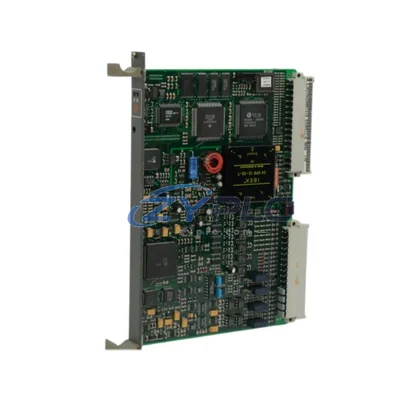
ABB DSQC406 Drive Unit for IRC5
The ABB DSQC406 is a precision-engineered drive unit designed to operate as a core motion control component within the ABB IRC5 and S4C+ robot controller architecture. Rather than functioning as a standalone module, the DSQC406 is conceived as an integral element of a layered automation system — one that coordinates seamlessly across the control layer, I/O layer, power distribution layer, communication network layer, and the mechanical execution layer. Its role is to translate high-level motion commands from the main computer unit into precise, real-time axis drive signals, ensuring that each robot joint responds with the accuracy and repeatability demanded by modern industrial automation environments.
In a complete IRC5 controller cabinet, the DSQC406 operates in close coordination with the DSQC400 main computer board, which handles program execution and trajectory planning. The drive unit receives interpolated position references and converts them into current-controlled output signals for the servo motors. This tight coupling between the DSQC400 and DSQC406 ensures deterministic motion performance across all six robot axes, with minimal latency between command generation and mechanical response. The DSQC406 is also designed to interface with the DSQC508 I/O board, enabling real-time feedback from encoders and limit switches to be processed and acted upon within the same control cycle.
From a power architecture perspective, the DSQC406 is supplied through the ABB DSQC609 power supply unit, which provides regulated DC bus voltage to the drive circuits. The power supply’s ability to maintain stable output under varying load conditions is critical to the DSQC406’s performance, particularly during high-acceleration motion profiles or multi-axis simultaneous movement. The DSQC609 and DSQC406 together form the backbone of the IRC5 power and drive subsystem, and their compatibility must be verified during any system upgrade or component replacement procedure.
At the network and communication layer, the IRC5 architecture relies on the DSQC688 DeviceNet gateway and DSQC679 teach pendant interface to coordinate operator commands, safety interlocks, and fieldbus data exchange. The DSQC406 does not communicate directly over fieldbus protocols, but its operational state — including fault codes, temperature status, and axis enable signals — is reported upstream through the main computer unit to the plant-level SCADA or DCS system. This architecture ensures that maintenance engineers can monitor drive health remotely without interrupting production cycles.
For installations requiring high availability, the IRC5 panel-mounted controller supports a modular redundancy design in which the DSQC406 can be replaced without full system shutdown, provided that the axis group is safely parked and the drive enable signal is inhibited. This hot-swap capability, combined with the DSQC406’s compact form factor and standardized connector layout, significantly reduces mean time to repair (MTTR) in production environments where downtime carries substantial cost. The DSQC406 is also compatible with the DSQC352 resolver board, which provides absolute position feedback for each axis, further enhancing system reliability and restart accuracy after power interruptions.
In terms of system expansion, the DSQC406 supports multi-axis configurations within the IRC5 drive module cabinet. When additional axes are required — for example, in track motion or external positioner applications — supplementary drive units can be added to the same cabinet backplane, sharing the common DC bus and communicating through the internal drive bus. This scalability makes the DSQC406 a future-proof investment for facilities planning to expand their robotic cell capacity without replacing the entire controller infrastructure.
From a maintenance and lifecycle management perspective, the DSQC406 benefits from ABB’s well-documented spare parts ecosystem. Engineers familiar with the IRC5 platform will find that the DSQC406’s diagnostic LED indicators, fault log integration, and parameter backup compatibility with RobotStudio software make it straightforward to commission, tune, and troubleshoot. system integration with existing IRC5 configurations means that replacement units can be brought online with minimal reconfiguration, preserving axis calibration data and motion parameters stored in the DSQC400 main computer.
ZYPLC maintains Availability subject to confirmation of the ABB DSQC406 with full functional testing prior to shipment. Every unit is covered by a Warranty and condition confirmed before quote, ensuring that your system architecture investment is protected against component defects. Our technical team can assist with compatibility verification, installation guidance, and system-level integration support for IRC5 and S4C+ platforms across manufacturing, automotive, food processing, electronics assembly, and logistics automation sectors.
Product Specification Table
| Parameter |
Specification |
| System Role |
Axis Drive Unit — IRC5 / S4C+ Robot Controller |
| Compatible Controller |
ABB IRC5 Panel Mount, IRC5 Cabinet, S4C+ |
| Axes Supported |
Multi-axis servo drive (up to 6 axes per cabinet) |
| Input Voltage |
DC Bus from DSQC609 Power Supply Unit |
| Output |
Current-controlled servo motor drive signals |
| Communication Interface |
Internal IRC5 Drive Bus; status reporting via DSQC400 |
| Feedback Compatibility |
Resolver-based (DSQC352), Encoder feedback |
| Mounting |
IRC5 Drive Module Cabinet Backplane |
| Operating Temperature |
0°C to +55°C (standard industrial environment) |
| Origin |
Sweden (ABB Robotics) |
| Warranty |
Warranty and condition confirmed before quote — Functional test verified |
| system integration |
Full system integration with IRC5 RobotStudio configuration |
System Compatibility Notes
The DSQC406 achieves its full performance potential only when deployed within a correctly specified IRC5 system architecture. The following components are commonly integrated alongside the DSQC406 in a complete robotic control solution:
The DSQC400 main computer board serves as the central processing unit, executing RAPID programs and generating motion references for the DSQC406. The DSQC609 power supply unit provides the regulated DC bus voltage essential for stable drive operation. The DSQC508 digital I/O board handles discrete signal exchange with end-of-arm tooling, safety relays, and peripheral equipment. The DSQC352 resolver measurement board delivers absolute axis position data, enabling accurate homing and restart after emergency stops.
At the operator interface layer, the DSQC679 teach pendant connection unit links the FlexPendant to the controller, allowing engineers to jog axes, monitor drive status, and execute calibration routines directly from the cell floor. The DSQC688 DeviceNet gateway extends the IRC5 architecture into plant-level fieldbus networks, enabling integration with conveyor PLCs, vision systems, and safety controllers. For installations requiring additional I/O capacity, the DSQC651 analog I/O board can be added to the same backplane, supporting process sensors, force-torque transducers, and weld current monitoring.
In multi-robot or coordinated motion applications, the IRC5 MultiMove option allows multiple DSQC406 drive units — each assigned to a separate robot — to synchronize their motion profiles under a single controller, eliminating the communication latency that would otherwise arise from inter-controller coordination. Terminal blocks and cable harnesses within the IRC5 cabinet are standardized to the DSQC406’s connector pinout, simplifying replacement and reducing the risk of wiring errors during maintenance.
Industrial Application Notes
The ABB DSQC406 is deployed across a wide range of industrial sectors where robotic motion control is central to production efficiency and product quality. In automotive manufacturing, DSQC406-equipped IRC5 controllers manage spot welding, seam sealing, and body assembly robots, where sub-millimeter repeatability and high duty cycle reliability are non-negotiable. The drive unit’s thermal management design and robust power electronics ensure continuous operation across multi-shift production schedules.
In electronics assembly and semiconductor handling, the DSQC406 supports high-speed pick-and-place and precision dispensing applications, where smooth velocity profiles and minimal vibration at path endpoints are critical to component placement accuracy. The resolver feedback architecture provided by the DSQC352 ensures that axis positions are maintained with high fidelity even after power cycling or emergency stop events.
For food and beverage processing and pharmaceutical packaging lines, the IRC5 architecture with DSQC406 drive units supports hygienic design requirements and wash-down compatible cabinet configurations. The modular replacement capability of the DSQC406 is particularly valued in these environments, where production schedules leave narrow maintenance windows and rapid component exchange is essential to minimizing line stoppages.
In metal fabrication, foundry, and heavy industry applications, the DSQC406 operates within IRC5 cabinets configured for high-payload robots handling casting extraction, press tending, and material transfer. The drive unit’s compatibility with external axis configurations allows it to coordinate robot motion with servo-driven positioners and track systems, enabling complex multi-axis synchronized movements that would be impractical with conventional relay-based control architectures.
Process industries including petrochemical, water treatment, and power generation facilities increasingly deploy IRC5-based robotic systems for inspection, valve actuation, and hazardous material handling. In these environments, the DSQC406’s integration with the IRC5 safety architecture — including SafeMove2 speed and position monitoring — ensures that robotic operations comply with functional safety standards such as ISO 10218 and IEC 62061.
Product Compatibility FAQ
Q1: Is the ABB DSQC406 compatible with both IRC5 and S4C+ controller platforms?
The DSQC406 was originally developed for the S4C+ platform and is also widely used in IRC5 drive module configurations. Compatibility depends on the specific cabinet variant and firmware revision of the main computer unit (DSQC400 or equivalent). ZYPLC recommends providing your controller serial number and software version when ordering to ensure full system compatibility. Our technical team can cross-reference your existing configuration and confirm the correct drive unit specification before shipment.
Q2: How does the Warranty and condition confirmed before quote apply to the DSQC406, and what does it cover?
Every ABB DSQC406 supplied by ZYPLC is covered by a Warranty and condition confirmed before quote from the date of shipment. The warranty covers manufacturing defects, component failures under normal operating conditions, and functional performance deviations from ABB’s published specifications. Units are fully tested prior to dispatch using IRC5-compatible test rigs that simulate real axis load conditions. In the event of a warranty claim, ZYPLC provides advance replacement service to minimize system downtime, subject to technical verification of the fault condition.
Q3: What is the recommended procedure for replacing a DSQC406 in a live IRC5 system, and how does system integration simplify recommissioning?
The recommended replacement procedure involves safely parking all robot axes, inhibiting the drive enable signal via the IRC5 safety chain, and powering down the drive module cabinet before extracting the DSQC406. Once the replacement unit is installed and the cabinet is powered up, the IRC5 main computer automatically recognizes the new drive unit and restores axis parameters from the system backup stored on the DSQC400. This system integration capability eliminates the need for manual axis recalibration in most cases, significantly reducing recommissioning time. ZYPLC’s technical support team is available to guide engineers through the replacement and verification process remotely.