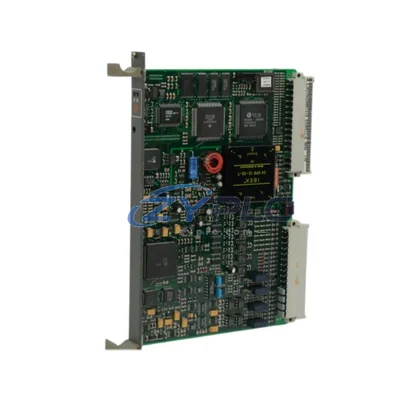
ABB HENF 105296 R0001 E5LA Industrial Ethernet Communication Module for ACS880 Drive Systems
The ABB HENF 105296 R0001 E5LA is a high-performance industrial Ethernet communication interface module engineered for seamless integration within ABB ACS880 series variable frequency drive platforms. This module serves as a critical data bridge between field-level devices and upper-level supervisory systems, enabling real-time protocol conversion, transparent data exchange, and reliable network communication across complex industrial automation architectures. Whether deployed in discrete manufacturing, process control, water treatment, or energy management applications, the HENF 105296 R0001 E5LA ensures that drive-level parameters, diagnostic data, and control commands flow efficiently between PLCs, SCADA platforms, HMI panels, and cloud-based monitoring systems.
In modern smart factory environments, the ability to connect every actuator, sensor, and controller to a unified communication backbone is essential. The ABB HENF 105296 R0001 E5LA addresses this requirement by providing robust Ethernet-based connectivity with support for industrial protocols including EtherNet/IP and Modbus TCP. This enables plant engineers to consolidate data from multiple drive units into a single, coherent network topology, reducing wiring complexity and eliminating data silos that traditionally hinder operational transparency.
Network Communication Specifications
| Parameter |
Specification |
| Brand |
ABB |
| Full SKU |
HENF 105296 R0001 E5LA |
| Module Type |
Ethernet Communication Interface |
| Supported Protocols |
EtherNet/IP, Modbus TCP |
| Interface Type |
RJ45 Ethernet Port |
| Compatible Drive Series |
ABB ACS880, ACS580 |
| Data Transmission Rate |
10/100 Mbps Auto-Negotiation |
| Network Topology |
Star, Linear, Ring (with managed switches) |
| System Application |
PLC Control, SCADA, HMI, MES, Cloud Gateway |
| Mounting |
Direct slot installation on drive unit |
| Operating Temperature |
-10°C to +55°C |
| Warranty |
|
Connected Automation Data Flow
In a typical smart factory deployment, the ABB HENF 105296 R0001 E5LA operates at the intersection of the field device layer and the control network layer. At the lowest level, analog and digital sensors feed process variables such as temperature, pressure, flow rate, and vibration data into the ABB ACS880 drive unit. The HENF communication module then encapsulates this data into standard Ethernet frames and transmits it upstream through industrial managed switches — such as the Scalance XC208 or equivalent layer-2 switching platforms — to the control layer.
At the control layer, a programmable logic controller — for example, an ABB AC500 PLC or a Siemens S7-1500 running an EtherNet/IP scanner — receives cyclic I/O data from the drive, including speed feedback, torque values, motor current, and fault codes. The PLC executes closed-loop control algorithms and sends speed reference commands and control words back to the ACS880 through the HENF module. For installations requiring distributed I/O, remote modules such as the ABB CI501-PNIO communication interface or third-party remote I/O blocks can coexist on the same Ethernet segment, sharing bandwidth with the drive communication traffic.
Moving further upstream, the data reaches the supervisory level where SCADA software platforms and HMI touch panels aggregate information from dozens or even hundreds of networked devices. An ABB Panel 800 HMI or a CP600 series touch panel can display real-time drive status, trend historical performance data, and allow operators to modify setpoints without physically accessing the drive. Meanwhile, the SCADA system — whether ABB Ability Symphony Plus, Wonderware, or Ignition — logs all communication events, triggers alarms on abnormal conditions, and generates production reports for management review.
For facilities implementing edge computing or IIoT strategies, the HENF 105296 R0001 E5LA also supports data forwarding to edge gateways such as the ABB Edgenius platform, which preprocesses drive analytics before pushing summarized KPIs to cloud dashboards. This layered architecture ensures that raw drive data is transformed into actionable intelligence at every level of the automation pyramid, from the shop floor to the executive boardroom.
In multi-drive installations, several ACS880 units equipped with HENF modules can be networked together alongside ABB ACS580 general-purpose drives and ABB ACH580 HVAC drives, all communicating over a shared Ethernet backbone. The protocol flexibility of the HENF module means that mixed-vendor environments — where ABB drives coexist with third-party PLCs, sensors from brands like Endress+Hauser, or power analyzers from the ABB M4M series — can be unified under a single communication standard without requiring proprietary gateways.
Solving Data Isolation in Industrial Sites
One of the most persistent challenges in brownfield industrial facilities is data isolation. Legacy drive installations often rely on serial communication protocols such as RS-485 Modbus RTU, which limit transmission distance, bandwidth, and the number of nodes on a single network segment. The ABB HENF 105296 R0001 E5LA eliminates these constraints by migrating drive communication to Ethernet, instantly unlocking higher data throughput, longer cable runs via fiber media converters, and virtually unlimited node counts through standard network switching infrastructure.
Protocol fragmentation is another common pain point. In plants where different subsystems use different communication standards — for instance, Profibus DP for older drives, DeviceNet for conveyor systems, and BACnet for building automation — the HENF module’s Ethernet-based protocols serve as a unifying layer. By standardizing on EtherNet/IP or Modbus TCP at the drive level, engineers can reduce the number of protocol converters, simplify PLC programming, and lower the total cost of network maintenance.
Remote diagnostics represent a significant operational advantage enabled by the HENF module. When a drive fault occurs at a remote pumping station, water treatment plant, or offshore platform, maintenance engineers can access real-time fault logs, parameter snapshots, and communication statistics through the Ethernet network without dispatching a technician to the site. This capability dramatically reduces mean time to repair and helps prevent downtime that can cost thousands of dollars per hour in lost production.
For plants pursuing digital transformation and transparent production line visibility, the HENF 105296 R0001 E5LA provides the foundational connectivity layer that makes MES integration, OEE tracking, and predictive maintenance analytics possible. Every speed change, every fault event, and every energy consumption reading from the ACS880 drive becomes a data point that feeds into continuous improvement initiatives.
System scalability is built into the architecture. Adding new drives to the network requires only an Ethernet cable and an IP address assignment — no additional communication cards, no bus termination resistors, and no complex network configuration. This plug-and-play expandability makes the HENF module ideal for phased factory expansion projects where production capacity grows incrementally over months or years.
Every ABB HENF 105296 R0001 E5LA unit shipped by ZYPLC undergoes comprehensive functional testing before dispatch, including protocol handshake verification, data integrity checks, and physical inspection. All units are covered by a , and our technical support team is available to assist with commissioning, parameter configuration, and network troubleshooting.
Industrial Connectivity FAQ
Q1: What communication latency can I expect with the HENF 105296 R0001 E5LA in an EtherNet/IP network?
A: The module supports cyclic communication with typical update times in the range of 2–10 milliseconds depending on the PLC scan cycle, network load, and the number of I/O data words configured. For most industrial drive control applications, this latency is well within acceptable limits for speed and torque regulation.
Q2: Is the HENF 105296 R0001 E5LA compatible with non-ABB PLCs and SCADA systems?
A: Yes. Because the module communicates via standard EtherNet/IP and Modbus TCP protocols, it is fully compatible with PLCs from Rockwell Automation, Siemens, Schneider Electric, Mitsubishi, and other vendors, as well as SCADA platforms including Ignition, Wonderware, and WinCC. No proprietary software is required for basic communication setup.
Q3: How does ZYPLC ensure product quality and reliability before shipping?
A: Every unit undergoes pre-shipment functional testing that includes protocol response verification, connector inspection, and firmware version confirmation. We maintain RFQ-based sourcing support for export shipping options after RFQ confirmation and provide a covering manufacturing defects and communication failures under normal operating conditions.
Q4: Can I add more drives to the network later without redesigning the communication architecture?
A: Absolutely. The Ethernet-based architecture supported by the HENF module is inherently scalable. Each additional ACS880 drive with a HENF module simply requires an Ethernet port on a managed switch and a unique IP address. No bus termination changes or protocol converter additions are needed, making future expansion straightforward and cost-effective.