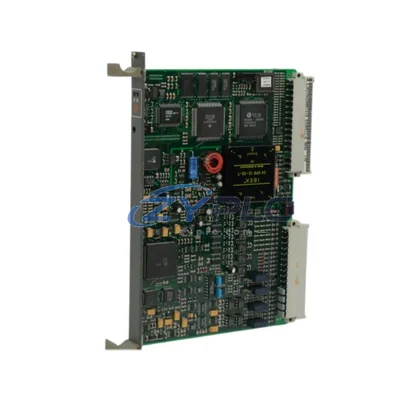
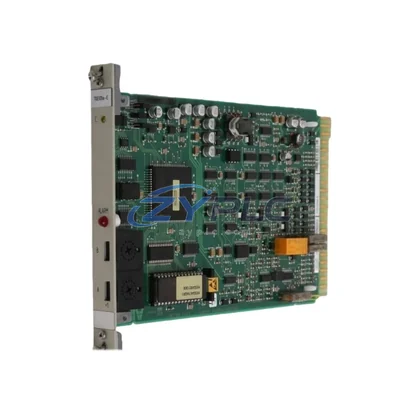
The ABB IMFEC12 is a high-precision analog input module purpose-built for deployment within the ABB INFI 90 and Harmony DCS control architecture. Designed to serve as a critical signal acquisition node at the I/O layer, the IMFEC12 enables seamless system integration across multi-tier automation systems — from field instrumentation through to supervisory control. Whether you are commissioning a new process control loop or expanding an existing distributed control system, the IMFEC12 delivers the signal fidelity, architectural compatibility, and long-term reliability that industrial environments demand.
In a fully layered automation architecture, the IMFEC12 occupies the I/O acquisition layer, receiving analog signals from field transmitters, sensors, and transducers and converting them into digital process values that the INFI 90 controller can act upon. This module does not operate in isolation — it functions as part of a coordinated signal chain that spans the control layer, network layer, power layer, HMI layer, and execution layer. Its role is to ensure that every analog measurement — whether a 4–20 mA current loop from a pressure transmitter or a voltage signal from a flow meter — is accurately captured, conditioned, and delivered to the CPU module with minimal latency and maximum integrity.
The IMFEC12 is rack-mounted within the INFI 90 modular backplane system, where it communicates with the CPU module via the internal module bus. This tight architectural coupling ensures deterministic scan cycle performance and eliminates the signal degradation risks associated with remote I/O topologies. For system engineers managing large-scale process plants, the ability to co-locate analog input acquisition with the controller reduces wiring complexity, simplifies loop calibration, and accelerates fault isolation during maintenance windows.
From a system architecture perspective, the IMFEC12 supports redundant I/O configurations when paired with appropriate redundancy modules within the INFI 90 platform. This is particularly valuable in critical process applications — such as power generation, petrochemical refining, and water treatment — where a single point of failure in the analog input chain could trigger unplanned shutdowns or safety system activations. By integrating the IMFEC12 into a redundant I/O architecture, engineers can achieve the high availability targets required by IEC 61511 and ISA-84 functional safety standards.
The module’s signal conditioning capabilities are engineered to handle the full range of analog input types encountered in industrial process control. Its multi-channel design allows a single IMFEC12 to serve multiple field instruments simultaneously, reducing the total module count required in a control cabinet and optimizing rack space utilization. This is especially advantageous in brownfield expansion projects where backplane slots are at a premium and adding new I/O capacity must be achieved without a full cabinet redesign.
Long-term maintainability is a core design principle of the IMFEC12. ABB’s INFI 90 platform has been deployed across thousands of industrial facilities worldwide, and the availability of compatible spare modules — including the IMFEC12 — remains a priority for plant maintenance teams. ZYPLC maintains RFQ-confirmed availability of the IMFEC12 with full functional testing completed prior to shipment, ensuring that replacement modules arrive prepared for installation after site verification without the need for extended bench testing or factory recalibration. Every IMFEC12 supplied by ZYPLC is covered by a Warranty and support terms confirmed before quote, providing procurement teams and plant engineers with the confidence to plan maintenance cycles and spare parts budgets with certainty.
Product Specification Table
| Parameter |
Specification |
| Model / SKU |
IMFEC12 |
| Brand |
ABB |
| Series |
INFI 90 / Harmony DCS |
| Module Type |
Analog Input Module |
| System Role |
I/O Acquisition Layer — Field Signal Conditioning & Digitization |
| Input Channels |
Multi-channel analog input (4–20 mA / voltage signal compatible) |
| Signal Types |
Current loop (4–20 mA), Voltage (configurable range) |
| Communication |
Internal INFI 90 module bus; backplane-integrated data exchange |
| Mounting |
INFI 90 modular rack / backplane (DIN rail compatible enclosure) |
| Power Supply |
Supplied via INFI 90 backplane power rail |
| Operating Temperature |
0°C to 60°C (standard industrial range) |
| Redundancy Support |
Compatible with INFI 90 redundant I/O architecture |
| Installation Environment |
Control cabinet / DCS marshalling panel |
| system integration |
Full compatibility with INFI 90 CPU, power, and network modules |
| Warranty |
Warranty and support terms confirmed before quote (ZYPLC RFQ-confirmed availability) |
| Origin |
USA (ABB manufactured) |
System Compatibility Notes
The IMFEC12 achieves its full performance potential when deployed as part of a coordinated INFI 90 control system architecture. At the control layer, the IMMFP12 or IMMFP02 multi-function processor module serves as the primary CPU, executing control strategies and managing I/O scan cycles. The IMFEC12 feeds digitized analog values directly to this processor via the backplane bus, enabling closed-loop PID control, cascade control, and feedforward strategies with scan cycle times appropriate for process control applications.
Power integrity is maintained by the IMPS10 or IMPS02 power supply modules, which provide regulated DC power to the backplane rail shared by the IMFEC12 and all co-installed modules. In redundant power configurations, dual power supply modules operate in parallel, ensuring that a single power supply failure does not interrupt analog signal acquisition. This power architecture is essential in continuous process industries where even a brief interruption in analog input data can cause controller fallback to manual mode.
At the network layer, the INFI 90 platform supports integration with plant-wide DCS networks via the INFI-NET communication highway. Modules such as the IMCPM02 or IMCPM12 communication processor modules manage data exchange between the local controller and the supervisory INFI-NET backbone, allowing process values acquired by the IMFEC12 to be transmitted to operator workstations, historian servers, and advanced process control applications. This network architecture supports both peer-to-peer controller communication and centralized supervisory monitoring.
For human-machine interface applications, the INFI 90 system integrates with ABB’s Conductor NT or Symphony Plus operator stations, where analog values from the IMFEC12 are displayed as real-time process trends, alarm setpoints, and loop status indicators. Operators can monitor the health of individual analog input channels, acknowledge out-of-range alarms, and initiate manual overrides directly from the HMI without interrupting the automated control loop.
At the I/O termination layer, the IMFEC12 interfaces with field wiring through terminal modules and marshalling panels. Companion modules such as the NTAI05 or NTAI09 analog input termination units provide the physical connection points for field instrument cables, incorporating signal isolation and surge protection to safeguard the IMFEC12 from electrical transients originating in the field. This termination architecture simplifies field wiring, reduces installation time, and enables module replacement without disturbing field cable connections — a significant advantage during live plant maintenance.
In redundant I/O architectures, the IMFEC12 can be paired with a redundant analog input module on a mirrored backplane slot, with automatic switchover managed by the INFI 90 redundancy controller. This configuration is commonly specified in safety-critical applications such as reactor temperature monitoring, turbine control, and pipeline pressure management, where continuous analog input availability is a functional safety requirement.
Industrial Application Notes
The ABB IMFEC12 analog input module is deployed across a wide range of industrial sectors where precise analog signal acquisition is fundamental to process control performance. In power generation facilities — including thermal, hydro, and combined-cycle plants — the IMFEC12 monitors critical process variables such as steam pressure, turbine inlet temperature, feedwater flow, and generator output voltage. These measurements feed directly into the INFI 90 control strategies that govern turbine speed regulation, boiler combustion control, and load dispatch optimization.
In petrochemical and refining applications, the IMFEC12 supports continuous process monitoring across distillation columns, heat exchangers, reactor vessels, and pipeline networks. The module’s ability to handle multiple analog input channels simultaneously makes it well-suited for dense instrumentation environments where dozens of transmitters must be scanned within a single control loop execution cycle. Plant engineers in these facilities rely on the IMFEC12’s architectural compatibility with the INFI 90 platform to maintain consistent control performance across aging DCS installations that may have been in service for fifteen years or more.
Water and wastewater treatment plants utilize the IMFEC12 for monitoring flow rates, chemical dosing levels, pH values, turbidity, and dissolved oxygen concentrations. In these applications, the module’s multi-channel capability allows a single IMFEC12 to serve an entire treatment stage — from raw water intake through to final effluent discharge — reducing the number of I/O modules required and simplifying system maintenance. The Warranty and support terms confirmed before quote provided by ZYPLC gives municipal utility operators the assurance that replacement modules will perform to specification throughout the warranty period, supporting the long maintenance intervals typical of water infrastructure projects.
Mining and minerals processing operations deploy the IMFEC12 in conveyor control systems, crusher monitoring, flotation cell management, and tailings pump control. The harsh electrical environment of mining facilities — characterized by high-voltage motor switching, ground faults, and electromagnetic interference — demands robust signal conditioning at the analog input stage. The IMFEC12’s backplane-integrated architecture provides inherent isolation from field-side electrical disturbances, protecting the INFI 90 controller from noise-induced measurement errors.
In packaging and discrete manufacturing lines, the IMFEC12 supports tension control, web speed monitoring, temperature profiling in heat-seal stations, and pressure regulation in pneumatic actuator circuits. These applications require fast analog input scan rates and tight integration with the CPU module’s motion control and sequencing functions — capabilities that the IMFEC12 delivers through its direct backplane connection to the INFI 90 processor.
Product Compatibility FAQ
Q1: Is the ABB IMFEC12 compatible with both the INFI 90 and Harmony DCS platforms, and can it be used in mixed-generation control system architectures?
The IMFEC12 was originally designed for the ABB INFI 90 DCS platform and is fully compatible with INFI 90 backplane systems and CPU modules. ABB’s Harmony DCS platform, which evolved from the INFI 90 architecture, maintains backward compatibility with INFI 90 I/O modules including the IMFEC12 in many configurations. However, compatibility in mixed-generation architectures should be verified against the specific Harmony DCS version and backplane type in use. ZYPLC’s technical team can assist with compatibility verification prior to procurement, and all supplied modules are covered by a Warranty and support terms confirmed before quote to support risk-managed integration projects.
Q2: What installation and commissioning steps are required when replacing an IMFEC12 in a live INFI 90 system, and how can downtime be minimized?
Replacing an IMFEC12 in a live INFI 90 system typically involves placing the affected control loop in manual mode at the operator station, removing the faulty module from the backplane slot, inserting the replacement IMFEC12, and verifying channel configuration via the INFI 90 engineering workstation. In systems with redundant I/O architecture, the switchover to the redundant module can be performed before physical replacement, allowing the replacement to proceed without placing the loop in manual mode. ZYPLC supplies IMFEC12 modules that have been fully functionally tested prior to shipment, reducing the risk of commissioning delays caused by out-of-specification replacement modules. The Warranty and support terms confirmed before quote covers any performance issues identified during the commissioning period.
Q3: How does ZYPLC support long-term spare parts availability for the ABB IMFEC12, and what is covered under the Warranty and support terms confirmed before quote?
ZYPLC maintains verified inventory of the ABB IMFEC12 to support both planned maintenance programs and emergency replacement requirements. Each module undergoes functional testing before shipment to confirm analog input channel performance, backplane communication integrity, and power consumption within specification. The Warranty and support terms confirmed before quote covers manufacturing defects and functional failures identified under normal operating conditions within the INFI 90 architecture. Warranty claims are supported by ZYPLC’s technical team, who can assist with fault diagnosis, module exchange logistics, and documentation for plant maintenance records. Long-term procurement agreements are available for facilities requiring guaranteed spare parts availability across multi-year maintenance cycles.