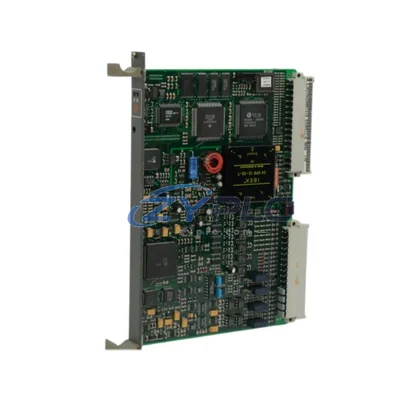
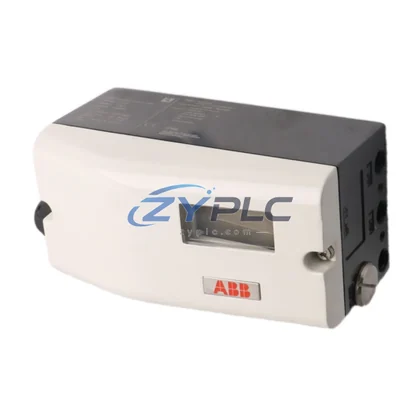
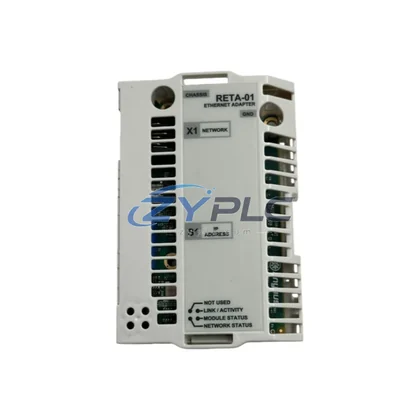
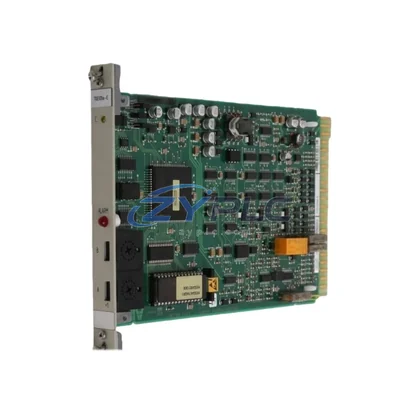
ABB NTRL02B Industrial Network Interface for AC31 Systems: Bridging the Industrial Data Link
In modern smart factory environments, seamless data flow between field devices and supervisory systems is not a luxury — it is the backbone of operational efficiency. The ABB NTRL02B Remote I/O Termination Unit is engineered precisely for this mission: to serve as a reliable, protocol-ready termination node within the ABB Advant Controller 31 (AC31) distributed control architecture, ensuring that every signal from the plant floor reaches the control layer with integrity and speed.
The NTRL02B functions as the physical and logical termination point for remote I/O modules in AC31-based systems. It provides the structured wiring interface that connects field-level sensors, actuators, and transmitters to the AC31 controller backbone, enabling deterministic data exchange across the automation network. Whether deployed in a discrete manufacturing line, a process control loop, or a utility management system, the NTRL02B delivers the connectivity discipline that industrial networks demand.
Compatibility & Integration Notes
| Parameter |
Specification |
| SKU / Part Number |
NTRL02B |
| Brand |
ABB |
| Series |
Advant Controller 31 (AC31) |
| Product Type |
Remote I/O Termination Unit |
| Communication Protocol |
ABB Advant Fieldbus / RCOM / Serial I/O Bus |
| Interface Type |
Remote I/O Termination / Backplane Connection |
| Network Compatibility |
AC31 Remote I/O Subsystem, Advant OCS Architecture |
| System Application |
PLC I/O Expansion, SCADA Integration, DCS Node Termination |
| SCADA / HMI Integration |
Compatible with ABB Advant Station, third-party SCADA via OPC |
| Origin |
Germany (DE) |
| Warranty |
12 Months |
| Availability |
Confirmed via RFQ before quotation |
Connected Automation Data Flow
The NTRL02B sits at the heart of a layered industrial data flow. At the field level, analog and digital signals from sensors — such as pressure transmitters, flow meters, and proximity switches — are wired into I/O modules like the ABB NTAI05 analog input module and the ABB NTDI02 digital input module. These modules mount directly onto the termination unit, which provides the structured backplane connection to the AC31 controller network.
The AC31 controller — typically a unit such as the ABB 07KT97 or 07KT98 CPU module — processes the incoming field data and executes the control logic. Output commands are then routed back through the NTRL02B to output modules such as the ABB NTDO02 digital output module and the ABB NTAO01 analog output module, which drive actuators, valve positioners, and variable frequency drives on the plant floor.
For network-level communication, the AC31 system interfaces with higher-level SCADA and HMI platforms via communication processors such as the ABB CI532V02 or CI520V1 fieldbus communication interface modules. These gateways translate the AC31’s internal bus protocol into standard industrial communication formats, enabling real-time data visibility in supervisory systems. The ABB TB820V2 media converter further extends network reach across fiber or copper Ethernet segments, ensuring that remote I/O nodes — including those terminated by the NTRL02B — remain continuously connected to the control room.
At the edge, data aggregated from multiple AC31 remote I/O stations can be forwarded to industrial edge gateways or historian servers, feeding SCADA dashboards with live process variables, alarm states, and diagnostic counters. This end-to-end data chain — from field sensor through NTRL02B termination, across the AC31 bus, through the communication gateway, and up to the SCADA layer — is what transforms isolated field devices into a transparent, manageable smart factory network.
Solving Data Isolation in Industrial Sites
One of the most persistent challenges in legacy and hybrid industrial environments is data isolation: field devices that speak different protocols, I/O subsystems that cannot communicate with modern SCADA platforms, and remote stations that are invisible to the control room. The ABB NTRL02B directly addresses these challenges within the AC31 ecosystem.
By providing a standardized termination interface for the AC31 remote I/O bus, the NTRL02B eliminates the wiring inconsistencies and signal integrity issues that arise from ad-hoc field connections. Its structured backplane design ensures that I/O modules are correctly seated and electrically terminated, reducing the risk of communication errors caused by impedance mismatches or loose connections — a common source of intermittent faults in distributed I/O systems.
For sites undergoing modernization, the NTRL02B enables a phased migration strategy: existing AC31 remote I/O infrastructure can be retained and integrated with newer control layers through communication gateways, avoiding the cost and disruption of a full system replacement. This approach supports production line transparency — operators gain real-time visibility into remote station status, I/O health, and process variables — without requiring a complete hardware overhaul.
Remote diagnostics are further enhanced when the NTRL02B-terminated I/O nodes are connected through the AC31 communication network to OPC-compatible SCADA systems. Maintenance teams can monitor module status, identify fault conditions, and initiate corrective actions from the control room or via remote access, reducing downtime and accelerating mean time to repair (MTTR).
System expansion is equally straightforward: additional NTRL02B units can be deployed at new remote I/O locations, extending the AC31 network’s reach without architectural changes to the existing control system. This scalability makes the NTRL02B a long-term asset for growing industrial operations.
Industrial Connectivity FAQ
Q1: What communication protocol does the ABB NTRL02B support?
The NTRL02B is designed for use within the ABB Advant Controller 31 (AC31) remote I/O architecture, operating over the ABB Advant serial I/O bus. It is compatible with AC31 communication processors that support RCOM and Advant fieldbus protocols, enabling integration with SCADA systems via OPC interfaces.
Q2: Is the NTRL02B compatible with third-party SCADA and HMI systems?
Yes. When paired with ABB communication interface modules such as the CI532V02 or CI520V1, the AC31 system — including NTRL02B-terminated remote I/O nodes — can exchange data with third-party SCADA and HMI platforms via OPC DA/UA, Modbus, or PROFIBUS gateways, depending on the communication module selected.
Q3: How does the NTRL02B contribute to network stability in distributed I/O systems?
The NTRL02B provides a mechanically and electrically standardized termination point for AC31 I/O modules, ensuring correct bus termination impedance and reliable backplane connectivity. This reduces the risk of communication timeouts, data corruption, and intermittent faults that are common in improperly terminated distributed I/O networks.
Q4: What warranty and testing standards apply to the NTRL02B supplied by ZYPLC?
Every ABB NTRL02B unit supplied by ZYPLC is covered by a warranty and support terms confirmed before quote and undergoes pre-shipment functional testing to verify communication integrity and I/O module compatibility. Units are sourced from verified supply channels and shipped with full traceability documentation, supporting quality assurance requirements in regulated industrial environments.