ABB RDIO-01 64379216D: Industrial Data Link and Smart Factory Connectivity for ACS800 Drive Systems
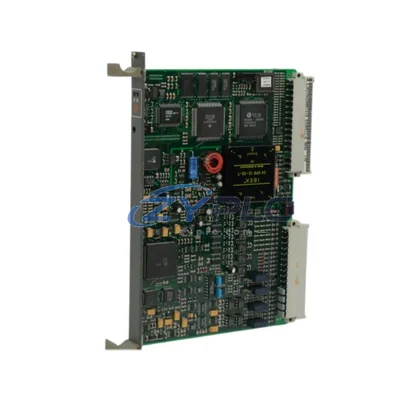
In modern industrial automation, the ability to seamlessly bridge field-level devices with upper-level control and monitoring systems is no longer optional — it is the foundation of operational efficiency. The ABB RDIO-01 64379216D Digital I/O Extension Module is engineered precisely for this purpose, serving as a critical connectivity node within the ACS800 variable speed drive architecture. By expanding the digital signal capacity of the ACS800 drive platform, the RDIO-01 enables engineers to integrate more field signals, reduce wiring complexity, and achieve a higher degree of system transparency across the entire automation data chain.
The RDIO-01 mounts directly onto the ACS800 drive’s option slot, extending the drive’s native I/O capability without requiring additional external hardware enclosures. This tight physical and electrical integration ensures minimal signal latency between the drive’s control logic and the connected field devices, whether those are proximity sensors, limit switches, solenoid valves, or relay-driven actuators. In a typical smart factory deployment, the RDIO-01 acts as the last-mile connectivity layer between the drive’s internal processing and the physical world of motors, conveyors, pumps, and compressors.
Compatibility & Integration Notes
| Parameter |
Specification |
| Product SKU |
RDIO-01 64379216D |
| Brand / Manufacturer |
ABB |
| Series Compatibility |
ACS800 Variable Speed Drive Series |
| Module Type |
Digital I/O Extension Module |
| Digital Inputs |
3 × Programmable Digital Inputs (DI) |
| Digital Outputs |
3 × Programmable Digital Outputs (DO), Relay Type |
| Interface / Mounting |
Direct Option Slot Mounting on ACS800 Drive |
| Communication Protocol |
Internal Drive Bus (DDCS-compatible architecture) |
| Signal Voltage |
24 VDC Digital Logic Level |
| Output Contact Rating |
250 VAC / 30 VDC, 2A Resistive |
| Operating Temperature |
-10°C to +55°C |
| Installation Environment |
Industrial Control Cabinet, IP20 Enclosure |
| Origin |
Finland |
| Warranty |
Warranty and support terms confirmed before quote |
Connected Automation Data Flow
Understanding the RDIO-01’s role requires viewing it within the full automation data flow of an ACS800-based drive system. At the field level, sensors and actuators generate discrete signals — a motor running confirmation, a conveyor jam detection, a valve open/close status. These signals are wired directly into the RDIO-01’s digital input terminals, where they are conditioned and passed into the ACS800 drive’s internal control logic via the option slot bus.
The ACS800 drive itself communicates upward to the plant’s control layer through fieldbus adapter modules such as the RPBA-01 PROFIBUS-DP Adapter or the RCAN-01 CANopen Adapter, both of which are compatible option modules within the ACS800 ecosystem. These fieldbus adapters translate the drive’s internal status — including the I/O states captured by the RDIO-01 — into standard industrial protocol frames that can be consumed by a Siemens S7-300 PLC or an Allen-Bradley ControlLogix controller acting as the PROFIBUS or CANopen master. This multi-layer communication chain ensures that every digital signal captured at the field level by the RDIO-01 is ultimately visible at the SCADA or HMI layer.
At the supervisory level, systems such as Wonderware InTouch HMI or Ignition SCADA by Inductive Automation receive real-time drive and I/O data through OPC-DA or OPC-UA servers connected to the PLC. Engineers monitoring the plant floor can observe motor start/stop commands, fault relay outputs, and process interlock states — all of which originate from the RDIO-01’s digital channels — without leaving the control room. This end-to-end data visibility is the essence of smart factory connectivity.
For plants operating with distributed control architectures, the RDIO-01 can be deployed across multiple ACS800 drives installed in different sections of the production line. Each drive’s RDIO-01 module feeds its local I/O data into the fieldbus network, where a Moxa EDS-308 Industrial Ethernet Switch or similar managed switch aggregates the data streams and routes them to the central PLC or DCS. In high-availability installations, redundant network paths ensure that a single cable fault does not interrupt the data flow from any drive node.
Power supply stability is equally important in these deployments. The ACS800 drive’s internal 24 VDC auxiliary power rail — often sourced from a dedicated Phoenix Contact QUINT Power Supply or an ABB CP-E 24/5.0 Power Supply — provides the clean, regulated voltage that the RDIO-01 requires for reliable digital signal processing. Voltage fluctuations or ground loops at this level can cause false digital triggers, making a stable power architecture a prerequisite for accurate I/O data.
In process industries such as water treatment, chemical processing, and oil and gas, the RDIO-01’s relay outputs are frequently used to drive solenoid valves, motor contactors, and alarm annunciators. The relay contact rating of 250 VAC / 2A allows direct switching of small loads without intermediate relay panels, simplifying the control cabinet design and reducing potential failure points in the signal chain.
Solving Data Isolation in Industrial Sites
One of the most persistent challenges in industrial automation is data isolation — the condition where field devices, drives, and controllers operate in silos, unable to share status information with each other or with upper-level systems. The RDIO-01 directly addresses this challenge by expanding the ACS800 drive’s native I/O capacity, allowing more field signals to be captured and integrated into the drive’s control logic and, by extension, into the plant-wide data network.
In older installations, drives with limited I/O often required separate hardwired relay panels to handle interlock signals, emergency stops, and process feedback. These panels introduced additional wiring, additional failure points, and additional maintenance burden. By adding the RDIO-01 to the ACS800’s option slot, engineers can eliminate many of these external relay panels, consolidating signal management within the drive itself and making the entire system easier to commission, troubleshoot, and maintain.
Protocol unification is another key benefit. Because the RDIO-01’s digital signals are processed internally by the ACS800 and then transmitted upstream via the drive’s fieldbus adapter, there is no need for separate protocol converters or signal conditioners between the field device and the control system. The data path is clean, deterministic, and fully integrated within the ABB drive ecosystem.
For remote monitoring applications, the RDIO-01’s I/O states can be mapped to the drive’s fieldbus data objects, making them accessible to remote SCADA systems over Ethernet-based networks. This capability is particularly valuable in unmanned substations, remote pump stations, and offshore platforms where physical access for manual inspection is limited or costly. Engineers can diagnose drive and I/O faults remotely, reducing the need for on-site service visits and minimizing production downtime.
Production line transparency is further enhanced when the RDIO-01 is used in conjunction with the ACS800’s built-in diagnostic and event logging features. Fault events, I/O state changes, and drive parameter deviations are all timestamped and stored in the drive’s event log, providing a complete audit trail for maintenance engineers and process analysts. This level of data granularity supports predictive maintenance programs and continuous improvement initiatives across the plant.
Industrial Connectivity FAQ
Q1: Does the RDIO-01 64379216D support real-time communication with SCADA systems?
A: Yes. The RDIO-01’s digital I/O states are processed by the ACS800 drive’s internal control logic and transmitted to the SCADA system via the drive’s fieldbus adapter module (e.g., RPBA-01 for PROFIBUS-DP or RCAN-01 for CANopen). The data update cycle is synchronized with the drive’s control cycle, typically in the range of 2–10 ms, ensuring real-time visibility of field signal states at the supervisory level.
Q2: Is the RDIO-01 compatible with all ACS800 drive variants, and are there any firmware requirements?
A: The RDIO-01 is designed for use with the ACS800 series, including the ACS800-01, ACS800-02, ACS800-04, and ACS800-07 variants. Compatibility depends on the drive’s option slot availability and firmware version. It is recommended to verify the drive’s firmware revision against ABB’s compatibility matrix before installation. ZYPLC’s technical team can assist with compatibility verification prior to shipment.
Q3: What does the Warranty and support terms confirmed before quote cover, and how is it supported?
A: All RDIO-01 64379216D units supplied by ZYPLC are covered by a Warranty and support terms confirmed before quote from the date of shipment. Each unit undergoes pre-shipment functional testing to verify digital input response, relay output switching, and option slot communication integrity. In the event of a warranty claim, ZYPLC provides replacement or repair support with a target response time of 3–5 business days. Contact our technical team at plc.sales@zyplc.com or +86 19859288691 for warranty service.
Q4: Can the RDIO-01 be used to expand I/O for multiple drives in a networked system?
A: Yes. Each ACS800 drive in a networked system can be fitted with its own RDIO-01 module, independently expanding the I/O capacity of each drive node. The I/O data from each drive is transmitted to the PLC or DCS master via the fieldbus network, where it can be aggregated and processed as part of the plant-wide control strategy. This distributed I/O architecture eliminates the need for centralized I/O panels and reduces long-distance signal wiring between the drive and the control room.