ABB SDCS-FEX-425 Field Exciter Board: Industrial Data Link for DCS800 Smart Factory Systems
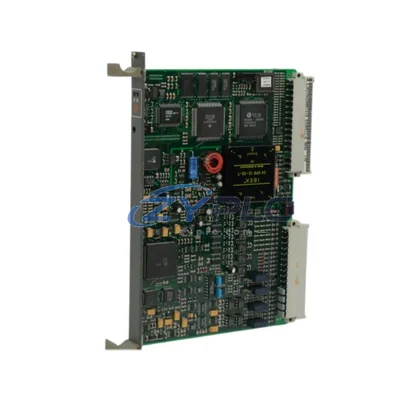
The ABB SDCS-FEX-425 INT Field Exciter Board is a precision-engineered excitation control module designed for the ABB DCS800 series DC drives. In modern smart factory environments, the SDCS-FEX-425 serves as a critical node in the industrial data chain — bridging field-level excitation signals with higher-level control architectures including PLC controllers, SCADA platforms, HMI systems, and remote I/O networks. Its role extends far beyond simple field excitation: it enables real-time feedback loops, supports remote diagnostics, and contributes to the transparent, connected production lines that Industry 4.0 demands.
As DC drive systems are increasingly integrated into plant-wide automation networks, the SDCS-FEX-425 ensures that excitation data — motor field current, voltage feedback, and fault status — flows reliably from the drive level up through the communication stack to supervisory systems. Whether deployed in steel rolling mills, paper machines, marine propulsion systems, or heavy-duty crane applications, this board maintains the signal integrity and communication stability that industrial operations depend on.
Compatibility & Integration Notes
| Attribute |
Specification |
| SKU |
SDCS-FEX-425 INT |
| Brand |
ABB |
| Series |
DCS800 |
| Product Type |
Field Exciter Board |
| Protocol Support |
Compatible with ABB DCS800 internal communication bus; integrates with DDCS (Distributed Drive Communication System) for upstream PLC/SCADA connectivity |
| Interface Type |
Internal drive board interface; connects to DCS800 control unit via dedicated slot |
| Communication Gateway |
Works in conjunction with SDCS-COM-8 and RDCO-03 DDCS communication adapters for Profibus, DeviceNet, CANopen, and Modbus RTU integration |
| Network Compatibility |
Profibus-DP, Modbus RTU, DeviceNet, CANopen (via adapter modules) |
| System Application |
DC motor field excitation control; SCADA/HMI integration; PLC-supervised drive systems; remote monitoring and diagnostics |
| Origin |
Germany |
| Warranty |
12 Months |
Connected Automation Data Flow
In a fully connected industrial site, the SDCS-FEX-425 operates at the heart of the DC drive’s excitation circuit, but its data impact reaches across the entire automation hierarchy. At the field level, motor field current and voltage signals are captured and regulated by the SDCS-FEX-425, feeding real-time excitation status back to the ABB DCS800 main control unit (SDCS-CON-4). This control unit aggregates drive-level data and communicates upstream via the SDCS-COM-8 communication option board, which supports Profibus-DP and other industrial fieldbus protocols.
Through the Profibus-DP network, the DCS800 drive — with the SDCS-FEX-425 providing stable field excitation — connects to a Siemens S7-300 or S7-400 PLC acting as the plant-floor controller. The PLC coordinates multi-drive sequences, interlocks, and process logic, while simultaneously forwarding drive status data to a WinCC SCADA platform for operator visualization and alarm management. Operators at the ABB CP600 HMI or equivalent touchscreen panel can monitor field current trends, excitation fault codes, and drive operating modes in real time.
For remote I/O expansion and distributed sensor integration, the system may incorporate ABB AC500 remote I/O modules connected via Modbus RTU or CANopen, feeding process variables such as temperature, speed feedback, and load current into the same data backbone. In applications where legacy serial devices must be bridged to Ethernet-based SCADA systems, an industrial protocol gateway — such as the Moxa MGate MB3180 or equivalent Modbus-to-EtherNet/IP converter — ensures seamless data translation without disrupting the drive’s real-time control loop.
At the edge layer, an industrial edge gateway (such as the ABB Ability Edge or a Siemens SINEMA Remote Connect node) aggregates drive data, applies local analytics, and pushes key performance indicators to cloud-based MES or ERP platforms. This architecture enables predictive maintenance alerts based on field excitation anomalies detected by the SDCS-FEX-425 — long before a motor fault causes unplanned downtime. The entire data chain, from field excitation signal to enterprise dashboard, depends on the reliability and precision of components like the SDCS-FEX-425 operating without interruption.
Power supply stability across this network is maintained by ABB CP-E series 24VDC industrial power supplies, ensuring that communication modules, I/O racks, and the drive control boards receive clean, regulated power even under heavy industrial load conditions.
Solving Data Isolation in Industrial Sites
One of the most persistent challenges in legacy industrial environments is protocol fragmentation — where DC drives, AC inverters, PLCs, and SCADA systems speak different communication languages, creating data silos that prevent plant-wide visibility. The ABB DCS800 platform, with the SDCS-FEX-425 providing reliable field excitation, addresses this through its modular communication architecture. By pairing the drive with the appropriate communication adapter (SDCS-COM-8 for Profibus, or RDCO-03 for DDCS fiber-optic networks), the DCS800 can be integrated into virtually any existing plant network without requiring a full system overhaul.
Remote monitoring is another area where the SDCS-FEX-425’s role becomes strategically important. In multi-drive installations — such as a paper machine with separate drives for the press section, dryer section, and winder — each DCS800 unit reports its excitation status, fault history, and operating parameters to a central SCADA system. Maintenance engineers can diagnose field weakening issues, excitation circuit faults, or communication timeouts remotely, reducing the need for on-site intervention and cutting mean time to repair (MTTR) significantly.
Production line transparency is achieved when every drive, sensor, and controller contributes its data to a unified information model. The SDCS-FEX-425 ensures that the DC motor’s field excitation — a parameter critical to torque control and speed regulation — is always visible to the control system. This transparency supports system scalability: as production capacity grows, additional DCS800 drives with SDCS-FEX-425 boards can be added to the network and immediately recognized by the existing SCADA and PLC infrastructure, with minimal reconfiguration required.
All units supplied by ZYPLC undergo pre-shipment functional testing, verifying board integrity, communication interface continuity, and excitation circuit performance before dispatch. This ensures that replacement boards integrate seamlessly into live production environments with minimal commissioning time.
Industrial Connectivity FAQ
Q1: What communication protocols does the ABB DCS800 with SDCS-FEX-425 support for SCADA integration?
The DCS800 drive supports Profibus-DP, Modbus RTU, DeviceNet, and CANopen through optional communication adapter boards such as the SDCS-COM-8. The SDCS-FEX-425 itself is an internal excitation control board; its data is accessible to the drive’s main control unit and subsequently transmitted to SCADA/HMI systems via the configured fieldbus protocol. This makes it compatible with most industrial automation platforms including Siemens WinCC, Wonderware, and iFIX.
Q2: How does the SDCS-FEX-425 contribute to network stability in multi-drive systems?
By maintaining precise and stable field excitation, the SDCS-FEX-425 prevents erratic motor behavior that could trigger false alarms or communication timeouts in the drive network. Stable excitation means consistent torque and speed responses, which reduces the frequency of fault events that would otherwise flood the SCADA alarm system and disrupt network traffic on shared fieldbus segments.
Q3: Can the SDCS-FEX-425 be used in systems requiring real-time data exchange with minimal latency?
Yes. The SDCS-FEX-425 operates within the DCS800’s internal high-speed control loop, providing excitation feedback at the drive’s native scan rate. When the drive communicates via Profibus-DP, cycle times as low as 1–2 ms are achievable for critical process variables, making it suitable for applications requiring tight synchronization between multiple drives or fast response to SCADA setpoint changes.
Q4: What warranty and testing standards apply to SDCS-FEX-425 units supplied by ZYPLC?
All SDCS-FEX-425 units supplied by ZYPLC carry a warranty and support terms confirmed before quote covering manufacturing defects and functional failures under normal operating conditions. Each unit undergoes pre-shipment inspection including visual examination, board-level continuity testing, and where applicable, functional verification against ABB DCS800 drive specifications. Units are shipped with full export documentation and are available for fast global dispatch from our stocked inventory.