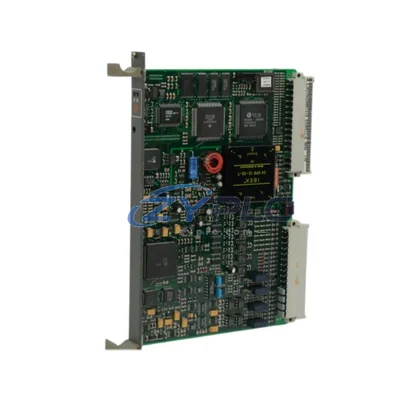
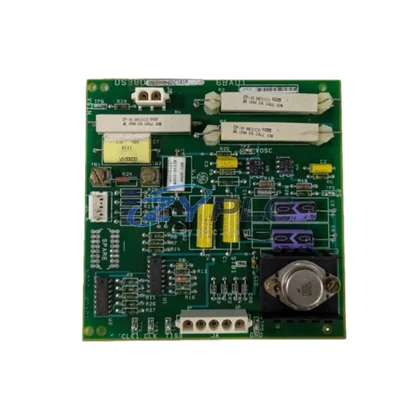
ABB SDCS-PIN-41A Industrial Network Interface for DCS800 Systems: Enabling Real-Time Industrial Data Links in Smart Factory Environments
The ABB SDCS-PIN-41A (Part No. 3BSE004939R1) is a precision-engineered Pulse Transformer Module designed for seamless integration within ABB’s DCS800 series DC drive platforms. In modern smart factory architectures, where uninterrupted data flow between field devices, control systems, and supervisory layers is mission-critical, the SDCS-PIN-41A serves as a foundational component in the industrial communication chain. It bridges the gap between power electronics and digital control networks, ensuring that firing pulse signals are transmitted with galvanic isolation, high fidelity, and zero signal degradation — even in electrically noisy industrial environments.
As industrial sites evolve toward fully connected automation ecosystems, the integrity of every signal path matters. The SDCS-PIN-41A supports the DCS800 drive’s internal communication architecture, enabling reliable coordination between the drive’s control board (such as the SDCS-CON-4) and the power interface layer. This coordination is essential for maintaining precise motor speed regulation, torque control, and real-time feedback loops that feed into higher-level systems including SCADA platforms, HMI terminals, and MES layers.
Compatibility & Integration Notes
| Specification |
Details |
| SKU / Part Number |
SDCS-PIN-41A / 3BSE004939R1 |
| Brand |
ABB |
| Compatible Platform |
ABB DCS800 Series DC Drives |
| Module Type |
Pulse Transformer / Gate Drive Interface |
| Communication Role |
Firing Pulse Signal Transmission with Galvanic Isolation |
| Protocol Compatibility |
Internal DCS800 Drive Bus; Compatible with DDCS, PROFIBUS-DP (via RDCO/RPBA adapters), Modbus RTU, DeviceNet (via RDNA adapter) |
| Interface Type |
Internal Board-to-Board; Pulse Transformer Coupling |
| Network Compatibility |
Integrates with ABB DriveAP, ABB Mint, SCADA/DCS via fieldbus adapters |
| System Application |
DC Motor Drive Control, Rolling Mills, Extruders, Winders, Cranes, Marine Drives |
| Origin |
Sweden (ABB) |
| Warranty |
Warranty and support terms confirmed before quote |
| Availability |
Confirmed via RFQ before quotation |
Connected Automation Data Flow
In a fully integrated DCS800 drive system, the SDCS-PIN-41A sits at the heart of the firing circuit communication path. The drive’s master control board — typically the SDCS-CON-4 — generates precise firing angle commands based on real-time feedback from speed encoders, current transducers, and process references received from the plant’s SCADA or DCS layer. These commands are transmitted through the pulse transformer module to the thyristor gate drive circuits, ensuring synchronized and isolated triggering of the power semiconductors.
Upstream, the DCS800 drive communicates with plant-level control systems via fieldbus adapter modules. The RDCO-02 DDCS Communication Module enables high-speed fiber-optic communication between the drive and ABB’s AC800M or AC500 PLC platforms, allowing real-time speed references, torque limits, and status words to be exchanged at millisecond cycle times. For sites using PROFIBUS-DP networks, the RPBA-01 PROFIBUS Adapter connects the DCS800 seamlessly into Siemens S7-300/S7-400 or other PROFIBUS master controllers, enabling the drive to appear as a standard DP slave on the network.
At the field level, process sensors — including tachogenerators, incremental encoders, and analog current/voltage transducers — feed real-time signals into the SDCS-IOB-3 I/O expansion board, which aggregates analog and digital I/O for the drive’s closed-loop control algorithms. These signals are processed locally within the DCS800 and simultaneously forwarded to the plant’s HMI terminals (such as ABB’s CP600 Panel series or third-party Weintek/Siemens TP panels) via the fieldbus network, providing operators with live drive status, alarm conditions, and production metrics.
For remote monitoring and diagnostics, the DCS800 ecosystem supports integration with ABB’s DriveAP application programming tool and remote access gateways. Edge gateway devices — such as the ABB Edge Controller AC500-eCo — can aggregate drive data from multiple DCS800 units across a production line and push structured datasets to cloud-based SCADA platforms or MES systems via OPC-UA or MQTT protocols. This enables plant managers to monitor motor load trends, energy consumption, and predictive maintenance indicators from any location, without requiring physical access to the drive cabinet.
Variable frequency drives and soft starters on adjacent production lines — including ABB’s ACS880 series AC drives — can be coordinated with DCS800 DC drives through a shared PROFIBUS or Ethernet/IP backbone, enabling synchronized multi-drive control for complex processes such as tandem rolling mills or multi-zone winding lines. The SDCS-PIN-41A’s role in maintaining firing pulse integrity is therefore not isolated to a single drive but contributes to the stability of the entire interconnected drive network.
Solving Data Isolation in Industrial Sites
One of the most persistent challenges in legacy industrial environments is protocol fragmentation — where DC drives, AC drives, PLCs, remote I/O stations, and SCADA systems each speak different communication languages, creating data silos that prevent plant-wide visibility and coordinated control. The ABB DCS800 platform, with the SDCS-PIN-41A at its core firing interface, addresses this challenge through its modular fieldbus adapter architecture.
By supporting multiple communication protocols — including PROFIBUS-DP, Modbus RTU, DeviceNet, and DDCS fiber-optic — the DCS800 can be integrated into virtually any existing plant network without requiring a complete infrastructure overhaul. This protocol flexibility eliminates the need for standalone protocol converters or gateway devices between the drive and the control system, reducing network latency, minimizing single points of failure, and simplifying the overall system architecture.
For sites undergoing digital transformation toward Industry 4.0 standards, the DCS800’s ability to expose real-time drive parameters — including armature current, field current, motor speed, drive temperature, and fault codes — to SCADA and MES layers via standardized fieldbus protocols is a critical enabler of production line transparency. Maintenance teams can configure alarm thresholds directly in the SCADA system, receive push notifications for drive fault conditions, and initiate remote parameter adjustments without dispatching technicians to the drive cabinet — dramatically reducing mean time to repair (MTTR) and unplanned downtime.
System expansion is equally straightforward. Additional DCS800 drives can be added to an existing PROFIBUS or DDCS network segment with minimal configuration effort, and the modular I/O architecture — supported by boards such as the SDCS-IOB-3 — allows each drive’s I/O capacity to be scaled independently based on process requirements. This scalability ensures that the investment in DCS800 infrastructure remains viable as production capacity grows or process requirements evolve.
Every SDCS-PIN-41A unit supplied by ZYPLC undergoes pre-shipment functional testing to verify pulse transformer integrity, isolation resistance, and signal transmission performance. Warranty terms are confirmed during quotation.
Industrial Connectivity FAQ
Q1: What communication protocols does the ABB DCS800 support when using the SDCS-PIN-41A?
The DCS800 drive natively supports ABB’s DDCS fiber-optic protocol for high-speed drive-to-controller communication. With optional fieldbus adapter modules (RPBA-01, RDNA-01, RMBA-01), it also supports PROFIBUS-DP, DeviceNet, and Modbus RTU, enabling integration into virtually any industrial network architecture without additional protocol converters.
Q2: How does the SDCS-PIN-41A contribute to network stability in multi-drive systems?
The SDCS-PIN-41A provides galvanic isolation between the drive’s digital control circuitry and the thyristor gate drive circuits, preventing ground loops and electrical noise from propagating into the control network. This isolation is essential in multi-drive installations where high-power switching transients could otherwise corrupt communication signals and cause spurious faults or network dropouts.
Q3: Can the DCS800 with SDCS-PIN-41A be integrated into an existing SCADA or HMI system?
Yes. The DCS800 exposes a comprehensive set of drive parameters, status words, and fault codes via its fieldbus interface, which can be mapped directly to SCADA tags in platforms such as Wonderware, Ignition, WinCC, or iFIX. HMI terminals connected to the same fieldbus network can display real-time drive data and allow operators to issue speed references or control commands without any custom programming beyond standard fieldbus configuration.
Q4: What is the warranty coverage and how is pre-shipment testing conducted for the SDCS-PIN-41A?
All SDCS-PIN-41A modules supplied by ZYPLC are covered by a warranty and support terms confirmed before quote from the date of shipment. Prior to dispatch, each unit undergoes functional verification including pulse transformer continuity testing, isolation resistance measurement, and visual inspection for component integrity. Test records are available upon request. Units are shipped in anti-static packaging via DHL or FedEx with full tracking and insurance coverage.
|