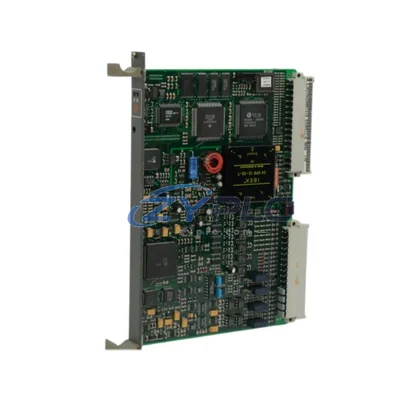
ABB SNAT632PAC Industrial Network Interface for ACS800 Systems: Precision Data Link for Smart Factory Drive Communication
In modern industrial automation environments, the integrity of signal transmission between field devices and upper-level control systems is the foundation of operational efficiency. The ABB SNAT632PAC (also referenced as SNAT 632 PAC, part number 61049428) is a high-performance Pulse Amplifier and Network Interface Board engineered specifically for the ABB ACS800 series of industrial AC drives. This board serves as a critical hardware node in the drive’s internal communication and feedback architecture, enabling precise encoder pulse signal conditioning, amplification, and transmission across the drive control chain — forming the backbone of reliable industrial network communication in smart factory deployments.
As smart factories demand tighter integration between rotating machinery, PLC controllers, remote I/O modules, HMI terminals, and supervisory SCADA systems, the SNAT632PAC plays an indispensable role in ensuring that encoder feedback signals from motors and spindles are accurately captured, amplified, and delivered to the ACS800 drive’s control unit without degradation or latency. This directly supports closed-loop speed and torque control, which is fundamental to high-precision manufacturing, conveyor synchronization, and process automation across Industry 4.0 environments.
Compatibility & Integration Notes
| Parameter |
Specification |
| Part Number |
SNAT632PAC / SNAT 632 PAC / 61049428 |
| Brand |
ABB |
| Compatible Platform |
ABB ACS800 Series AC Drives |
| Function |
Pulse Amplifier & Network Interface Board – Encoder Signal Conditioning & Amplification |
| Signal Interface |
Incremental Encoder Pulse Input / Output |
| Communication Protocol |
Drive-native pulse signal protocol; DDCS (Drive-to-Drive Communication System) |
| Gateway Compatibility |
RDCO DDCS fiber optic network; ABB DriveAP; ACS800 multi-drive configurations |
| Fieldbus Protocol Support |
PROFIBUS DP (via RPBA-01), Modbus RTU (via RMBA-01), DeviceNet (via RDNA-01) |
| Network Compatibility |
ABB AC800M PLC, ABB Symphony Plus DCS, SCADA/HMI upper systems |
| System Application |
Closed-loop vector control, torque control, multi-drive synchronization, SCADA/HMI feedback integration |
| Origin |
Germany (DE) |
| Warranty |
Warranty and condition confirmed before quote – All units pre-shipment tested |
| Availability |
Availability confirmed by RFQ – shipment arranged after confirmation |
Connected Automation Data Flow
The ABB SNAT632PAC sits at the heart of the ACS800 drive’s signal processing and network communication chain. In a typical smart factory deployment, the data flow begins at the motor shaft, where an incremental encoder generates pulse trains representing rotational speed and position. These raw signals are fed into the SNAT632PAC, which conditions and amplifies them before passing them to the ABB RMIO-11C or RMIO-02C main control board — the drive’s central processing unit responsible for executing vector control algorithms and managing all upstream communication.
From the main control board, processed drive status data — including actual speed, torque reference, fault codes, and operational state — is transmitted upstream via the ABB RDCO-02C or RDCO-04C DDCS fiber optic communication adapter. This gateway adapter connects the ACS800 drive to the plant-level ABB AC800M PLC or ABB Symphony Plus DCS, enabling real-time supervisory control and data acquisition. In multi-drive configurations, the DDCS network links multiple ACS800 units in a master-follower topology, with the SNAT632PAC ensuring that each drive’s encoder feedback is faithfully relayed throughout the chain without signal loss or protocol mismatch.
At the field level, sensors and encoders connected to conveyors, winders, extruders, or pump systems feed their signals through the SNAT632PAC into the ACS800’s control loop. The drive’s output is then monitored by ABB Panel Builder 800 HMI terminals or third-party SCADA platforms via fieldbus gateway adapters — including the ABB RPBA-01 PROFIBUS DP adapter, the RMBA-01 Modbus RTU adapter, or the RDNA-01 DeviceNet adapter — all of which interface directly with the ACS800’s option slot. This creates a seamless data pipeline: from the physical encoder through the SNAT632PAC, into the drive control unit, across the fieldbus network, and up to the SCADA/HMI layer — enabling operators to monitor motor performance, adjust speed references, and respond to fault conditions in real time.
In edge computing and IIoT architectures, the ACS800 drive data aggregated through this communication chain can be forwarded to an ABB Ability™ Edge gateway or a third-party industrial IoT edge gateway, enabling cloud-based predictive maintenance analytics and remote diagnostics. The SNAT632PAC’s role in maintaining signal fidelity at the encoder interface is therefore foundational to the entire data chain — from the rotating shaft to the cloud dashboard — making it a cornerstone component in any smart factory connectivity strategy built around the ACS800 platform.
Solving Data Isolation in Industrial Sites
One of the most persistent challenges in legacy industrial environments is data isolation — the inability to extract meaningful, real-time operational data from drive systems due to incompatible signal interfaces, proprietary communication protocols, or degraded hardware components. A faulty or missing pulse amplifier and network interface board such as the SNAT632PAC can sever the encoder feedback loop entirely, causing the ACS800 drive to fall back to open-loop control or trigger encoder fault alarms (e.g., fault code ENCODER or SPEED MEAS), resulting in unplanned downtime, production loss, and broken data continuity across the SCADA/MES layer.
By restoring or replacing the SNAT632PAC, maintenance engineers re-establish the closed-loop feedback path and the full network communication chain, enabling the drive to resume precise speed regulation and torque control. This directly supports production line transparency — operators can once again view accurate motor speed data on HMI panels, receive real-time fault alerts through SCADA alarm management systems, and perform remote diagnostics via the DDCS network without requiring physical access to the drive cabinet. Protocol unification is restored across the fieldbus layer, eliminating the data silos that arise when drive-level feedback is unavailable to upper control systems.
For facilities undergoing digital transformation, the SNAT632PAC also enables system expansion. As additional ACS800 drives are added to a multi-drive DDCS network, each unit requires a properly functioning pulse amplifier and interface board to participate in the synchronized control topology. The SNAT632PAC thus becomes a scalability enabler — allowing plant engineers to extend drive networks, integrate new motor axes, and connect additional process equipment without redesigning the control architecture or replacing the gateway infrastructure.
Furthermore, for sites transitioning from isolated drive control to unified SCADA/MES integration, the SNAT632PAC’s role in delivering accurate encoder data to the ACS800 control board is the prerequisite for meaningful OEE (Overall Equipment Effectiveness) monitoring, energy consumption tracking, and predictive maintenance scheduling — all of which depend on reliable, high-resolution speed and position feedback from the drive layer. Restoring this component restores the entire industrial data chain.
Industrial Connectivity FAQ
Q1: Will the ABB SNAT632PAC introduce any communication latency in the ACS800 encoder feedback loop?
The SNAT632PAC is designed as a hardware signal conditioning component operating at the electronic circuit level. Its pulse amplification function introduces negligible latency — well within the microsecond range — which has no measurable impact on the ACS800’s closed-loop control cycle time. The drive’s vector control algorithms operate on millisecond-level sampling cycles, making the SNAT632PAC’s signal propagation delay operationally transparent and fully compatible with high-speed industrial network communication requirements.
Q2: Is the SNAT632PAC compatible with all ACS800 variants and communication protocol adapters?
The SNAT632PAC (61049428) is designed for the ABB ACS800 series platform and is compatible with the DDCS fiber optic communication architecture used across ACS800 variants. Fieldbus protocol compatibility — including PROFIBUS DP, Modbus RTU, and DeviceNet — is handled by the respective option slot adapters (RPBA-01, RMBA-01, RDNA-01), which work in conjunction with the SNAT632PAC’s encoder feedback output. Compatibility should be verified against the specific ACS800 variant (e.g., ACS800-01, ACS800-04, ACS800-07, ACS800-11) and hardware revision. Our technical team can assist with cross-referencing before shipment.
Q3: How does the SNAT632PAC support network stability in multi-drive DDCS configurations?
In multi-drive DDCS fiber optic networks, each ACS800 unit’s encoder feedback must be accurately processed before drive status data is transmitted across the network gateway. A properly functioning SNAT632PAC ensures that the encoder signal entering the RMIO control board is clean and correctly amplified, preventing erroneous speed readings that could destabilize master-follower synchronization or trigger nuisance faults across the DDCS network. Network stability in multi-drive systems is therefore directly dependent on the integrity of each drive’s pulse amplifier and interface board.
Q4: What pre-shipment testing and warranty coverage is provided for the SNAT632PAC?
Every ABB SNAT632PAC unit supplied by ZYPLC undergoes functional verification testing prior to shipment, including signal continuity checks, encoder pulse response validation, and visual inspection for component integrity. All units are covered by a warranty and condition confirmed before quote from the date of delivery, with RFQ-based availability ensuring fast dispatch. In the event of a warranty claim, ZYPLC provides technical support and replacement coordination to minimize downtime impact on your production operations.