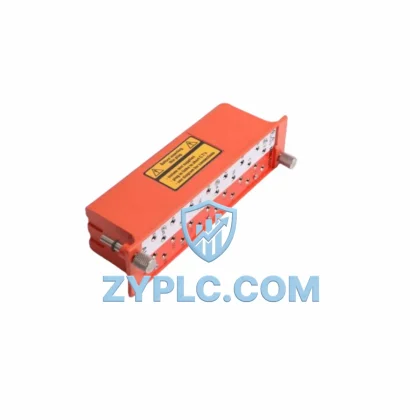
ABB SPHSS03 Hydraulic Servo Control for SPH
The ABB SPHSS03 Hydraulic Servo Control Module is a precision-engineered component designed to operate at the intersection of motion control and process automation within the ABB SPH Series distributed control architecture. Rather than functioning as a standalone device, the SPHSS03 is conceived as a system-level asset — one that derives its full operational value from its coordinated role across the control layer, I/O layer, power distribution layer, communication network layer, and the human-machine interface layer of a complete industrial automation system.
In modern industrial facilities — whether in petrochemical processing, power generation, metallurgical production, water treatment, or heavy manufacturing — hydraulic servo control is rarely isolated. The SPHSS03 integrates directly into the SPH Series rack infrastructure, receiving command signals from the upstream CPU module and translating them into precise hydraulic actuator positioning with sub-millisecond response characteristics. This tight coupling between the digital control layer and the physical execution layer is what defines the SPHSS03’s role in a layered automation system: it is the bridge between logic and motion.
From a system architecture perspective, the SPHSS03 occupies the execution layer, but its influence extends upward through the signal chain. Position feedback signals are routed back through the I/O bus to the CPU, enabling closed-loop control strategies that depend on the integrity and latency of every module in the chain. Engineers designing SPH-based systems must therefore consider the SPHSS03 not in isolation, but in the context of the full rack assembly, the backplane communication bus, and the redundancy architecture that protects critical hydraulic axes from single-point failure.
Product Specification Table
| Parameter |
Specification |
| System Role |
Hydraulic Servo Control Module — Execution Layer |
| Compatible Series |
ABB SPH Series Distributed Control Architecture |
| SKU / Part Number |
SPHSS03 |
| Manufacturer |
ABB (Country of Origin: Germany) |
| Module Function |
Closed-loop hydraulic servo axis positioning and feedback |
| Signal Interface |
Analog command input / encoder/resolver feedback |
| Communication Capability |
SPH Series backplane bus; compatible with PROFIBUS and PROFINET gateway configurations |
| Power Supply Compatibility |
24 VDC rack-distributed power via SPH Series power supply modules |
| Installation Environment |
DIN rail / rack-mount; IP20 enclosure; operating temp 0–55°C |
| Redundancy Support |
Hot-standby redundancy via SPH Series redundancy controller pairing |
| Warranty |
12-Month Warranty — fully tested prior to shipment |
| system integration |
Validated for system integration within SPH Series multi-axis architectures |
System Compatibility Notes
The SPHSS03 does not operate in isolation — its performance is inseparable from the system architecture surrounding it. In a fully configured SPH Series control cabinet, the SPHSS03 shares a backplane with the SPH CPU module, which handles the PLC logic execution and issues servo command references on each scan cycle. The SPH Series power supply module provides stable 24 VDC rail power to the entire rack, ensuring that voltage transients from hydraulic actuator switching do not propagate into the control electronics.
On the I/O side, the SPHSS03 works in conjunction with SPH Series analog input modules and digital I/O modules to monitor limit switches, pressure transducers, and position encoders distributed across the hydraulic circuit. These signals are aggregated at the backplane level and made available to the CPU for real-time closed-loop computation. In multi-axis installations, multiple SPHSS03 modules may be installed in the same rack, each managing an independent hydraulic axis while sharing the same CPU scan and communication bus — a configuration that demands careful attention to backplane bandwidth and scan time allocation.
For facilities requiring high availability, the SPHSS03 supports integration with SPH Series redundancy controller modules, enabling hot-standby CPU configurations where a secondary controller monitors the primary and assumes control within milliseconds of a detected fault. This redundancy architecture is particularly critical in applications such as turbine governor control, press brake positioning, and continuous casting machine hydraulics, where an uncontrolled axis movement during a controller failover could result in equipment damage or process interruption.
Communication integration is handled through SPH Series PROFIBUS DP gateway modules or PROFINET interface modules, which allow the SPHSS03’s axis status, fault codes, and position data to be surfaced to SCADA systems, DCS platforms, or MES layers without requiring dedicated point-to-point wiring. This network-layer integration is essential for facilities pursuing Industry 4.0 architectures, where real-time axis data must be available to analytics platforms and digital twin environments. The HMI layer — typically an ABB Panel 800 or compatible operator terminal — displays axis position, servo status, and alarm states sourced directly from the CPU’s data table, which is populated by the SPHSS03’s feedback loop.
Terminal modules and marshalling components within the control cabinet connect field wiring from hydraulic valve solenoids, LVDT position sensors, and pressure switches to the SPHSS03’s I/O terminals, providing the physical signal interface between the module and the hydraulic circuit. Proper terminal block selection, cable shielding, and grounding practices at this layer are critical to achieving the signal integrity that the SPHSS03’s servo algorithms require.
Industrial Application Notes
The SPHSS03 finds its most demanding applications in industries where hydraulic servo control is integral to the production process and where control system reliability directly determines plant availability and product quality.
In steel and metallurgical plants, the SPHSS03 is deployed in rolling mill hydraulic gap control systems, where sub-millimeter positioning accuracy is required to maintain strip thickness tolerances across multi-stand tandem mills. The module’s closed-loop response characteristics allow it to compensate for roll force variations in real time, working in concert with the mill’s main drive control system and the process computer that calculates gap references from incoming strip gauge measurements.
In power generation facilities, the SPHSS03 controls hydraulic actuators on steam turbine governor valves and inlet guide vanes, where precise flow control directly affects turbine speed regulation and grid frequency response. These applications demand the highest levels of redundancy and fault tolerance, making the SPHSS03’s compatibility with SPH Series hot-standby architectures a critical selection criterion.
In petrochemical and refinery environments, the SPHSS03 manages hydraulic positioning of control valves, reactor feed systems, and compressor anti-surge valve actuators. The module’s ability to maintain precise position control under varying hydraulic supply pressure conditions — common in facilities with shared hydraulic power units — makes it well-suited to these demanding process control applications.
In packaging and press machinery, the SPHSS03 provides the servo control backbone for hydraulic press brake positioning, injection molding clamp control, and die-casting machine shot control. These applications require high-speed, repeatable positioning with tight cycle time constraints, and the SPHSS03’s integration with the SPH Series CPU’s high-speed task execution environment supports these requirements.
In water and wastewater treatment facilities, the SPHSS03 controls hydraulic actuators on large-bore control valves and sluice gates, where reliable, low-maintenance operation over extended periods is the primary engineering requirement. The module’s compatibility with SPH Series remote I/O configurations allows it to be deployed in distributed architectures where the control cabinet is located remotely from the hydraulic actuators.
Product Compatibility FAQ
Q1: Is the SPHSS03 compatible with existing SPH Series racks, and can it be added to a running system without a full shutdown?
The SPHSS03 is designed for installation within the SPH Series rack infrastructure and is compatible with existing SPH backplane assemblies. In systems configured with SPH Series hot-swap capable racks, module replacement or addition can be performed with the rack powered, subject to the specific rack revision and firmware version in use. Engineers should consult the SPH Series hardware manual and verify backplane slot assignments before installation. ZYPLC provides pre-shipment configuration verification and can supply documentation to support site installation planning.
Q2: How does the SPHSS03 behave during a CPU failover in a redundant SPH architecture, and will the hydraulic axis hold position?
In a properly configured SPH Series redundant architecture, the secondary CPU maintains a synchronized copy of the primary CPU’s data table, including the SPHSS03’s current command reference and feedback values. During a failover event, the secondary CPU assumes control within the system’s configured switchover time, and the SPHSS03 continues executing the last valid command reference until the new primary CPU issues an updated reference. For safety-critical axes, engineers typically configure the SPHSS03’s output to a defined safe state (e.g., hold position or retract) via the CPU’s fault output configuration, ensuring predictable behavior during any control system interruption. This behavior should be validated during commissioning as part of the site acceptance test procedure.
Q3: What does the 12-Month Warranty cover, and what support is available for long-term maintenance and spare parts supply?
The 12-Month Warranty covers the SPHSS03 against manufacturing defects and functional failures under normal operating conditions from the date of shipment. All units supplied by ZYPLC are fully tested prior to dispatch, with functional verification performed against ABB SPH Series compatibility parameters. For long-term maintenance planning, ZYPLC maintains inventory of SPHSS03 modules and compatible SPH Series components to support planned maintenance cycles, emergency replacements, and system expansion projects. Customers are encouraged to establish a spare parts agreement to ensure availability of critical modules without lead time risk. For technical support, commissioning assistance, or warranty claims, contact ZYPLC directly.
© 2026 ZYPLC. All rights reserved.
Original Source: https://zyplc.com
Contact: +86 19859288691 | plc.sales@zyplc.com