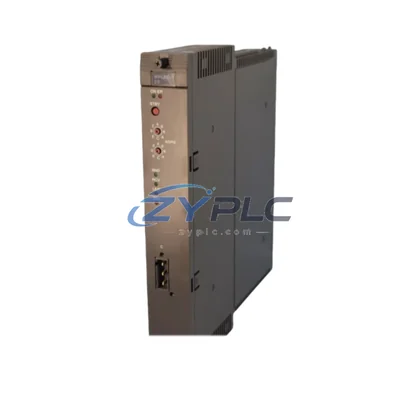
Allen-Bradley 1747-L541/C CPU for SLC 500: Control System Coordination and system integration
The Allen-Bradley 1747-L541/C is a fixed-memory CPU module engineered for deployment within the SLC 500 modular control platform — one of the most widely adopted small-to-mid-range PLC families in industrial automation. With 16K words of user memory and a robust instruction set covering ladder logic, data manipulation, and process control functions, this processor is designed not as a standalone component but as the central coordination node within a layered, multi-tier automation architecture. Understanding its role requires examining how it interacts with every layer of the control system: from the backplane and I/O modules it directly governs, to the HMI terminals and SCADA systems that depend on its data, and the power supply and communication infrastructure that sustains its continuous operation.
In a complete SLC 500 system architecture, the 1747-L541/C occupies Slot 0 of the 1746-A series chassis — typically a 1746-A7, 1746-A10, or 1746-A13 rack — and communicates with all installed I/O modules through the SLC 500 backplane bus. The processor scans discrete and analog I/O modules including the 1746-IB16 (16-point 24VDC input), 1746-OB16 (16-point transistor output), 1746-NI4 (4-channel analog input), and 1746-NO4I (4-channel analog current output), executing the user program and updating the I/O image table on every scan cycle. This tight integration between the CPU and the I/O subsystem is fundamental to achieving deterministic control response times — a critical requirement in process control, packaging lines, and discrete manufacturing environments.
Power integrity is equally essential. The 1747-L541/C operates from a 1746-P2 or 1746-P4 power supply module installed in the same chassis, which provides regulated 5VDC and 24VDC rails to the backplane. Proper power supply sizing — accounting for the total current draw of all installed modules — is a prerequisite for stable CPU operation, particularly in high-density I/O configurations or environments with significant electrical noise. Engineers specifying this processor must calculate the chassis power budget before finalizing the module complement.
Communication capability is a defining feature of the 1747-L541/C’s architecture role. The processor includes a built-in RS-232 DH-485 port that supports connection to the Allen-Bradley DH-485 network — a token-passing, multi-drop serial network capable of linking up to 32 nodes including other SLC 500 processors, PanelView HMI terminals, and 1747-AIC Advanced Interface Converters. For integration into broader plant networks, the 1747-SN SLC 500 Remote I/O Scanner or 1747-KE DH-485/RS-232C Interface Module can extend connectivity to DeviceNet, ControlNet, or EtherNet/IP infrastructure, enabling the SLC 500 system to participate in a unified plant-wide communication architecture alongside ControlLogix and CompactLogix platforms.
At the human-machine interface layer, the 1747-L541/C supports direct connection to PanelView 300, PanelView 550, and PanelView 600 terminals via DH-485, providing operators with real-time process visualization, alarm management, and parameter adjustment without requiring a separate communication processor. This direct HMI integration reduces system complexity, lowers wiring costs, and improves diagnostic transparency — all of which contribute to reduced mean time to repair (MTTR) during downtime events.
For applications requiring enhanced availability, the 1747-L541/C can be deployed in architectures that incorporate redundant power supplies and distributed I/O strategies using 1747-ASB Remote I/O Adapter modules, allowing I/O expansion beyond the local chassis while maintaining centralized program execution. While the SLC 500 platform does not support hot-standby CPU redundancy natively, system architects frequently implement redundancy at the I/O and network layers to minimize single points of failure in critical process applications.
From an engineering and maintenance perspective, the 1747-L541/C is fully programmable using RSLogix 500 software, which provides ladder diagram editing, online monitoring, forced I/O, and data table access. Program upload and download are performed via the RS-232 port using a 1747-CP3 programming cable or through the DH-485 network. The processor supports online editing, allowing program modifications to be made while the system remains in Run mode — a capability that significantly reduces planned maintenance windows in continuous-process environments such as water treatment, chemical processing, and power generation.
Long-term maintainability is supported by the broad availability of SLC 500 spare parts and the extensive installed base of this platform across global industrial facilities. The 1747-L541/C is compatible with all 1746-series I/O modules and chassis, ensuring that system expansions or module replacements can be executed without platform migration. ZYPLC maintains RFQ-confirmed availability of the 1747-L541/C and associated SLC 500 components, with all units covered by a Warranty and support terms confirmed before quote and subject to pre-shipment functional verification.
Product Specification Table
| Parameter |
Specification |
| System Role |
Central Processing Unit — SLC 500 Modular Platform |
| User Memory |
16K Words (Data + Program) |
| I/O Capacity |
Up to 4096 discrete I/O points (with remote I/O expansion) |
| Instruction Set |
Ladder Logic, Timer/Counter, Math, PID, Data Manipulation |
| Communication Port |
RS-232 DH-485 (built-in), 19.2 Kbps max |
| Network Compatibility |
DH-485, Remote I/O (via 1747-SN scanner) |
| Power Supply Compatibility |
1746-P2, 1746-P4 (5VDC/24VDC backplane) |
| Chassis Compatibility |
1746-A4, 1746-A7, 1746-A10, 1746-A13 |
| Operating Temperature |
0°C to 60°C (32°F to 140°F) |
| Relative Humidity |
5% to 95% non-condensing |
| Programming Software |
RSLogix 500 (Allen-Bradley) |
| system integration |
DH-485 network, PanelView HMI, Remote I/O, SCADA via gateway |
| Warranty |
Warranty and support terms confirmed before quote — all units pre-shipment verified |
System Compatibility Notes
A fully realized SLC 500 control system built around the 1747-L541/C typically incorporates the following coordinated components. The 1746-A10 chassis provides the physical backplane infrastructure accommodating up to nine I/O modules alongside the CPU. The 1746-P4 power supply delivers sufficient current capacity for high-density module configurations. Discrete I/O is handled by 1746-IB16 input and 1746-OB16 output modules, while process variables are acquired through 1746-NI4 analog input and controlled via 1746-NO4I analog output modules. Network connectivity is extended using the 1747-SN Remote I/O Scanner for distributed I/O architectures, and the 1747-AIC Advanced Interface Converter bridges the DH-485 network to RS-232 programming devices. Operator interaction is delivered through a PanelView 550 terminal connected directly to the DH-485 port, while the 1747-CP3 programming cable enables RSLogix 500 access for commissioning and maintenance. For applications requiring analog process control loops, the 1746-NIO4I combination analog module provides both input and output channels in a single slot, optimizing chassis density. This coordinated architecture ensures that the 1747-L541/C operates within a fully validated, interoperable system environment rather than as an isolated component.
Industrial Application Notes
The 1747-L541/C is deployed across a broad spectrum of industrial sectors where the SLC 500 platform has established a long operational history. In discrete manufacturing environments — including automotive assembly, metal fabrication, and electronics production — the processor manages conveyor sequencing, robotic cell coordination, and quality inspection interlocks with scan times well within the response requirements of high-speed production lines. In water and wastewater treatment facilities, the 1747-L541/C controls pump stations, valve actuators, and chemical dosing systems, with PID instruction blocks managing flow rates and chemical concentrations against setpoints transmitted from SCADA systems via DH-485 gateways. In power generation and distribution substations, the processor handles protection relay coordination, load shedding logic, and generator synchronization sequences, where its deterministic scan behavior and robust electrical noise immunity are essential. In oil, gas, and petrochemical process plants, the 1747-L541/C manages separator control, compressor sequencing, and emergency shutdown (ESD) logic within hazardous area control panels, often in conjunction with intrinsically safe I/O barriers and remote I/O drops located at field junction boxes. In mining and metallurgical operations, the processor controls crusher sequencing, conveyor belt tension management, and ore processing plant interlocks, where its wide operating temperature range and vibration tolerance support reliable operation in harsh physical environments. Across all these applications, the 1747-L541/C’s system integration capability — its ability to share data with upstream SCADA systems, peer PLCs on DH-485, and operator HMI terminals simultaneously — makes it a versatile and enduring choice for system architects managing complex, multi-layer automation infrastructures.
Product Compatibility FAQ
Q1: Is the 1747-L541/C compatible with all 1746-series I/O modules, and can it be mixed with newer SLC 500 CPU revisions in the same DH-485 network?
Yes. The 1747-L541/C is fully compatible with all 1746-series discrete, analog, and specialty I/O modules. On a DH-485 network, it can coexist with other SLC 500 processors of different memory sizes and revision levels, as well as PanelView terminals and 1747-AIC converters, provided each node is assigned a unique network address. RSLogix 500 manages all node addressing and communication configuration from a single programming environment.
Q2: What are the recommended practices for long-term maintenance and spare parts management for systems using the 1747-L541/C?
Best practice is to maintain at least one verified spare 1747-L541/C per production site, particularly for systems where the SLC 500 platform has been in service for more than five years. ZYPLC supplies tested units with a Warranty and support terms confirmed before quote, enabling maintenance teams to execute rapid CPU replacements without extended lead times. Program backup should be maintained in RSLogix 500 project files stored on a secured engineering workstation, with copies archived off-site. Battery replacement (1747-BA series) should be performed on a scheduled basis to protect user memory during power interruptions.
Q3: Can the 1747-L541/C be integrated into a modern EtherNet/IP or ControlLogix-based architecture for system migration or hybrid operation?
Direct EtherNet/IP communication is not native to the 1747-L541/C, but integration is achievable through protocol gateway devices such as the 1761-NET-ENI Serial-to-EtherNet/IP adapter or third-party Modbus/EtherNet/IP gateways, which translate DH-485 or DF1 data to EtherNet/IP for consumption by ControlLogix processors or SCADA/MES systems. This approach supports hybrid architectures where legacy SLC 500 subsystems continue to operate alongside newer Logix5000-based platforms during phased migration programs, preserving existing I/O infrastructure investment while extending system connectivity.
—