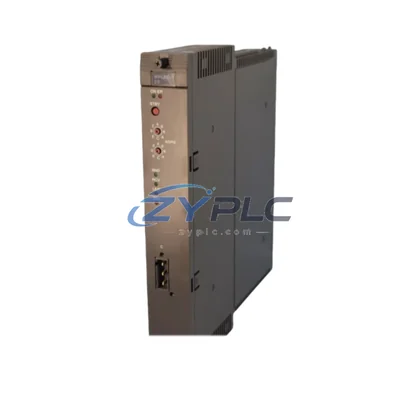
Allen-Bradley 1769-SM2 Industrial Network Interface: Bridging the Data Link in Smart Factory Automation
The Allen-Bradley 1769-SM2 is a high-performance DSI/Modbus Communication Gateway designed to integrate seamlessly into CompactLogix control architectures. As industrial facilities accelerate their transition toward smart manufacturing, the demand for reliable, protocol-agnostic communication modules has never been greater. The 1769-SM2 answers this demand by serving as a critical bridge between field-level devices and upper-layer control and monitoring systems — enabling real-time data exchange, remote diagnostics, and full network transparency across the production floor.
Engineered for demanding industrial environments, the 1769-SM2 slots directly into the CompactLogix 1769 backplane, providing native DSI (Drive Serial Interface) and Modbus RTU/ASCII communication support. This dual-protocol capability allows engineers to connect variable frequency drives, smart sensors, and distributed I/O modules to the CompactLogix controller without the need for additional protocol converters or external gateways — reducing wiring complexity, minimizing latency, and improving overall system reliability.
Compatibility & Integration Notes
| Specification |
Details |
| SKU / Part Number |
1769-SM2 |
| Brand |
Allen-Bradley (Rockwell Automation) |
| Series |
CompactLogix 1769 |
| Communication Protocols |
DSI (Drive Serial Interface), Modbus RTU, Modbus ASCII |
| Interface Type |
1769 Backplane, Serial (RS-485) |
| Transmission Capability |
Up to 19.2 Kbps (Modbus RTU/ASCII); DSI native rate |
| Network Compatibility |
EtherNet/IP (via CompactLogix controller), Modbus network, DSI drive network |
| System Application |
SCADA integration, HMI connectivity, drive parameter monitoring, remote I/O, PLC-to-drive communication |
| Product Type |
Communication Gateway / Protocol Converter |
| Origin |
United States |
| Warranty |
Warranty and support terms confirmed before quote |
| Availability |
Confirmed via RFQ before quotation |
Connected Automation Data Flow
In a typical smart factory deployment, the 1769-SM2 sits at the heart of the device-level communication layer. Signal acquisition begins at the field level, where sensors, encoders, and actuators feed data into PowerFlex 400 and PowerFlex 700 variable frequency drives via the DSI interface. The 1769-SM2 collects drive status, speed feedback, fault codes, and operating load data directly from these drives and maps them into the CompactLogix controller’s data table — making every parameter instantly accessible to the control program.
From the CompactLogix 1769-L33ER or 1769-L30ER controller, data travels upstream over EtherNet/IP to the plant-level SCADA system or FactoryTalk View SE HMI. Operators at the control room can monitor real-time drive performance, acknowledge alarms, and initiate remote start/stop commands — all without leaving the SCADA interface. This seamless data path from field device to supervisory system is precisely what the 1769-SM2 enables.
On the Modbus side, the 1769-SM2 acts as a Modbus master or slave, allowing it to communicate with third-party devices such as Modbus-compatible power meters, temperature controllers, and remote I/O modules from vendors outside the Rockwell ecosystem. This cross-vendor interoperability is essential in brownfield installations where legacy Modbus devices must coexist with modern EtherNet/IP infrastructure.
For distributed control architectures, the 1769-SM2 works alongside 1769-IQ16 digital input modules and 1769-OB16 digital output modules within the same CompactLogix backplane, sharing the backplane bus for high-speed, deterministic data exchange. When remote I/O expansion is required, the system can be extended using 1734 POINT I/O modules over EtherNet/IP, with the CompactLogix controller managing all I/O mapping transparently.
Edge computing and remote diagnostics are further enhanced when the CompactLogix system is paired with an industrial edge gateway running FactoryTalk Analytics or a third-party MQTT broker. In this configuration, the 1769-SM2’s drive and device data is aggregated at the controller level, then forwarded to cloud-based analytics platforms for predictive maintenance, OEE calculation, and maintenance planning — closing the loop between the physical production line and the digital enterprise.
Solving Data Isolation in Industrial Sites
One of the most persistent challenges in industrial automation is data isolation — the condition where field devices, controllers, and supervisory systems operate in separate communication silos, preventing unified visibility and coordinated control. The Allen-Bradley 1769-SM2 directly addresses this problem by providing a standardized, protocol-transparent communication path between DSI/Modbus devices and the CompactLogix control platform.
Protocol Unification: Many production facilities operate a mix of legacy Modbus RTU devices and modern DSI-capable drives. Without a dedicated communication gateway, engineers are forced to deploy separate serial converters, custom ladder logic, or third-party middleware — each adding complexity and potential failure points. The 1769-SM2 eliminates this fragmentation by natively supporting both DSI and Modbus within a single compact module, reducing panel space and simplifying commissioning.
Production Line Transparency: With the 1769-SM2 in place, every connected drive and Modbus device becomes a visible node in the plant network. Drive speed, torque, current draw, fault history, and runtime hours are all mapped into the CompactLogix data table and made available to FactoryTalk View HMI screens and SCADA dashboards. This level of transparency enables shift supervisors and maintenance engineers to identify performance degradation before it leads to unplanned downtime.
Remote Monitoring and Diagnostics: The 1769-SM2 supports remote fault diagnostics by exposing drive fault codes and communication status registers to the CompactLogix controller. When a drive fault occurs, the controller can log the event, trigger an alarm on the HMI, and send a notification to the maintenance team — all automatically. Remote access via VPN or Rockwell’s FactoryTalk Remote Access further allows engineers to diagnose and resolve issues without being physically present on the production floor.
System Scalability: As production requirements evolve, the 1769-SM2 supports system expansion without requiring architectural redesign. Additional drives or Modbus devices can be added to the serial network up to the module’s supported node count, and the CompactLogix controller can be upgraded to a higher-capacity model — such as the 1769-L36ERM — without changing the communication module or rewiring the field devices.
Outgoing Inspection and Warranty: Every 1769-SM2 unit supplied by ZYPLC undergoes functional communication testing prior to shipment, verifying DSI and Modbus protocol handshaking, backplane integration, and parameter read/write operations. Warranty terms are confirmed during quotation.
Industrial Connectivity FAQ
Q1: What is the communication latency of the 1769-SM2 when used in a Modbus RTU network?
The 1769-SM2 operates at baud rates up to 19.2 Kbps in Modbus RTU/ASCII mode. In a typical network with a small number of nodes, poll cycle times are in the range of 10–50 ms per device, depending on the number of registers polled and the baud rate configured. For time-critical applications, DSI communication offers faster, deterministic data exchange with compatible PowerFlex drives.
Q2: Is the 1769-SM2 compatible with third-party Modbus devices from non-Rockwell vendors?
Yes. The 1769-SM2 implements standard Modbus RTU and ASCII protocols, making it compatible with any Modbus-compliant device regardless of manufacturer. This includes third-party power meters, temperature controllers, flow meters, and remote I/O modules. The CompactLogix controller manages all Modbus polling and data mapping through standard MSG instructions in the ladder logic program.
Q3: How does the 1769-SM2 contribute to network stability in a multi-drive system?
The 1769-SM2 uses a dedicated serial port isolated from the EtherNet/IP backplane traffic, ensuring that drive communication does not interfere with controller-to-SCADA data exchange. The module also supports configurable timeout and retry parameters, allowing engineers to fine-tune network resilience for environments with electrical noise or long cable runs. Proper RS-485 termination and shielded cabling further enhance signal integrity across the drive network.
Q4: What warranty and pre-shipment testing does ZYPLC provide for the 1769-SM2?
All 1769-SM2 units supplied by ZYPLC are Warranty terms are confirmed during quotation. Prior to shipment, each unit undergoes a functional test that verifies backplane communication with a CompactLogix controller, DSI handshaking with a compatible PowerFlex drive, and Modbus RTU register read/write operations. Units are shipped with original packaging and documentation where available. For volume orders or urgent requirements, please contact our team directly.