Allen-Bradley 1771-ASB Remote I/O Adapter for 1771
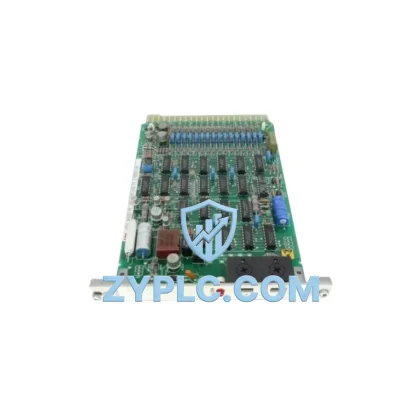
The Allen-Bradley 1771-ASB Remote I/O Adapter Module is a foundational component within the Rockwell Automation 1771 PLC platform, engineered to extend the reach of centralized control logic into distributed I/O chassis across complex industrial environments. Rather than functioning as a standalone device, the 1771-ASB operates as a critical node in a layered automation architecture — bridging the control layer, I/O layer, and communication network into a unified, high-integrity system. For engineers designing or maintaining systems in manufacturing, power distribution, petrochemical processing, water treatment, mining, metallurgy, or packaging lines, the 1771-ASB delivers the structural reliability and system integration that modern process control demands.
Product Specification Table
| Parameter |
Specification |
| System Role |
Remote I/O Adapter — Distributed Chassis Communication |
| Compatible Platform |
Allen-Bradley 1771 PLC Series (PLC-2, PLC-3, PLC-5) |
| Communication Protocol |
Remote I/O (RIO) — 57.6K / 115.2K / 230.4K baud |
| Chassis Compatibility |
1771 I/O Chassis (e.g., 1771-A1B, 1771-A2B, 1771-A3B, 1771-A4B) |
| Backplane Interface |
1771 Series Backplane |
| Node Addressing |
Up to 32 nodes per RIO scanner link |
| Power Requirement |
Supplied via 1771 chassis backplane |
| Operating Temperature |
0°C to 60°C (32°F to 140°F) |
| Storage Temperature |
-40°C to 85°C |
| Relative Humidity |
5% to 95% non-condensing |
| Installation Environment |
Industrial control panel, DIN rail chassis mount |
| Certifications |
UL Listed, CE Marked |
| Warranty |
12-Month Warranty — Covered by ZYPLC Quality Assurance Program |
System Compatibility Notes
The 1771-ASB does not operate in isolation — its value is realized through its role in a coordinated, multi-layer control architecture. At the control layer, the 1771-ASB interfaces directly with Allen-Bradley PLC-5 processors such as the 1785-L40B or 1785-L80B, which serve as the central intelligence of the automation system. The processor communicates with remote I/O chassis via the RIO scanner link, and the 1771-ASB acts as the adapter on the remote end, receiving scan commands and managing local I/O data exchange.
At the I/O layer, the 1771-ASB supports a full range of 1771 series I/O modules installed in the remote chassis. These include discrete input modules such as the 1771-IA (120VAC input) and 1771-OA (120VAC output), as well as analog modules like the 1771-IFE (analog input) and 1771-OFE1 (analog output), enabling precise signal acquisition and actuation across the process. The adapter ensures that all module data is accurately mapped to the processor’s I/O image table, maintaining signal integrity across the communication link.
At the network layer, the RIO cable connecting the PLC-5 scanner to the 1771-ASB must be properly terminated and shielded to maintain communication stability at higher baud rates. In multi-drop RIO configurations, multiple 1771-ASB adapters can be daisy-chained on a single RIO link, each assigned a unique node address. This topology reduces wiring complexity and supports modular system expansion without requiring additional scanner cards in the main chassis.
At the power layer, the remote chassis housing the 1771-ASB requires a dedicated power supply. The 1771-P4S or 1771-P7 chassis power supply modules are commonly paired with the 1771-ASB to ensure stable backplane voltage across all installed I/O modules. Proper power supply sizing is critical in high-density I/O configurations to prevent voltage sag and communication faults.
At the human-machine interface layer, operator stations running RSView32 or FactoryTalk View SE communicate with the PLC-5 processor via Data Highway Plus (DH+) or Ethernet/IP gateways, while the 1771-ASB handles the downstream I/O data collection transparently. This separation of HMI communication from I/O scanning ensures that operator interface latency does not impact real-time control performance.
At the execution layer, the field devices — including motor starters, solenoid valves, proximity sensors, and variable frequency drives — connect directly to the 1771 I/O modules in the remote chassis. The 1771-ASB ensures that control commands from the PLC-5 processor reach these actuators with minimal latency, and that feedback signals are returned accurately for closed-loop control. In redundant system designs, a secondary 1771-ASB can be configured in a complementary chassis to provide hot-standby I/O capability, improving system availability in critical process applications.
Industrial Application Notes
In manufacturing and assembly lines, the 1771-ASB enables distributed I/O placement close to the machine, reducing field wiring runs and simplifying panel layouts. A single PLC-5 processor can manage multiple remote chassis via RIO, each handling a distinct machine section — conveyor drives, robotic end-effectors, vision system triggers, and safety interlocks — all coordinated through a unified control program.
In power distribution and substation automation, the 1771-ASB supports remote monitoring of switchgear status, breaker positions, and transformer alarms. Its robust communication protocol and industrial-grade construction make it suitable for high-EMI environments typical of electrical substations and motor control centers.
In petrochemical and refinery applications, the 1771-ASB integrates with process instrumentation — pressure transmitters, flow meters, temperature sensors — through analog I/O modules in the remote chassis. The adapter’s reliable RIO communication ensures that process variables are continuously updated in the PLC-5 scan cycle, supporting tight regulatory control loops and safety interlock systems.
In water and wastewater treatment facilities, the 1771-ASB allows control of remote pump stations, valve actuators, and level sensors from a central control room. Its ability to operate across extended cable distances — up to 3,048 meters at lower baud rates — makes it ideal for geographically distributed plant layouts.
In mining and metallurgical operations, the 1771-ASB supports high-availability control of crushers, conveyors, and smelting equipment. Its compatibility with redundant PLC-5 configurations and hot-standby I/O chassis designs ensures continuous operation even during component maintenance or failure events.
In packaging and material handling systems, the 1771-ASB enables precise coordination of servo drives, pneumatic actuators, and vision inspection systems across multi-station production lines. Its deterministic RIO scan cycle supports the high-speed, synchronized motion control required in modern packaging machinery.
Product Compatibility FAQ
Q1: Is the 1771-ASB compatible with both PLC-5 and PLC-2 processors?
Yes. The 1771-ASB is designed to operate with Allen-Bradley PLC-2, PLC-3, and PLC-5 family processors that include an integrated or supplemental RIO scanner. The adapter responds to standard RIO scan commands regardless of the processor generation, making it a versatile component for both legacy system maintenance and hybrid architecture upgrades. When integrating with newer ControlLogix platforms, a 1756-DHRIO or 1756-RIO bridge module can be used to extend RIO communication to the 1771-ASB without replacing the remote I/O infrastructure.
Q2: How many 1771-ASB adapters can be connected on a single RIO link, and what are the addressing constraints?
A single RIO scanner link supports up to 32 logical rack addresses (nodes 0–31), with each 1771-ASB occupying one or more rack addresses depending on the chassis size and I/O module density. In practice, system designers typically limit active nodes to 16–24 per link to maintain adequate scan cycle performance and communication headroom. Node addresses are set via DIP switches on the 1771-ASB module face, and each adapter on the same link must have a unique address. Proper address planning during system design prevents conflicts and simplifies future expansion.
Q3: What does the 12-Month Warranty cover, and how does ZYPLC support long-term maintenance for 1771-ASB installations?
ZYPLC’s 12-Month Warranty covers the 1771-ASB against manufacturing defects, communication failures, and component malfunctions under normal operating conditions. In the event of a warranty claim, ZYPLC provides direct replacement or repair with a target turnaround of 5–7 business days. For long-term maintenance, ZYPLC maintains inventory of 1771-ASB modules and compatible 1771 series components, enabling rapid spare parts fulfillment to minimize unplanned downtime. Our technical team can also assist with module configuration, RIO link diagnostics, and system architecture review to ensure continued operational reliability throughout the product lifecycle.
© 2026 ZYPLC. All rights reserved.
Original Source: https://zyplc.com
Contact: +86 19859288691 | plc.sales@zyplc.com