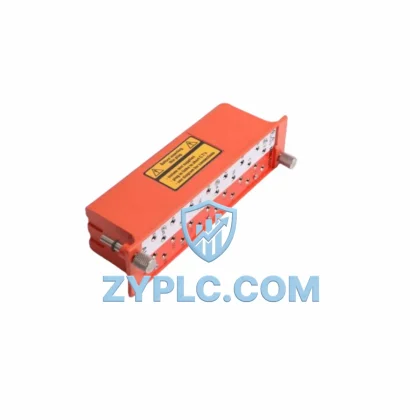
Allen-Bradley 1771-HS3A 3-Axis Servo for 1771
The Allen-Bradley 1771-HS3A IMC-123 3-Axis Servo Control Module is a precision motion control component engineered for seamless integration within the Allen-Bradley 1771 PLC platform. Rather than functioning as a standalone device, the 1771-HS3A is designed to operate as a coordinated element within a layered industrial automation architecture — interfacing directly with the control layer, I/O subsystem, power distribution network, and execution layer to deliver synchronized, high-performance servo motion across up to three axes simultaneously.
In modern industrial control environments, system consistency is not achieved through individual component performance alone, but through the coherent interaction of every module within the control cabinet. The 1771-HS3A fulfills a critical role in this ecosystem: it bridges the gap between the programmable logic controller’s command layer and the physical motion of servo-driven machinery, ensuring that position, velocity, and torque commands are executed with the precision and repeatability that demanding manufacturing and process applications require.
The module slots directly into the 1771 I/O chassis — such as the 1771-A1B, 1771-A2B, or 1771-A4B backplane — and communicates with the host processor, typically a PLC-5 family controller such as the 1785-L40B or 1785-L80B, via the 1771 I/O bus. This tight architectural coupling allows the 1771-HS3A to receive motion profiles, execute interpolated moves, and report real-time axis status back to the supervisory control layer without introducing latency or communication overhead that could compromise system timing.
From a power architecture perspective, the 1771-HS3A relies on the 1771 chassis power supply — such as the 1771-P4S or 1771-P7 — to maintain stable operating voltage across the backplane. Proper power budgeting within the chassis is essential when deploying multi-axis servo modules alongside analog I/O modules, digital I/O modules, and communication interface cards. Engineers integrating the 1771-HS3A into a new or existing control cabinet should account for the module’s current draw during peak servo acceleration phases to avoid power supply saturation.
At the network and communications layer, the 1771-HS3A operates within systems that may also include Data Highway Plus (DH+) communication modules such as the 1771-KA or 1785-KA5, enabling remote programming, diagnostics, and data acquisition from SCADA or MES platforms. In architectures where redundancy is a design requirement, the 1771-HS3A can be deployed alongside redundant processor configurations, with the 1785-L40C or similar redundant PLC-5 controllers managing failover logic to ensure uninterrupted servo operation during processor switchover events.
The human-machine interface layer — typically implemented using PanelView terminals such as the 2711-T10C8 or 2711P-T12C4D9 — provides operators with real-time visibility into axis position, fault status, and motion program execution. The 1771-HS3A’s status registers are mapped directly into the PLC-5 data table, making it straightforward to surface axis diagnostics on operator panels without requiring custom communication drivers or middleware.
At the execution layer, the 1771-HS3A drives servo amplifiers and motors that deliver the physical motion commanded by the control system. Compatible servo amplifiers from the 1391 and 1394 drive families are commonly paired with the 1771-HS3A in legacy and retrofit applications, providing a well-validated motion control stack that has been proven across decades of industrial deployment in automotive assembly, packaging machinery, printing equipment, and material handling systems.
Product Specification Table
| Parameter |
Specification |
| System Role |
3-Axis Servo Control Module (IMC-123) |
| Compatible Platform |
Allen-Bradley 1771 I/O System / PLC-5 Family |
| Number of Axes |
3 (simultaneous coordinated motion) |
| Chassis Compatibility |
1771-A1B, 1771-A2B, 1771-A4B I/O Chassis |
| Host Controller |
PLC-5 Series (e.g. 1785-L40B, 1785-L80B) |
| Communication Interface |
1771 Parallel I/O Bus |
| Power Supply Compatibility |
1771-P4S, 1771-P7 Chassis Power Supplies |
| Electrical Rating |
Backplane powered; 5 VDC logic via chassis supply |
| Operating Temperature |
0°C to 60°C (32°F to 140°F) |
| Storage Temperature |
-40°C to 85°C |
| Relative Humidity |
5% to 95% non-condensing |
| Installation Environment |
Industrial control cabinet, DIN rail or chassis mount |
| Network Layer Support |
DH+ via 1771-KA / 1785-KA5 (host controller) |
| Warranty |
12-Month Warranty — tested, inspected, and verified |
| Origin |
USA |
System Compatibility Notes
Deploying the 1771-HS3A within a complete control system requires careful coordination across multiple hardware layers. At the processor level, the PLC-5 family — including the 1785-L40B, 1785-L60B, and 1785-L80B — provides the motion program execution environment, managing block transfer reads and writes to the 1771-HS3A to update motion parameters and retrieve axis status in real time. The processor’s scan time must be configured to accommodate the servo module’s update rate, ensuring that position commands are refreshed at intervals consistent with the application’s dynamic requirements.
Within the 1771 chassis, the 1771-HS3A coexists with a range of I/O modules that handle discrete and analog signals from field devices. Digital input modules such as the 1771-IB16 and analog output modules such as the 1771-OFE1 are commonly installed in adjacent slots, providing the broader I/O infrastructure that supports limit switches, home sensors, and analog feedback signals associated with the servo axes. Proper slot assignment and chassis addressing are critical to avoiding I/O map conflicts that could cause erratic servo behavior.
For applications requiring communication with upstream systems, the 1771-KA Data Highway Plus communication adapter bridges the 1771 backplane to the DH+ network, enabling the PLC-5 host to exchange data with other controllers, operator interface terminals, and data collection systems. In larger plant architectures, this connectivity allows the 1771-HS3A’s motion data to be integrated into plant-wide MES or SCADA platforms without requiring dedicated motion network infrastructure.
Power integrity across the chassis is maintained by the 1771-P4S or 1771-P7 power supply modules, which must be sized to support the combined current demand of all installed modules, including the 1771-HS3A during peak acceleration. In high-availability applications, redundant power supply configurations using dual 1771-P4S units with external transfer relays provide protection against power supply failure without interrupting servo operation.
At the drive level, the 1391 and 1394 servo drive families provide the amplification stage between the 1771-HS3A’s command outputs and the servo motors. These drives accept analog ±10V velocity or torque reference signals from the module and return encoder feedback, closing the position loop within the 1771-HS3A’s internal motion controller. Proper tuning of the drive’s velocity loop gains, in conjunction with the 1771-HS3A’s position loop parameters, is essential for achieving stable, responsive motion across all three axes.
Industrial Application Notes
The 1771-HS3A has established a strong application record across a broad range of industrial sectors where coordinated multi-axis motion is a fundamental process requirement. In automotive manufacturing, the module controls robotic welding positioners, transfer line indexing mechanisms, and assembly fixture actuators, where precise synchronization between axes directly impacts weld quality and cycle time. The module’s ability to execute coordinated linear and circular interpolation moves makes it well-suited for contour-following applications where multiple axes must move in a defined geometric relationship.
In the packaging industry, the 1771-HS3A drives the servo axes of form-fill-seal machines, cartoning lines, and case erectors, where high-speed, repeatable motion profiles are essential for maintaining throughput and minimizing product waste. The module’s integration with the PLC-5 ladder logic environment allows packaging engineers to implement electronic gearing and cam profiles directly within the control program, eliminating the need for mechanical gearboxes and cam followers that require periodic maintenance and replacement.
Power generation and utilities applications leverage the 1771-HS3A in valve actuator control systems, turbine governor positioning, and boiler feed pump speed regulation, where the module’s ability to maintain precise position under varying load conditions contributes to process stability and energy efficiency. In water treatment facilities, the module controls chemical dosing pump drives and filter backwash valve actuators, where accurate flow control is critical to meeting regulatory discharge standards.
Mining and mineral processing operations deploy the 1771-HS3A in conveyor drive systems, crusher feed control mechanisms, and flotation cell agitator drives, where the module’s robust industrial design and compatibility with the established 1771 platform simplifies spare parts management and reduces the engineering effort required for system modifications. The module’s 12-Month Warranty provides procurement teams with the confidence to maintain strategic inventory positions without concern for latent defects or premature failure.
Product Compatibility FAQ
Q1: Is the 1771-HS3A compatible with all PLC-5 processor variants, and are there any firmware or chassis configuration requirements for system integration?
The 1771-HS3A is compatible with the full range of PLC-5 family processors, including the 1785-L40B, 1785-L60B, 1785-L80B, and their enhanced variants. system integration — the ability to map the module’s axis data directly into the PLC-5 data table for use by ladder logic, HMI displays, and network-connected systems — is supported natively through the standard block transfer mechanism. No special firmware is required on the processor side; however, the chassis slot address must be correctly configured in the I/O configuration table, and the block transfer length must match the module’s defined data structure. Engineers should verify chassis compatibility with the 1771-A1B, 1771-A2B, or 1771-A4B backplane before installation.
Q2: What are the recommended practices for maintaining servo system performance and minimizing downtime in long-term deployments?
Long-term maintenance of systems incorporating the 1771-HS3A should include periodic inspection of the chassis backplane connectors for oxidation or mechanical wear, verification of power supply output voltages under full load, and review of the module’s fault log registers for recurring error codes that may indicate developing issues with encoder feedback signals or drive communication. Maintaining a documented baseline of the module’s tuning parameters — including position loop gain, velocity feedforward, and acceleration limits — allows maintenance engineers to restore system performance quickly following a module replacement. The 12-Month Warranty covers manufacturing defects and provides a structured return process for modules that exhibit performance anomalies within the warranty period.
Q3: Can the 1771-HS3A be integrated into a redundant control architecture, and what considerations apply to servo axis handover during processor failover?
The 1771-HS3A can be deployed in systems using redundant PLC-5 processors, such as the 1785-L40C with the 1785-CHBM Hot Backup Module, which manages automatic failover between primary and secondary processors. During a failover event, the incoming processor assumes control of the 1771 I/O chassis, including the 1771-HS3A. To minimize motion disturbance during handover, the redundant processor should be configured to mirror the primary’s output data table continuously, ensuring that the servo module receives consistent position and velocity commands immediately after switchover. Applications with stringent continuity requirements should implement a controlled deceleration-to-hold sequence in the motion program that is triggered by the redundancy module’s switchover signal, preventing abrupt axis stops that could damage tooling or workpieces.
© 2026 ZYPLC. All rights reserved.
Original Source: https://zyplc.com
Contact: +86 19859288691 | plc.sales@zyplc.com