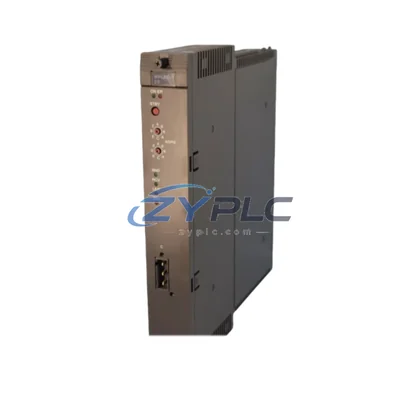
Allen-Bradley 1771-NOV: Industrial Data Link and Smart Factory Analog Output for PLC-5 Systems
In modern industrial automation, the integrity of the data link between field devices and control systems determines the efficiency, safety, and scalability of the entire operation. The Allen-Bradley 1771-NOV analog output module is a precision-engineered component designed to serve as a critical node in the PLC-5 control architecture, converting digital control signals into accurate analog outputs that drive actuators, control valves, variable frequency drives, and process instrumentation across manufacturing, chemical processing, water treatment, and energy management facilities.
As part of the Allen-Bradley 1771 I/O platform, the 1771-NOV integrates seamlessly into the PLC-5 rack system, enabling deterministic signal delivery from the controller to field-level devices. Its role in the automation data chain is not limited to signal conversion — it is a foundational element that supports real-time process control, remote diagnostics, and system-wide transparency in smart factory environments.
Compatibility & Integration Notes
| Parameter |
Specification |
| SKU / Part Number |
1771-NOV |
| Brand |
Allen-Bradley (Rockwell Automation) |
| Series |
PLC-5 / 1771 I/O Platform |
| Module Type |
Analog Output Module |
| Output Channels |
4 Channels (Voltage / Current) |
| Output Signal Range |
0–10 VDC / 4–20 mA (configurable) |
| Resolution |
12-bit |
| Communication Interface |
1771 I/O Backplane (Data Highway Plus compatible) |
| Protocol Compatibility |
Data Highway Plus (DH+), Remote I/O (RIO) |
| Network Architecture |
PLC-5 Rack-based I/O, Remote I/O Drop |
| Power Supply Compatibility |
1771-P4, 1771-P7 Series Power Supplies |
| Installation Environment |
Industrial Panel / Control Cabinet |
| Operating Temperature |
0°C to 60°C |
| Origin |
United States |
| Warranty |
Warranty and support terms confirmed before quote |
Connected Automation Data Flow
The 1771-NOV operates at the intersection of the control layer and the field execution layer, receiving processed output commands from the Allen-Bradley PLC-5/40 or PLC-5/80 processor and translating them into calibrated analog signals that directly govern field devices. This signal path begins at the CPU, where ladder logic or function block programs generate output values based on real-time sensor feedback, operator setpoints from a PanelView 1000 or PanelView Plus 700 HMI terminal, and supervisory commands from a RSView32 or FactoryTalk View SE SCADA platform.
Within the 1771 chassis, the 1771-NOV shares the backplane with complementary modules including the 1771-IFE analog input module, which captures process variables such as temperature, pressure, and flow from field transmitters, and the 1771-OBD discrete output module, which handles on/off switching for solenoids and contactors. Together, these modules form a complete I/O subsystem that feeds data bidirectionally through the PLC-5 processor.
On the network layer, the PLC-5 system communicates upstream via Data Highway Plus (DH+) to SCADA workstations and engineering terminals, and laterally via Remote I/O (RIO) links to distributed 1771 I/O racks located across the plant floor. A 1771-ASB adapter module enables remote I/O drops, extending the reach of the 1771-NOV’s analog output capability to remote control panels without requiring additional processors. For facilities integrating legacy PLC-5 systems with modern Ethernet-based infrastructure, a 1761-NET-ENI or 1784-PKTX communication interface card bridges the DH+ network to EtherNet/IP, enabling data visibility in modern MES and cloud-based monitoring platforms.
The analog outputs generated by the 1771-NOV directly command PowerFlex 40 or PowerFlex 700 variable frequency drives via 4–20 mA speed reference signals, enabling precise motor speed regulation in conveyor systems, pump stations, and compressor control applications. In process industries, the same output channels drive control valve positioners, proportional solenoid valves, and electro-pneumatic transducers, closing the loop between the PLC-5 controller and the physical process.
Solving Data Isolation in Industrial Sites
One of the most persistent challenges in legacy industrial environments is data isolation — the inability to share real-time process data across control systems, departments, and enterprise platforms. The Allen-Bradley 1771-NOV, when deployed within a well-architected PLC-5 system, directly addresses several dimensions of this problem.
Protocol Fragmentation: Many industrial sites operate a mix of legacy and modern control systems using incompatible protocols. The 1771-NOV’s native compatibility with DH+ and RIO protocols, combined with gateway devices such as the 1761-NET-ENI Ethernet interface, allows PLC-5 analog output data to be surfaced on EtherNet/IP networks, making it accessible to modern SCADA, MES, and OPC-UA data aggregators without replacing the existing control infrastructure.
Remote Monitoring Gaps: In distributed plant environments, analog output modules located in remote I/O drops are often invisible to central monitoring systems. By integrating the 1771-NOV into a Remote I/O architecture with proper adapter modules and network segmentation, engineers can achieve full visibility of output states, fault conditions, and calibration status from a central RSLogix 5 or FactoryTalk Diagnostics workstation.
Production Line Transparency: In packaging, automotive, and food processing lines, the inability to correlate analog output commands with actual process outcomes creates quality and efficiency blind spots. The 1771-NOV’s 12-bit resolution ensures that output signals are precise enough to support closed-loop PID control, enabling the PLC-5 system to continuously adjust process variables and log performance data for OEE analysis and predictive maintenance programs.
System Scalability: As production requirements evolve, the modular architecture of the 1771 I/O platform allows additional 1771-NOV modules to be added to existing chassis without disrupting ongoing operations. This scalability, combined with the availability of tested replacement stock with a Warranty and support terms confirmed before quote, ensures that expansion projects can be executed with confidence and minimal downtime risk.
Industrial Connectivity FAQ
Q1: Is the 1771-NOV compatible with both local and remote I/O configurations in a PLC-5 system?
Yes. The 1771-NOV is designed for use in both local 1771 chassis directly connected to a PLC-5 processor and in remote I/O drops managed by a 1771-ASB adapter module. In remote configurations, the module communicates with the PLC-5 processor over the Remote I/O (RIO) link, maintaining the same output functionality and scan cycle performance as in a local rack. Engineers should verify the RIO link baud rate and node address settings during commissioning to ensure proper integration.
Q2: Can the 1771-NOV be integrated into a modern EtherNet/IP or SCADA network without replacing the PLC-5 controller?
Yes. While the 1771-NOV itself communicates via the 1771 backplane and DH+ protocol, the PLC-5 system can be connected to EtherNet/IP networks using interface devices such as the 1761-NET-ENI or 1784-PKTX communication cards. This allows analog output data and controller status to be accessed by FactoryTalk View SE, RSView32, or third-party OPC-DA/UA SCADA platforms, enabling modern remote monitoring and diagnostics without a full system migration.
Q3: What testing and quality assurance procedures are applied to the 1771-NOV before shipment?
Every 1771-NOV unit supplied by ZYPLC undergoes a multi-stage inspection process that includes visual examination, functional output channel testing across the full 0–10 VDC and 4–20 mA ranges, backplane communication verification, and calibration accuracy checks. Units that pass all inspection criteria are shipped with a Warranty and support terms confirmed before quote, providing assurance of performance reliability from the date of receipt. Detailed test records are available upon request for quality-critical procurement processes.
Q4: How does network communication latency affect the 1771-NOV’s performance in time-sensitive control loops?
The 1771-NOV’s output update rate is governed by the PLC-5 processor’s I/O scan cycle, which is configurable and typically ranges from 5 ms to 50 ms depending on system load and rack configuration. For time-sensitive applications such as PID control of fast-response processes, engineers should optimize the I/O scan rate and minimize the number of modules per rack to reduce latency. In remote I/O configurations, the RIO link baud rate (57.6K, 115.2K, or 230.4K baud) should be set to the highest value supported by the cable infrastructure to minimize communication delay between the processor and the 1771-NOV.