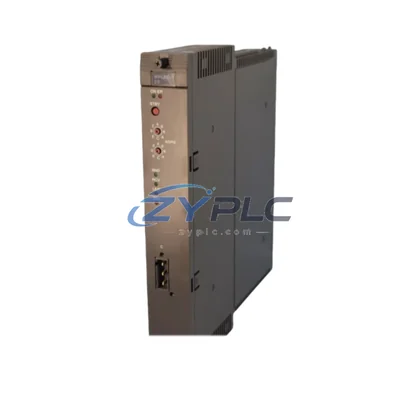
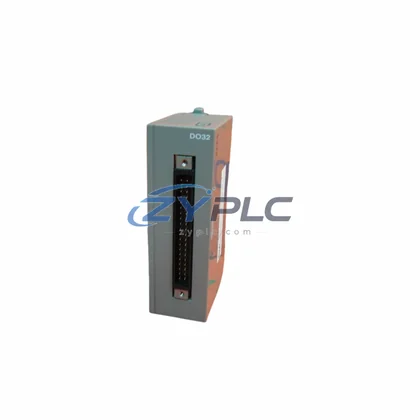
Allen-Bradley 1771-OBN/B Industrial Network Interface for PLC-5 Systems: Precision Data Links for Smart Factory Connectivity
The Allen-Bradley 1771-OBN/B is a discrete digital output module purpose-built for the PLC-5 programmable controller platform — one of Rockwell Automation’s most enduring and widely deployed control architectures across heavy industry, process manufacturing, utilities, and critical infrastructure. Designed to slot directly into the 1771 I/O chassis, this module delivers reliable, high-density digital output capability that forms the backbone of field-level command and control, translating PLC logic decisions into real-world actuator responses across conveyors, valve banks, motor starters, solenoids, and safety interlocks.
In modern smart factory environments, the 1771-OBN/B does not operate in isolation. It sits at the intersection of a layered industrial communication architecture: field signals flow upward through the 1771 backplane into the PLC-5 processor, where ladder logic executes control decisions and passes data upstream via Data Highway Plus (DH+) or Remote I/O (RIO) networks to supervisory systems. This bidirectional data flow — from sensor and actuator at the field level, through the PLC-5 controller, across the plant network, and into SCADA and HMI platforms — is precisely where the 1771-OBN/B plays its critical role. Every output state change is logged, timestamped, and made available for real-time monitoring, alarm management, and historical trending.
Compatibility & Integration Notes
| Parameter |
Specification |
| Module Type |
Discrete Digital Output Module |
| SKU |
1771-OBN/B |
| Compatible Platform |
Allen-Bradley PLC-5 / 1771 I/O Chassis |
| Communication Protocol |
Remote I/O (RIO), Data Highway Plus (DH+) |
| Interface Type |
1771 Backplane I/O Slot |
| Output Type |
Solid-State Discrete Output |
| Network Compatibility |
ControlNet, DH+, RIO, EtherNet/IP (via gateway) |
| Gateway Support |
1756-DHRIO, 1761-NET-AIC, Third-Party Protocol Converters |
| SCADA / HMI Integration |
FactoryTalk View SE, RSView32, Wonderware, Ignition |
| System Application |
Discrete Control, Process Automation, Safety Interlock, Smart Factory |
| Series |
Allen-Bradley 1771 I/O Series |
| Origin |
United States |
| Warranty |
Warranty and support terms confirmed before quote — Tested Before Shipping |
| Availability |
Confirmed via RFQ before quotation |
Connected Automation Data Flow
Understanding the 1771-OBN/B requires understanding the full data chain it participates in. At the field level, sensors — including proximity switches, photoelectric detectors, and pressure transmitters — feed digital status signals into companion input modules such as the 1771-IBN (DC input module) or 1771-IAD (AC input module), which reside in the same 1771 chassis. The PLC-5 processor — for example, a PLC-5/40 or PLC-5/80 variant — scans these inputs at high speed, executes the control program, and writes output commands to the 1771-OBN/B, which then drives field actuators with the appropriate signal.
This control loop is not isolated. The PLC-5 processor communicates upstream via Data Highway Plus (DH+) to operator workstations running RSView32 or FactoryTalk View SE, giving plant operators real-time visibility into output states, fault conditions, and production metrics. In larger architectures, a 1756-DHRIO communication module bridges the legacy DH+ network to a modern ControlLogix backplane, enabling the 1771-OBN/B’s output data to be aggregated alongside newer I/O systems and forwarded over EtherNet/IP to enterprise-level SCADA platforms such as Ignition by Inductive Automation or Wonderware System Platform.
For remote sites or distributed manufacturing cells, a 1761-NET-AIC protocol gateway extends DH+ connectivity across longer distances or converts to RS-232/RS-485 for integration with third-party HMI panels and remote I/O adapters. Variable frequency drives — such as the PowerFlex 700 series — connected via DeviceNet or hardwired discrete I/O also receive run/stop commands sourced from the 1771-OBN/B output states, closing the loop between high-level scheduling logic and physical motor control. Edge gateways deployed at the panel level can further capture this output data and push it to cloud-based MES or ERP systems, enabling production transparency from the field device all the way to the enterprise dashboard. The 1771-ASB adapter module, used in remote I/O drops, works in tandem with the 1771-OBN/B to extend the control reach of the PLC-5 across geographically distributed process cells without additional processor hardware.
Solving Data Isolation in Industrial Sites
One of the most persistent challenges in legacy industrial environments is data isolation — the condition where field-level control activity is invisible to plant management, maintenance teams, and remote engineers. The 1771-OBN/B, when properly integrated into a networked PLC-5 architecture, directly addresses this problem. Because the PLC-5 platform supports DH+ and Remote I/O natively, every output state managed by the 1771-OBN/B can be surfaced to any node on the DH+ network without additional hardware modification.
Protocol fragmentation is another common barrier. Many plants operate mixed environments where older Allen-Bradley RIO devices coexist with newer EtherNet/IP-based systems. By deploying a 1756-DHRIO bridge module or a third-party protocol converter, the 1771-OBN/B’s output data can be translated and forwarded across modern Ethernet infrastructure, eliminating the need for a full system replacement and protecting the capital investment in existing 1771 hardware.
Remote monitoring and diagnostics are equally critical. With the 1771-OBN/B integrated into a SCADA-connected PLC-5 system, maintenance engineers can monitor output channel health, detect field wiring faults, and respond to alarm conditions from a central control room or even a remote location — reducing mean time to repair (MTTR) and minimizing unplanned downtime. Production line transparency improves as output state data feeds into historian databases, enabling trend analysis, OEE calculation, and predictive maintenance workflows. As production demands grow, the modular 1771 chassis architecture allows additional output modules to be added without disrupting existing wiring or control logic, providing a scalable path for system expansion that aligns with Industry 4.0 digitalization strategies.
Industrial Connectivity FAQ
Q1: What communication protocols does the Allen-Bradley 1771-OBN/B support for SCADA and HMI integration?
The 1771-OBN/B communicates natively via the 1771 backplane to the PLC-5 processor, which supports Data Highway Plus (DH+) and Remote I/O (RIO) protocols. For integration with modern SCADA platforms over EtherNet/IP, a protocol bridge such as the 1756-DHRIO or a third-party gateway is required. This allows the module’s output data to be accessed by FactoryTalk View SE, Ignition, Wonderware, and other supervisory systems without replacing the existing control hardware.
Q2: How does the 1771-OBN/B perform in terms of network latency and real-time control?
The 1771-OBN/B operates within the deterministic scan cycle of the PLC-5 processor, which typically ranges from 5 to 50 milliseconds depending on program size and I/O configuration. This deterministic behavior ensures that output commands are executed within a predictable time window, making the module suitable for time-sensitive discrete control applications including conveyor sequencing, valve actuation, and safety interlock systems.
Q3: Is the 1771-OBN/B compatible with mixed-protocol industrial networks and system expansion?
Yes. While the module itself uses the 1771 backplane interface, the PLC-5 platform’s support for DH+ and RIO allows it to coexist in networks that also include ControlNet, DeviceNet, and EtherNet/IP segments. Protocol gateways and bridge modules enable data exchange between the 1771-OBN/B’s output states and devices on other network segments, supporting phased modernization strategies without full system replacement. The modular 1771 chassis design also allows straightforward capacity expansion as production requirements grow.
Q4: What quality assurance and warranty coverage is provided with the 1771-OBN/B?
Every 1771-OBN/B unit supplied by ZYPLC undergoes functional testing prior to shipment, verifying output channel operation, backplane communication integrity, and indicator LED functionality. Warranty terms are confirmed during quotation. Availability and shipment timing are confirmed by RFQ, and our technical team provides pre-sales application support and post-sales integration guidance to ensure successful deployment in your control system.