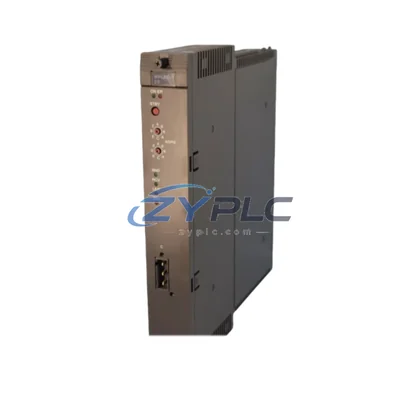
Allen-Bradley 1775-S4A Industrial Network Interface for PLC-3 Systems: Bridging Field Devices and Smart Factory Data Links
The Allen-Bradley 1775-S4A I/O Scanner Programmer Interface is a purpose-built industrial communication module designed to serve as the critical data bridge between PLC-3 series controllers and distributed field devices across the plant floor. In modern smart factory environments where real-time data visibility, protocol interoperability, and network stability are non-negotiable, the 1775-S4A delivers a robust and proven connectivity solution that integrates seamlessly into both legacy and contemporary automation architectures.
As industrial sites evolve toward fully connected production ecosystems, the demand for reliable I/O scanning and programmer interface modules has never been greater. The 1775-S4A addresses this need by enabling the Allen-Bradley PLC-3 platform to communicate efficiently with remote I/O racks, field instrumentation, and upstream supervisory systems — forming the backbone of a transparent, data-driven production environment.
Compatibility & Integration Notes
| Parameter |
Specification |
| SKU / Part Number |
1775-S4A |
| Brand / Manufacturer |
Allen-Bradley (Rockwell Automation) |
| Product Series |
PLC-3 Series |
| Module Type |
I/O Scanner & Programmer Interface |
| Communication Protocol |
Data Highway Plus (DH+), Remote I/O (RIO) |
| Interface Type |
Backplane / Programmer Port |
| Network Compatibility |
Allen-Bradley DH+ Network, Remote I/O Link |
| System Application |
PLC-3 Controller I/O Scanning, Programmer Communication, SCADA Integration |
| Transmission Capability |
Cyclic I/O data exchange, explicit messaging |
| HMI / SCADA Compatibility |
RSView, FactoryTalk View, WonderWare, Ignition SCADA |
| Origin |
USA |
| Warranty |
Warranty and support terms confirmed before quote |
| Availability |
Confirmed via RFQ before quotation |
Connected Automation Data Flow
In a typical smart factory deployment, the 1775-S4A sits at the heart of the PLC-3 chassis, orchestrating the continuous flow of process data between field-level devices and the control layer. Signal acquisition begins at the sensor and actuator level — pressure transmitters, flow meters, proximity switches, and temperature sensors — all feeding real-time process values into remote I/O racks connected via the Allen-Bradley Remote I/O (RIO) link. The 1775-S4A scans these distributed I/O nodes cyclically, ensuring that the PLC-3 processor always operates on current field data without latency gaps that could compromise process integrity.
Upstream from the PLC-3, the DH+ network carries both I/O scan data and programmer communications to connected workstations running RSLogix 3 or legacy programming terminals. This dual-role capability — simultaneous I/O scanning and programmer interfacing — makes the 1775-S4A uniquely efficient in environments where engineering access and live production control must coexist on the same network segment.
The data flow extends further into the supervisory layer, where FactoryTalk View SE HMI stations and Ignition SCADA gateways poll the PLC-3 for real-time production KPIs, alarm states, and equipment status. In multi-controller architectures, the 1775-S4A-equipped PLC-3 nodes peer with Allen-Bradley PLC-5 systems and SLC 500 controllers over the shared DH+ backbone, enabling cross-platform data exchange without the need for additional protocol converters.
For sites requiring Ethernet connectivity to modern MES or ERP platforms, an Allen-Bradley 1761-NET-DNI or 1784-PKTX communication card can bridge the DH+ segment to an Ethernet/IP network, extending the reach of the 1775-S4A’s data into cloud-ready industrial IoT architectures. Variable frequency drives such as the PowerFlex 700 series, connected via Remote I/O adapters, also benefit from the 1775-S4A’s scanning capability, delivering drive status, speed references, and fault codes directly into the PLC-3 data table for centralized monitoring and control.
Edge gateways deployed at the plant network boundary can aggregate data from the DH+ segment — including values scanned by the 1775-S4A — and forward structured payloads to cloud analytics platforms, enabling predictive maintenance models and OEE dashboards that draw on decades of proven Allen-Bradley field data.
Solving Data Isolation in Industrial Sites
One of the most persistent challenges in brownfield industrial environments is the fragmentation of control data across incompatible protocols and isolated network segments. Plants running legacy PLC-3 systems alongside newer Logix-based controllers often face a situation where critical process data is trapped within the older platform, invisible to modern SCADA dashboards and MES reporting tools. The 1775-S4A directly addresses this by maintaining a stable, high-integrity DH+ communication link that serves as the data extraction point for supervisory systems.
Protocol inconsistency is another common pain point. Field devices speaking Remote I/O, programmer terminals using DH+ messaging, and SCADA systems expecting structured data packets all need to coexist without data loss or timing conflicts. The 1775-S4A’s dual-function design — handling both I/O scanning and programmer port communication simultaneously — eliminates the need for separate interface modules, reducing hardware complexity and potential failure points.
Remote monitoring and diagnostics are increasingly essential as maintenance teams are asked to cover larger plant footprints with fewer personnel. With the 1775-S4A providing a stable programmer interface, remote access tools can connect to the PLC-3 over the DH+ network for live program monitoring, online edits, and fault diagnostics — without requiring a technician to be physically present at the controller chassis. This capability directly supports predictive maintenance strategies and reduces mean time to repair (MTTR) across the facility.
Production line transparency — the ability to see real-time status across every machine and process cell — depends on reliable I/O scanning. Gaps in scan cycles, caused by unstable communication modules, translate directly into blind spots in SCADA displays and delayed alarm responses. The 1775-S4A’s proven scan reliability ensures that every I/O point in the remote rack network is updated on schedule, keeping HMI displays accurate and alarm systems responsive.
System expansion is also simplified. As production capacity grows and new remote I/O drops are added to the network, the 1775-S4A accommodates the expanded scan list without requiring controller replacement, protecting the capital investment in the existing PLC-3 infrastructure while supporting incremental modernization.
Industrial Connectivity FAQ
Q1: What communication protocols does the Allen-Bradley 1775-S4A support?
The 1775-S4A supports Allen-Bradley Data Highway Plus (DH+) for programmer and peer-to-peer communication, and the Allen-Bradley Remote I/O (RIO) protocol for cyclic I/O scanning of distributed remote I/O racks. It is fully compatible with the PLC-3 backplane architecture and integrates with DH+ network segments shared by PLC-5 and SLC 500 controllers.
Q2: How does the 1775-S4A ensure network stability and minimize communication latency?
The module performs deterministic cyclic I/O scanning, meaning each remote I/O rack is polled at a fixed, predictable interval. This eliminates the variable latency associated with event-driven communication schemes and ensures that the PLC-3 processor always operates on fresh field data. The DH+ network’s token-passing architecture further guarantees orderly, collision-free data transmission across all connected nodes.
Q3: Can the 1775-S4A integrate with modern SCADA and HMI platforms?
Yes. Via the DH+ programmer port, SCADA gateways and HMI servers — including FactoryTalk View SE, Ignition, and WonderWare — can establish communication sessions with the PLC-3 to read and write data table values in real time. For Ethernet-based SCADA architectures, a DH+ to Ethernet/IP gateway such as the 1784-PKTX or a third-party protocol converter can bridge the two network layers transparently.
Q4: What does the warranty and support terms confirmed before quote cover, and how is the module tested before shipment?
Every 1775-S4A unit supplied by ZYPLC undergoes pre-shipment functional testing to verify communication port integrity, backplane interface operation, and I/O scan capability. The warranty and support terms confirmed before quote covers hardware defects and communication failures under normal operating conditions. Our technical team provides post-sale support for installation guidance, network configuration, and fault diagnosis throughout the warranty period.