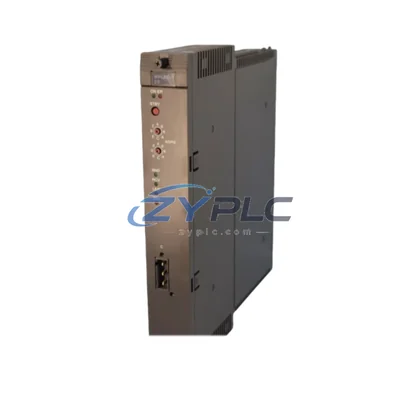
Allen-Bradley 1775-SR Industrial Data Link for Smart Factory PLC-3 Systems
The Allen-Bradley 1775-SR Scanner Communications Module is a purpose-built industrial network interface designed to serve as the backbone of data exchange within Allen-Bradley PLC-3 control architectures. In modern smart factory environments where real-time data visibility, protocol interoperability, and network stability are non-negotiable, the 1775-SR delivers a reliable communications bridge between field-level devices and upper-layer supervisory systems. Whether deployed in automotive assembly lines, chemical processing plants, discrete manufacturing cells, or utility infrastructure, this module ensures that critical process data flows without interruption across every layer of the industrial network.
The 1775-SR functions as a scanner module within the PLC-3 platform, enabling the processor to communicate with remote I/O racks, intelligent peripherals, and distributed field devices over the Allen-Bradley Remote I/O (RIO) network. This architecture allows the PLC-3 processor to scan and exchange data with remote I/O adapters, drive controllers, and specialty modules distributed across the plant floor — eliminating data isolation and enabling centralized supervisory control from a single SCADA or HMI platform.
Compatibility & Integration Notes
| Specification |
Details |
| SKU / Part Number |
1775-SR |
| Brand |
Allen-Bradley |
| Series |
PLC-3 |
| Module Type |
Scanner Communications Module |
| Communication Protocol |
Allen-Bradley Remote I/O (RIO) |
| Interface Type |
Remote I/O Scanner |
| Network Compatibility |
Allen-Bradley PLC-3 Backplane, Remote I/O Network |
| Data Transmission |
Real-time I/O scanning, block transfer |
| System Application |
SCADA Integration, HMI Communication, Remote I/O Control, PLC-3 Processor Expansion |
| Gateway Function |
PLC-3 to Remote I/O Adapter / Field Device Communication |
| Origin |
USA |
| Warranty |
12 Months |
| Availability |
Confirmed via RFQ before quotation |
Connected Automation Data Flow
In a fully integrated smart factory deployment, the Allen-Bradley 1775-SR sits at the heart of the control network, orchestrating data flow between the PLC-3 processor and a wide range of distributed automation components. At the field level, sensors and actuators connected to Allen-Bradley 1771 Remote I/O adapter modules transmit real-time process signals — temperature, pressure, flow rate, position — back to the 1775-SR scanner over the RIO network. The scanner module continuously polls these remote racks, ensuring that the PLC-3 processor maintains an accurate, up-to-the-millisecond image of the entire plant floor.
Drive systems such as Allen-Bradley PowerFlex variable frequency drives (VFDs) can be integrated into the RIO network via dedicated communication adapters, allowing the PLC-3 to issue speed references, read drive status, and respond to fault conditions in real time. Similarly, Allen-Bradley 1771-ASB Remote I/O Adapter modules extend the reach of the control network to remote I/O racks located hundreds of meters from the main control panel, maintaining data integrity across long cable runs in large industrial facilities.
At the supervisory layer, Rockwell Automation RSView32 or FactoryTalk View SCADA platforms connect to the PLC-3 system via Allen-Bradley 1784-KT or 1784-KTXD Data Highway Plus communication cards, enabling operators to monitor process variables, acknowledge alarms, and execute control commands from centralized HMI workstations. The 1775-SR ensures that the data scanned from remote I/O is always current in the PLC-3 data table, providing SCADA with an accurate and reliable data source for trending, reporting, and alarm management.
For facilities integrating legacy PLC-3 systems with modern Ethernet-based infrastructure, Rockwell Automation 1761-NET-ENI Serial-to-Ethernet interface modules or third-party protocol gateways can bridge the RIO network to higher-level MES and ERP systems, enabling plant-wide data transparency without requiring a full control system migration. Edge computing gateways deployed at the network boundary can aggregate data from the PLC-3 system and publish it to cloud-based analytics platforms, supporting predictive maintenance and OEE optimization initiatives.
The 1775-SR also supports block transfer operations, allowing specialty modules such as Allen-Bradley 1771-IFE Analog Input modules and 1771-OFE Analog Output modules to exchange large data blocks with the PLC-3 processor efficiently. This capability is essential for closed-loop process control applications where high-resolution analog data must be processed and acted upon within tight scan cycle times.
Solving Data Isolation in Industrial Sites
One of the most persistent challenges in legacy industrial environments is data isolation — the inability to aggregate, share, and act on process data across different control systems, protocols, and network segments. The Allen-Bradley 1775-SR Scanner Communications Module directly addresses this challenge by providing a standardized, high-reliability communications interface that connects the PLC-3 processor to the broader automation network.
In facilities where multiple generations of control equipment coexist, the 1775-SR enables the PLC-3 to serve as a central data aggregator, collecting I/O data from remote racks and making it available to SCADA and HMI systems for real-time visualization. Operators gain full production line transparency — monitoring machine states, tracking batch progress, and responding to alarms — without needing to physically access individual control panels or rely on manual data collection.
Protocol unification is another key benefit. By standardizing communications over the Allen-Bradley RIO protocol, the 1775-SR eliminates the need for custom point-to-point wiring between individual field devices and the controller, reducing installation complexity and improving network maintainability. When production requirements change and new remote I/O racks or intelligent devices need to be added to the network, the 1775-SR’s scanner architecture supports straightforward system expansion without disrupting existing network segments.
Remote diagnostics capabilities are equally important in minimizing unplanned downtime. Through SCADA integration, maintenance engineers can remotely monitor the health of the RIO network, identify communication faults, and diagnose module-level issues without dispatching technicians to the field. This remote visibility reduces mean time to repair (MTTR) and supports proactive maintenance strategies that keep production running at peak efficiency.
Every Allen-Bradley 1775-SR unit supplied by ZYPLC undergoes pre-shipment functional testing to verify communication integrity and module performance before dispatch. Warranty terms are confirmed during quotation.
Industrial Connectivity FAQ
Q1: What communication protocol does the Allen-Bradley 1775-SR use, and is it compatible with modern Ethernet networks?
The 1775-SR operates on the Allen-Bradley Remote I/O (RIO) protocol, which is a deterministic, token-passing network designed for real-time I/O scanning in PLC-3 systems. While RIO is not natively Ethernet-based, protocol gateways and serial-to-Ethernet interface modules can bridge the RIO network to modern Ethernet infrastructure, enabling integration with contemporary SCADA, MES, and ERP platforms without replacing the existing PLC-3 control system.
Q2: How does the 1775-SR handle network stability and communication latency in high-speed production environments?
The 1775-SR is engineered for deterministic, low-latency I/O scanning, making it well-suited for high-speed production environments where consistent scan cycle times are critical. The RIO network’s token-passing architecture ensures predictable data delivery, minimizing jitter and communication delays. Proper network configuration — including correct baud rate selection, cable termination, and rack addressing — is essential to maintaining optimal network stability across all connected remote I/O nodes.
Q3: Can the 1775-SR be expanded to support additional remote I/O racks as production requirements grow?
Yes. The 1775-SR scanner supports multiple remote I/O racks distributed across the RIO network, and additional racks can be added to the network as production capacity expands. Each rack is assigned a unique rack address, and the scanner module’s configuration is updated to include the new rack in its scan list. This modular expansion capability allows facilities to scale their control systems incrementally without requiring a complete network redesign.
Q4: What pre-shipment testing and warranty coverage does ZYPLC provide for the Allen-Bradley 1775-SR?
All Allen-Bradley 1775-SR modules supplied by ZYPLC undergo comprehensive pre-shipment functional testing, including communication interface verification and module self-diagnostics, to ensure full operational integrity upon delivery. Each unit is Warranty terms are confirmed during quotation. Our technical support team is available to assist with installation guidance, network configuration, and troubleshooting throughout the warranty period.