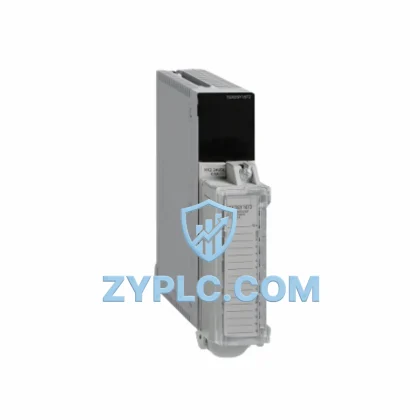
Allen-Bradley 1794-OA16 System-Ready Digital Output for FLEX I/O Architecture
The Allen-Bradley 1794-OA16 is a 16-point 120VAC digital output module engineered for deployment within the Rockwell Automation FLEX I/O platform. Rather than functioning as a standalone component, the 1794-OA16 occupies a critical position in the distributed I/O layer of a layered automation architecture — bridging the control layer decisions made by a ControlLogix or CompactLogix CPU with the physical execution layer where actuators, solenoids, motor starters, and contactors respond to process commands. Understanding its role within the full system hierarchy is essential for engineers designing scalable, maintainable, and redundancy-capable industrial control systems.
In a typical FLEX I/O deployment, the 1794-OA16 is mounted on a 1794-TB3 or 1794-TB3S terminal base, which provides both the electrical connection to field wiring and the mechanical interface to the FLEX I/O adapter. The adapter — commonly a 1794-AENT EtherNet/IP adapter or a 1794-ADN DeviceNet adapter — serves as the communication gateway between the I/O modules and the control network. This architecture allows the 1794-OA16 to be located remotely from the main control panel, reducing wiring costs and improving signal integrity across large plant floor installations.
Architecture Specification Table
| Parameter |
Specification |
| System Role |
Distributed Digital Output — FLEX I/O Execution Layer |
| SKU / Catalog Number |
1794-OA16 |
| Brand / Series |
Allen-Bradley / FLEX I/O 1794 Series |
| Output Points |
16 Points (AC Output) |
| Output Voltage |
74–132VAC (Nominal 120VAC) |
| Output Current per Point |
0.5A continuous per output |
| Total Module Current |
4A maximum (all outputs energized) |
| Communication Interface |
Via FLEX I/O Adapter (EtherNet/IP, DeviceNet, ControlNet, RIO) |
| Backplane Current Draw |
75mA @ 5VDC |
| Operating Temperature |
0°C to 55°C (32°F to 131°F) |
| Storage Temperature |
-40°C to 85°C |
| Mounting |
1794-TB3 / 1794-TB3S Terminal Base |
| Isolation |
Group isolated, 250VAC continuous |
| Enclosure Rating |
Open type — requires enclosure (IP20 equivalent) |
| Certifications |
UL, CE, CSA |
| Warranty |
12-Month Warranty — Tested, verified, and ready to ship |
Coordinated Control System Design
The 1794-OA16 achieves its full value when integrated within a coordinated FLEX I/O system architecture. At the control layer, a 1756-L85E ControlLogix CPU or a 1769-L33ER CompactLogix controller executes the ladder logic or function block programs that generate the discrete output commands delivered to the 1794-OA16. These commands travel across the EtherNet/IP network through a 1794-AENT EtherNet/IP adapter, which manages the I/O connection and ensures deterministic data exchange between the controller and the output module.
Power to the FLEX I/O system is supplied through a dedicated 1794-PS13 power supply, which conditions 24VDC backplane power for the adapter and all connected I/O modules. For installations requiring higher channel density, the 1794-OA16 can be combined with a 1794-IA16 digital input module and a 1794-IE8 analog input module on the same adapter, creating a compact mixed I/O node that handles both discrete and analog signals within a single remote drop.
In systems where network redundancy is a design requirement, the 1794-AENTR EtherNet/IP dual-port adapter replaces the standard AENT, enabling Device Level Ring (DLR) topology. This eliminates single points of network failure and ensures that the 1794-OA16 continues to receive output commands even if one segment of the ring is interrupted. For applications requiring output verification, the 1794-OA16 can be paired with a 1794-OW8 relay output module on a parallel circuit, providing both solid-state speed and relay-level isolation for critical actuator circuits.
At the human-machine interface layer, a 2711P-T10C21D8S PanelView Plus 7 terminal provides operators with real-time visibility into output states, alarm conditions, and system diagnostics. The HMI communicates with the ControlLogix controller over EtherNet/IP, displaying the status of each 1794-OA16 output channel and enabling manual override during commissioning or maintenance windows. This integration between the HMI, controller, and distributed I/O layer is fundamental to achieving the system consistency and operational transparency required in modern industrial automation.
Application in Layered Automation Systems
The 1794-OA16 is deployed across a wide range of industrial sectors where 120VAC discrete output control is required at distributed field locations. In water and wastewater treatment facilities, the module controls pump motor starters, valve actuators, and chemical dosing solenoids distributed across multiple lift stations — each connected to a central ControlLogix system via EtherNet/IP. The ability to mount FLEX I/O nodes close to field equipment eliminates long AC wiring runs and reduces voltage drop across large plant sites.
In power generation and electrical substation automation, the 1794-OA16 drives relay coils, breaker trip circuits, and annunciator panels within switchgear control systems. Its group isolation architecture ensures that a fault on one output group does not propagate to adjacent circuits, maintaining system integrity during fault conditions. The module’s 250VAC continuous isolation rating makes it suitable for applications where field wiring may be exposed to transient overvoltages from inductive loads.
In food and beverage packaging lines, the 1794-OA16 controls conveyor drive contactors, reject gate solenoids, and filling station actuators in high-cycle-rate environments. Its solid-state triac output design eliminates the mechanical wear associated with relay outputs, extending service life in applications where output switching frequency is high. For petrochemical and refinery process control systems, the module is integrated into distributed control architectures where FLEX I/O nodes are installed in field junction boxes, reducing the volume of intrinsically safe wiring required between the control room and the process area.
In mining and mineral processing applications, the 1794-OA16 is used to control crusher motor starters, conveyor belt drives, and dust suppression systems across geographically dispersed process areas. The module’s wide operating temperature range and robust terminal base design ensure reliable operation in environments subject to vibration, dust, and temperature cycling. Long-term inventory availability and the included 12-Month Warranty make the 1794-OA16 a preferred choice for maintenance engineers managing multi-year plant lifecycle programs.
Architecture Engineering FAQ
Q1: Which FLEX I/O adapters are compatible with the 1794-OA16, and how does adapter selection affect system architecture?
The 1794-OA16 is compatible with all standard FLEX I/O adapters, including the 1794-AENT (EtherNet/IP), 1794-ADN (DeviceNet), 1794-ACN15 (ControlNet), and 1794-ASB (Remote I/O). Adapter selection determines the communication protocol used between the I/O node and the controller, which in turn affects network topology, scan time, and redundancy options. For new installations, the 1794-AENT or 1794-AENTR is recommended to leverage EtherNet/IP’s standard infrastructure, high bandwidth, and DLR redundancy capability. Each adapter supports up to 8 FLEX I/O modules per node, allowing the 1794-OA16 to be combined with input, analog, and specialty modules within a single remote drop.
Q2: Can the 1794-OA16 be used in a redundant control system, and what architecture changes are required?
Yes. In a ControlLogix redundancy system using a 1756-SRM redundancy module, the 1794-OA16 can be connected via a 1794-AENTR dual-port adapter configured in DLR topology. The redundant controller pair maintains synchronized output data, and in the event of a primary controller fault, the secondary controller assumes control without interrupting output states. For applications requiring output-level redundancy, two 1794-OA16 modules can be wired in parallel through external relay logic, ensuring that a single module failure does not result in loss of field output. This architecture is commonly used in safety-critical applications where output availability is a design requirement.
Q3: What is covered under the 12-Month Warranty, and how does it support long-term maintenance planning?
The 12-Month Warranty covers the 1794-OA16 against defects in materials and workmanship from the date of shipment. Each unit is tested prior to dispatch to verify output switching function, backplane communication, and electrical isolation integrity. For maintenance engineers managing plant-wide spare parts programs, the warranty period provides a defined coverage window that aligns with annual maintenance budget cycles. Units supplied by ZYPLC are sourced from verified supply channels, inspected upon receipt, and stored under controlled conditions to preserve long-term reliability. Replacement support and technical consultation are available throughout the warranty period via the contact information below.
© 2026 ZYPLC. All rights reserved.
Original Source: https://zyplc.com
Contact: +86 19859288691 | [email protected]