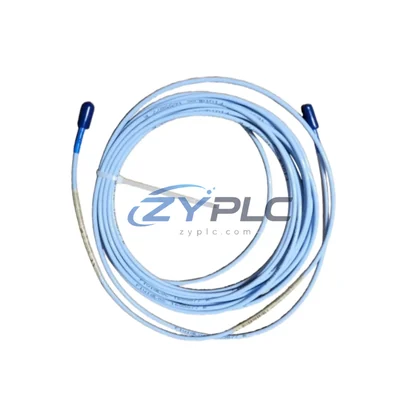
Bently Nevada 130539-17 Interconnect Cable for 3300 Series Automation
The Bently Nevada 130539-17 Interconnect Cable is a precision-engineered signal transmission component designed for the 3300 Series vibration monitoring platform. In industrial environments where unplanned downtime translates directly into unplanned downtime and production loss, this cable plays a foundational role in maintaining continuous, low-noise signal integrity between proximity probes and the 3300 Series monitor modules. By ensuring clean, uninterrupted data flow from rotating machinery to the control system, the 130539-17 enables plant engineers to act on real-time vibration data rather than reacting to catastrophic failures — a shift that directly reduces operating load per unit of output.
Modern manufacturing facilities are under increasing pressure to demonstrate measurable energy efficiency gains. The 130539-17 supports this goal not by being a power-consuming device itself, but by being the critical link that makes maintenance-focused automation possible. When vibration data is corrupted by cable degradation, signal noise, or impedance mismatch, the entire monitoring loop loses accuracy — leading to false alarms, unnecessary shutdowns, or worse, missed fault conditions that allow motors and rotating equipment to operate in degraded states that consume far more energy than necessary. A properly specified and tested 130539-17 eliminates this risk.
Product Specification Table
| Parameter |
Specification / Value |
| SKU / Part Number |
130539-17 |
| Compatible Platform |
Bently Nevada 3300 Series Vibration Monitoring System |
| Cable Function |
Proximity Probe Interconnect Signal Transmission |
| Signal Type |
Low-voltage analog (proximity probe output) |
| Application Environment |
Industrial rotating machinery, turbines, compressors, pumps |
| Maintenance Planning Role |
Enables accurate vibration data for predictive maintenance and motor efficiency control |
| Operational Efficiency Impact |
Reduces false trips, supports continuous uptime, lowers per-unit energy cost |
| Compatible Monitor Modules |
3300/16 Series, 3300/20 Series, 3300 XY Series |
| Origin |
United States |
| Warranty |
warranty terms confirmed during quotation |
| Stock Status |
RFQ Available — Tested & shipment arranged after confirmation |
System Compatibility and Application
The 130539-17 Interconnect Cable operates as part of a tightly integrated condition monitoring and maintenance planning architecture. In a typical turbine or compressor train, the signal chain begins at the Bently Nevada 3300/50 Proximitor Sensor, which converts shaft displacement into a voltage signal. This signal travels through the 130539-17 cable to the Bently Nevada 3300/16 Dual Vibration Monitor, where it is processed and compared against alarm setpoints. The monitor communicates trip and alert states to the plant’s DCS (Distributed Control System) — often a Honeywell Experion PKS or Emerson DeltaV — which in turn adjusts load distribution or initiates controlled shutdowns to prevent energy-wasting runaway conditions.
On the drive side, variable speed control of the monitored equipment is typically handled by a Rockwell Automation PowerFlex 755 Variable Frequency Drive or an equivalent unit. When vibration data from the 3300 Series system indicates resonance or imbalance, the VFD can be commanded to adjust motor speed, reducing mechanical stress and the associated energy penalty of operating at inefficient load points. The 130539-17 is the cable that makes this feedback loop reliable.
For facilities running Modbus RTU or FOUNDATION Fieldbus communication backbones, the 3300 Series monitors interface with I/O modules such as the Bently Nevada 3500/92 Communication Gateway, which aggregates vibration, position, and speed data and forwards it to the plant historian or SCADA layer. Maintenance planning dashboards built on platforms like OSIsoft PI System or Wonderware InTouch consume this data to calculate OEE (Overall Equipment Effectiveness) and specific operating load per production cycle. Without a reliable interconnect cable like the 130539-17, the data quality feeding these systems degrades — and so does the accuracy of every maintenance planning decision downstream.
In multi-machine installations, the 130539-17 is often deployed alongside Bently Nevada 3300 Series Extension Cables and 3300/55 Proximitor Sensors to extend monitoring reach across large machinery trains. Power supply to the monitoring rack is typically provided by a Bently Nevada 3300/05 Power Supply Module, ensuring stable, regulated voltage that protects signal integrity across all interconnect paths. Each of these components depends on the 130539-17 to maintain the signal chain that drives energy-efficient operation.
Maintenance and Replacement Notes
In a petrochemical plant running continuous compressor trains, unplanned vibration-related shutdowns can cost tens of thousands of dollars per hour in lost production and unplanned downtime — including the energy consumed during restart sequences, purge cycles, and re-pressurization. The Bently Nevada 130539-17 Interconnect Cable directly reduces the frequency of these events by ensuring that the 3300 Series monitoring system receives clean, accurate signals at all times.
Consider a scenario where a degraded interconnect cable introduces noise into the proximity probe signal. The 3300 Series monitor may interpret this noise as a vibration spike and trigger a false trip. The compressor shuts down, the VFD ramps down, cooling systems activate, and the restart sequence begins — consuming significant energy and disrupting production line rhythm. A properly specified 130539-17, tested before installation and backed by a warranty terms confirmed during quotation, eliminates this failure mode entirely.
Beyond false trip prevention, the 130539-17 supports predictive maintenance workflows that are central to modern maintenance planning strategies. When vibration trend data is reliable, maintenance teams can schedule bearing replacements, alignment corrections, and balance jobs during planned downtime windows — rather than responding to emergency failures. This shift from reactive to predictive maintenance reduces average operating load per production cycle by keeping equipment operating within its optimal efficiency band. Motors running with worn bearings or misaligned shafts consume measurably more energy; the 130539-17 is part of the system that detects and corrects these conditions before they escalate.
For production lines with tight cycle time requirements, the ability to maintain continuous monitoring without nuisance trips directly improves line throughput. Higher throughput at the same energy input means lower specific operating load — a key metric for ISO 50001 maintenance planning compliance. The 130539-17, as a tested and warranted OEM-compatible component, supports audit-ready documentation of the monitoring infrastructure.
Product Sourcing FAQ
Q1: How does the Bently Nevada 130539-17 contribute to operational stability in a rotating machinery application?
The 130539-17 ensures signal integrity in the vibration monitoring loop, enabling accurate detection of mechanical inefficiencies such as imbalance, misalignment, and bearing wear. By catching these conditions early, plant operators can correct them before they cause motors and driven equipment to operate in energy-wasting degraded states. Reliable monitoring data also supports VFD speed optimization, reducing operating load at partial load conditions.
Q2: Is the 130539-17 compatible with all 3300 Series monitor modules?
Yes. The 130539-17 is designed for use within the Bently Nevada 3300 Series ecosystem, including the 3300/16 Dual Vibration Monitor, 3300/20 Dual Vibration Monitor, and 3300 XY Series monitors. It is also compatible with standard 3300 Series Proximitor Sensors and extension cable configurations. For specific pin-out or length requirements, consult the 3300 Series installation documentation or contact our technical team.
Q3: What is the recommended replacement interval, and how does timely replacement affect energy efficiency?
Bently Nevada recommends inspecting interconnect cables during scheduled maintenance intervals, typically every 12–24 months depending on environmental conditions. Cable degradation — caused by heat, vibration fatigue, or chemical exposure — increases signal noise and reduces monitoring accuracy. Replacing the 130539-17 on schedule ensures the monitoring system continues to deliver the data quality needed for energy-efficient operation. Our warranty terms confirmed during quotation covers defects in materials and workmanship from the date of shipment.
Q4: What testing is performed before shipment, and how does this support reliable deployment?
Each 130539-17 unit is functionally tested prior to shipment to verify electrical continuity, insulation integrity, and connector seating. This pre-shipment testing process ensures that the cable performs to specification from day one, eliminating installation-related failures that could compromise monitoring accuracy and trigger unnecessary equipment shutdowns. Test records are available upon request for quality assurance documentation purposes.