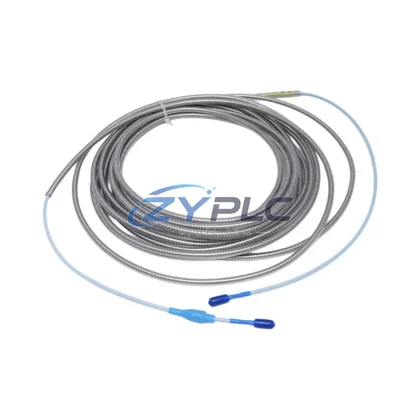
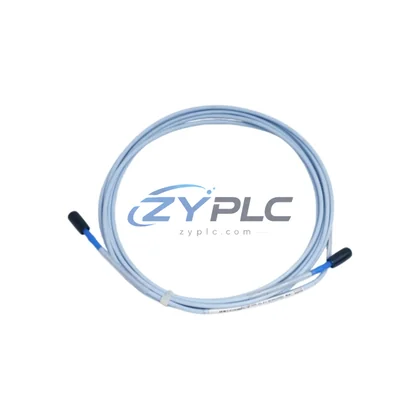
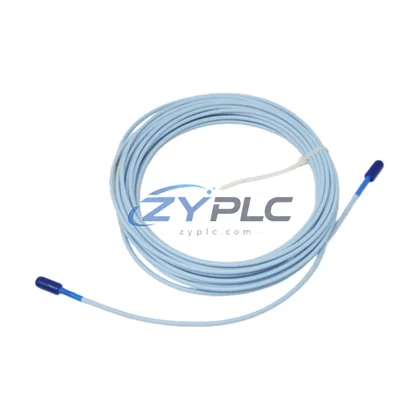
Bently Nevada 130539-30 Interconnect Cable for 3300 Series Automation
The Bently Nevada 130539-30 is a precision-engineered interconnect cable purpose-built for the Bently Nevada 3300 Series vibration monitoring system — one of the most widely deployed condition monitoring platforms in heavy industrial environments. In modern manufacturing and process plants where energy efficiency is a top operational priority, the signal integrity and low-loss transmission characteristics of the 130539-30 play a direct role in reducing unplanned downtime risk, minimizing unplanned downtime, and extending the productive life of rotating machinery.
Unlike generic cabling solutions, the 130539-30 is engineered to maintain stable, low-impedance signal paths between proximity probes and the 3300 Series monitor modules. This precision matters: degraded signal transmission forces monitoring systems to compensate with higher sensitivity thresholds, increasing false-alarm rates and triggering unnecessary shutdowns — each of which carries a measurable energy and productivity cost. By maintaining clean, consistent signal flow, the 130539-30 helps keep your vibration monitoring architecture operating at peak efficiency.
Product Specification Table
| Parameter |
Specification / Value |
| SKU / Part Number |
130539-30 |
| Compatible System |
Bently Nevada 3300 Series Vibration Monitoring |
| Cable Type |
Interconnect Cable (Proximitor / Monitor Interface) |
| Signal Transmission |
Low-loss, shielded, precision impedance-matched |
| Operating Environment |
Industrial — turbines, compressors, pumps, motors |
| Maintenance Value |
Reduces false trips; maintains accurate vibration data for maintenance-focused control |
| Application |
Rotating machinery condition monitoring, predictive maintenance |
| Compatibility |
3300/16 Monitor, 3300/20 Monitor, 3300 XY Dual Vibration Monitor |
| Warranty |
warranty terms confirmed during quotation |
| Stock Status |
RFQ Available — Tested Before Shipment |
System Compatibility and Application
The 130539-30 interconnect cable sits at the heart of a broader industrial automation system. In a typical high-efficiency plant configuration, the cable connects Bently Nevada 3300/50 Proximitor Sensors to the 3300/16 Dual Vibration Monitor or 3300/20 Dual Vibration Monitor, feeding real-time shaft displacement data into the monitoring rack. This data is then processed by the Bently Nevada 3500 Series Rack — a more advanced platform often used alongside 3300 Series components in hybrid monitoring setups — enabling plant engineers to correlate vibration signatures with operating load trends.
On the control side, the vibration data captured through the 130539-30 cable chain is frequently integrated with Allen-Bradley ControlLogix PLCs or Siemens S7-300/S7-400 PLCs via 4–20 mA analog output or Modbus RTU communication. This integration allows the PLC to modulate the speed of connected drive systems — such as ABB ACS880 variable frequency drives or Siemens SINAMICS G120 drives — in response to real-time vibration and load conditions. The result is a closed-loop maintenance planning system: when vibration levels indicate that a motor is running under light load, the VFD reduces speed and power draw accordingly, cutting unplanned downtime without sacrificing process throughput.
For facilities using Rockwell Automation PowerMonitor 5000 or Schneider Electric PowerLogic ION7650 power quality meters, the vibration data from the 3300 Series system — transmitted via the 130539-30 cable — can be correlated with real-time power consumption data. This correlation enables energy managers to identify which machines are consuming disproportionate power relative to their mechanical output, flagging candidates for maintenance or speed optimization before they become failure events.
In distributed I/O architectures, the 130539-30 supports integration with Bently Nevada 3300/55 I/O Module configurations, allowing vibration signals to be routed to SCADA systems or GE iFIX / Wonderware InTouch HMI platforms for operator visualization. This visibility is essential for energy-conscious operations teams who need to act on vibration anomalies before they escalate into energy-intensive emergency repairs.
Maintenance and Replacement Notes
In real production environments — petrochemical plants, power generation facilities, steel mills, and large-scale HVAC systems — the cost of a single unplanned shutdown of a critical rotating machine can run into tens of thousands of dollars in lost production, emergency labor, and wasted energy from restart cycles. The Bently Nevada 130539-30 interconnect cable directly reduces this risk by ensuring that the vibration monitoring system receives clean, uninterrupted signals at all times.
When the 130539-30 is properly installed and maintained, the 3300 Series monitor can detect early-stage bearing wear, rotor imbalance, and misalignment — conditions that, if left unaddressed, cause motors and compressors to draw significantly more current than their rated load. A motor running with a worn bearing may consume 8–15% more energy than a healthy unit at the same load point. By enabling early detection through reliable signal transmission, the 130539-30 helps maintenance teams intervene before unplanned downtime becomes structural.
Production line rhythm (takt time) is also directly affected by vibration monitoring quality. In automated assembly lines where conveyor motors, servo axes, and pump stations are monitored by the 3300 Series system, a false trip caused by a degraded interconnect cable can halt an entire line segment. Each halt disrupts the production takt, forces downstream buffers to absorb the shock, and often requires a full restart sequence — consuming a surge of energy in the process. The 130539-30, by maintaining signal fidelity, keeps false trips to a minimum and production rhythm stable.
All units supplied by ZYPLC are tested prior to shipment using calibrated signal injection equipment to verify impedance, shielding continuity, and connector integrity. This pre-shipment testing protocol ensures that every 130539-30 cable arrives ready for immediate installation without the need for on-site verification loops that delay commissioning and consume engineering time.
Product Sourcing FAQ
Q1: How does the 130539-30 contribute to operational stability in a rotating machinery application?
By maintaining accurate, low-noise vibration signal transmission to the 3300 Series monitor, the 130539-30 enables precise detection of mechanical inefficiencies — such as bearing wear or rotor imbalance — that cause motors to draw abnormal load. Early detection allows corrective maintenance before unplanned downtime compounds, and reduces the frequency of energy-intensive emergency shutdowns and restarts.
Q2: Is the 130539-30 compatible with both the 3300/16 and 3300/20 monitor modules?
Yes. The 130539-30 is designed for use within the Bently Nevada 3300 Series ecosystem and is compatible with the 3300/16 Dual Vibration Monitor, 3300/20 Dual Vibration Monitor, and related 3300 Series rack configurations. For hybrid installations involving 3500 Series racks, please confirm the specific interface module before ordering.
Q3: What is the recommended replacement interval, and how does timely replacement reduce energy costs?
Bently Nevada recommends inspecting interconnect cables during scheduled maintenance windows, typically every 12–24 months in high-vibration environments. A degraded cable increases signal noise, which can mask real vibration events or trigger false alarms — both of which carry energy and productivity costs. Proactive replacement with a tested 130539-30 unit is significantly more cost-effective than reactive replacement after a monitoring failure.
Q4: What warranty and testing does ZYPLC provide with the 130539-30?
Every 130539-30 supplied by ZYPLC comes with a warranty terms confirmed during quotation covering defects in materials and workmanship. Prior to shipment, each unit undergoes functional testing to verify signal integrity and connector condition. export shipping options available is available from RFQ-confirmed sourcing, minimizing plant downtime during cable replacement or new system commissioning.