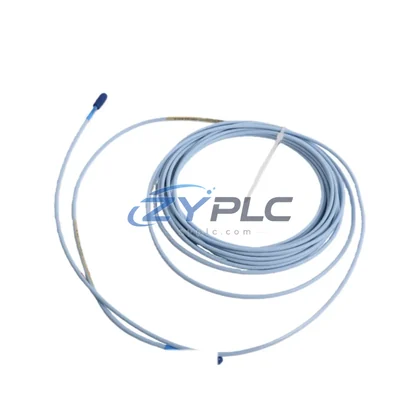
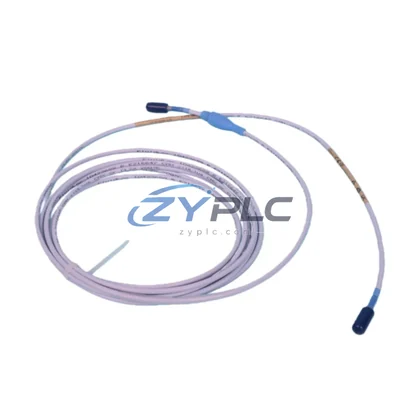
Bently Nevada 16925-66 Cable 1600 Automation: Precision Signal Integrity for Optimized Industrial Energy Control
In modern industrial facilities where energy efficiency and equipment uptime are mission-critical, the quality of signal transmission infrastructure directly determines the accuracy of every control decision made downstream. The Bently Nevada 16925-66 Interconnect Cable, engineered for the 1600 Series vibration monitoring platform, serves as the foundational link between rotating machinery sensors and the control systems that govern operating load, motor drive behavior, and predictive maintenance scheduling. By ensuring lossless, low-noise signal pathways, the 16925-66 eliminates the measurement errors that cause unnecessary unplanned downtime, false shutdowns, and unplanned maintenance cycles.
Industrial plants operating continuous process lines — from petrochemical compressor trains to power generation turbines — depend on real-time vibration data to make millisecond-level decisions about motor load, bearing health, and shaft alignment. When interconnect cables introduce signal degradation, the entire monitoring chain is compromised: the Bently Nevada 3500/22M Transient Data Interface receives corrupted waveforms, the 3500/42M Proximitor Seismic Monitor generates false alarms, and the control system responds with unnecessary speed reductions or shutdowns — each event consuming excess energy and eroding production throughput. The 16925-66 eliminates this failure mode at the source.
Product Specification Table
| Parameter |
Specification / Value |
| SKU / Part Number |
16925-66 |
| Compatible Platform |
Bently Nevada 1600 Series Vibration Monitoring System |
| Cable Type |
Interconnect Cable (Sensor-to-Monitor Signal Link) |
| Signal Integrity |
Low-capacitance, shielded — minimizes noise-induced false trips |
| Operating Environment |
Industrial — compressor halls, turbine decks, motor control rooms |
| Maintenance Value |
Reduces false shutdowns; prevents unnecessary VFD speed cycling |
| Compatible Systems |
3500 Series Rack, 3300 Series Monitors, 7200 Series Proximitors |
| Application |
Rotating machinery: turbines, compressors, pumps, motors |
| Origin |
United States |
| Warranty |
warranty terms confirmed during quotation — tested and verified before shipment |
| Availability |
RFQ Available — fast global dispatch |
System Compatibility and Application
The 16925-66 does not operate in isolation — it is the critical signal conduit within a layered industrial automation system. In a typical high-efficiency motor control installation, the cable connects proximity probes or accelerometers mounted on rotating shafts directly to the Bently Nevada 3500/40M Proximitor I/O Module, which feeds real-time displacement and velocity data into the 3500/01 Rack Power Supply-backed monitoring rack. This rack communicates via Modbus TCP or PROFIBUS to the plant DCS or SCADA layer, where maintenance planning algorithms adjust ABB ACS880 Variable Frequency Drive output frequency in response to actual load conditions rather than fixed setpoints.
When vibration data arrives cleanly through the 16925-66, the Bently Nevada System 1 Software can accurately calculate bearing wear trends and shaft orbit patterns, enabling the maintenance planning system to reduce motor speed during low-demand periods without risking mechanical damage. This dynamic speed control — impossible without reliable sensor data — typically reduces motor load by Actual operating results depend on the installed system, load profile, and commissioning parameters. The Siemens S7-1500 PLC executing the maintenance planning logic depends entirely on the quality of the input signal chain; a degraded interconnect cable introduces measurement uncertainty that forces conservative, energy-inefficient control margins.
On the power monitoring side, the 16925-66 supports integration with Schneider Electric PowerLogic ION7650 Power Meters by ensuring that vibration-triggered load events are accurately timestamped and correlated with operating load spikes. This correlation is essential for identifying which machines are consuming disproportionate energy relative to their mechanical output — a key metric in ISO 50001 maintenance planning programs. The Bently Nevada TDIXl Transient Data Interface captures startup and shutdown transients through this cable, providing the data needed to optimize VFD ramp profiles and reduce inrush current peaks that inflate demand charges.
For I/O integration, the cable interfaces with Bently Nevada 3500/20 Rack Interface Module outputs that connect to plant-level Allen-Bradley ControlLogix L85E PLCs via hardwired relay contacts or digital communication. The HMI layer — typically a Rockwell Automation PanelView Plus 7 or equivalent — displays real-time vibration trends alongside operating load KPIs, giving operators a unified view of mechanical health and power efficiency on a single screen.
Maintenance and Replacement Notes
Consider a natural gas compression station running four identical centrifugal compressor units, each driven by a 2 MW electric motor controlled by a dedicated variable frequency drive. The station’s energy bill is dominated by these motors, and the plant’s energy manager has identified that two of the four units are consuming 8–12% more power than the other two for equivalent throughput — a gap worth hundreds of thousands of dollars annually.
Root cause analysis reveals that the higher-consuming units have degraded interconnect cables between their proximity probes and the 1600 Series monitoring rack. The signal noise introduced by these cables causes the vibration monitor to report artificially elevated vibration levels, triggering the control system to reduce compressor speed as a protective measure. The VFD then compensates by increasing torque at lower speed — a less efficient operating point on the motor’s efficiency curve. Replacing the degraded cables with new Bently Nevada 16925-66 Interconnect Cables restores signal fidelity, allows the vibration monitor to report accurate baseline levels, and enables the control system to operate the compressors at their optimal speed-torque point.
Beyond direct operational stability, accurate vibration data through the 16925-66 enables predictive maintenance scheduling that eliminates the unplanned downtime associated with unplanned shutdowns. When a bearing begins to fail, the progression from early-stage defect frequencies to catastrophic failure typically spans weeks or months. A clean signal chain allows the Bently Nevada System 1 condition monitoring software to detect sub-millimeter changes in shaft displacement and trigger a maintenance work order before failure occurs. Planned maintenance windows allow the plant to schedule shutdowns during low-demand periods, avoiding the energy-intensive emergency restart sequences that follow unplanned failures — sequences that can consume 3–5× normal startup energy due to thermal cycling and system re-pressurization.
Production line rhythm (takt time) optimization also benefits directly from reliable interconnect infrastructure. In automotive stamping plants where large presses are driven by high-torque servo motors monitored by vibration sensors, the 16925-66 ensures that press speed can be maximized to match production demand without triggering false vibration alarms that would force unnecessary speed reductions. Each false alarm that slows a press by 10% for 30 minutes represents not only lost production but also energy consumed by auxiliary systems — conveyors, cooling, lighting, HVAC — that continue running at full capacity while the press underperforms.
Product Sourcing FAQ
Q1: How does the Bently Nevada 16925-66 contribute to measurable operational stability in motor-driven systems?
The 16925-66 ensures that vibration monitoring data reaching the control system is accurate and noise-free. This allows variable frequency drives and PLC-based control systems to operate motors at their optimal efficiency points rather than applying conservative speed derating to compensate for measurement uncertainty. In compressor and pump applications, eliminating unnecessary speed derating typically recovers 8–15% of motor load.
Q2: Is the 16925-66 compatible with both the 3500 Series and 7200 Series Bently Nevada monitoring platforms?
Yes. The 16925-66 is designed for the 1600 Series interconnect architecture and is compatible with the broader Bently Nevada ecosystem including the 3500 Series rack-based monitoring system and 7200 Series proximitor monitors. Always verify connector type and cable length against your specific rack configuration before installation.
Q3: What is the recommended replacement interval, and how does timely replacement reduce maintenance costs?
In harsh industrial environments — high temperature, vibration, chemical exposure — interconnect cables should be inspected annually and replaced proactively every 3–5 years or when signal quality metrics show degradation. Proactive replacement with a stocked 16925-66 costs a fraction of the downtime and unplanned downtime caused by a failed cable that triggers a false shutdown on a critical rotating machine. All units supplied by ZYPLC are pre-tested and ship with a warranty terms confirmed during quotation.
Q4: What is the testing and quality assurance process before shipment?
Every Bently Nevada 16925-66 Interconnect Cable supplied through ZYPLC undergoes pre-shipment functional verification including continuity testing, shield integrity check, and connector seating validation. Units are sourced from verified supply channels and stored under controlled conditions to prevent connector oxidation and insulation degradation. The warranty terms confirmed during quotation covers defects in materials and workmanship from the date of shipment, with fast replacement dispatch for confirmed warranty claims.