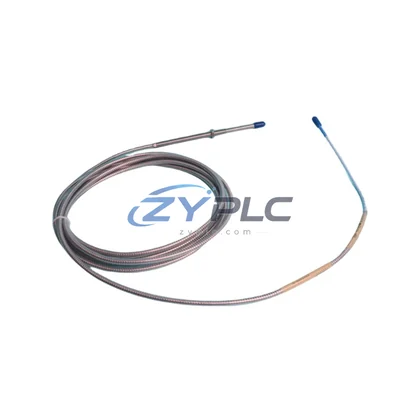
Bently Nevada 172103-01 Industrial Network Interface for Proximitor Systems: Bridging Field Sensors to Smart Factory Data Chains
The Bently Nevada 172103-01 RTD/Isolated Tip TC I/O Module is a precision-engineered signal acquisition and protocol interface module designed for the Proximitor Series condition monitoring platform. In modern industrial environments where rotating machinery health, vibration analysis, and thermal measurement must be continuously streamed to supervisory systems, the 172103-01 serves as a critical node in the plant-wide data chain — converting raw RTD and thermocouple signals into structured, network-ready data that feeds SCADA, DCS, and asset management platforms in real time.
Whether deployed in turbine monitoring skids, compressor trains, pump stations, or generator protection panels, this I/O module ensures that temperature and process signals from field-mounted sensors are accurately digitized, isolated, and transmitted upstream without signal degradation or ground loop interference. Its isolated tip thermocouple input design eliminates common-mode noise — a persistent challenge in high-voltage industrial environments — while its RTD input channels deliver four-wire measurement accuracy essential for critical asset protection.
Compatibility & Integration Notes
| Parameter |
Specification |
| SKU / Part Number |
172103-01 |
| Brand / Manufacturer |
Bently Nevada |
| Series |
Proximitor Series |
| Product Type |
RTD / Isolated Tip TC I/O Module |
| Protocol Support |
Modbus RTU, Modbus TCP/IP (via gateway), FOUNDATION Fieldbus (system-level), OPC-UA (via System 1 integration) |
| Interface Type |
RTD (4-wire), Isolated Tip Thermocouple (TC) Input |
| Communication Architecture |
Backplane bus integration within Proximitor rack; upstream Ethernet/serial gateway to DCS/SCADA |
| Network Compatibility |
Bently Nevada System 1, 3500 Series rack, DCS (DeltaV, Honeywell, ABB), SCADA (Wonderware, iFIX, Ignition) |
| System Application |
Rotating machinery protection, turbine monitoring, compressor health, pump station automation |
| Signal Isolation |
Galvanic isolation on TC inputs; eliminates ground loop interference |
| Origin |
USA |
| Warranty |
Warranty and support terms confirmed before quote |
| Shipping |
DHL / FedEx global express; full export documentation |
| Availability |
Confirmed via RFQ before quotation |
Connected Automation Data Flow
In a typical smart factory deployment, the Bently Nevada 172103-01 sits at the signal acquisition layer, receiving analog inputs from PT100 RTD sensors mounted on bearing housings and isolated tip thermocouples embedded in turbine exhaust flanges. These raw analog signals are conditioned and digitized within the Proximitor rack, where the 172103-01 module operates alongside the Bently Nevada 3500/42M Proximitor/Seismic Monitor and the 3500/22M Transient Data Interface to form a complete machinery protection system.
Once digitized, process values — bearing temperatures, differential temperatures, and thermal gradients — are passed via the rack backplane to the Bently Nevada 3500/92 Communication Gateway Module, which bridges the proprietary Proximitor bus to plant Ethernet infrastructure using Modbus TCP/IP. From there, data flows into the Bently Nevada System 1 Evolution asset management platform, where engineers configure alarm setpoints, trend historical data, and generate predictive maintenance reports without leaving the control room.
At the field level, the 172103-01 works in concert with Bently Nevada 330180 Series proximity probes and 3300 XL 8mm proximity transducers to provide a unified view of both vibration and thermal behavior on the same rotating asset. This multi-parameter approach is essential for detecting early-stage bearing failures, where rising temperature often precedes measurable vibration changes by hours or days.
For plants running hybrid automation architectures, the temperature data acquired by the 172103-01 can be forwarded via OPC-UA to Siemens S7-1500 PLC controllers or Rockwell Automation ControlLogix systems through an industrial edge gateway such as the Moxa MGate MB3480 Modbus-to-Ethernet converter. This enables the PLC layer to incorporate machinery thermal data into process interlocks — for example, triggering a controlled shutdown sequence if bearing temperature exceeds a configurable threshold while the DCS simultaneously logs the event and notifies the SCADA alarm management system.
HMI operators using Wonderware InTouch or Ignition SCADA dashboards receive live temperature readings from the 172103-01 with sub-second update rates, enabling real-time monitoring of thermal trends across multiple assets on a single screen. Remote diagnostic sessions can be initiated through the System 1 web client, allowing condition monitoring engineers to review waveform data and alarm histories from off-site locations — reducing the need for physical site visits and accelerating mean time to repair (MTTR).
Solving Data Isolation in Industrial Sites
One of the most persistent challenges in legacy industrial facilities is data isolation — where critical machinery health information exists only within proprietary monitoring systems and cannot be accessed by the broader plant automation network. The Bently Nevada 172103-01, when properly integrated into a networked Proximitor rack, directly addresses this problem by making RTD and TC measurement data available to any Modbus-capable system on the plant network.
Protocol fragmentation is another common barrier. Plants that have grown organically over decades often run a mix of FOUNDATION Fieldbus, Profibus DP, Modbus RTU, and Ethernet/IP segments that do not natively communicate with each other. By positioning the 172103-01 within a 3500 Series rack equipped with the appropriate communication gateway, operators can consolidate temperature data from the machinery protection layer into a unified data historian — eliminating the need for manual data transcription and reducing the risk of missed alarms.
Remote monitoring capability is increasingly non-negotiable for facilities operating under lean maintenance models. The 172103-01’s integration with System 1 Evolution enables continuous, cloud-accessible condition monitoring, so that a single reliability engineer can oversee dozens of critical assets across multiple plant sites simultaneously. Alarm notifications can be routed to mobile devices, ensuring that abnormal thermal events trigger immediate response regardless of shift schedules.
Production line transparency improves significantly when thermal data from the 172103-01 is correlated with vibration data from co-located proximity probes and process data from the DCS. This multi-source data fusion enables root cause analysis that would be impossible with siloed monitoring systems, and supports the transition from reactive to predictive maintenance strategies that reduce downtime and extend asset service life.
System scalability is preserved through the modular architecture of the Proximitor rack. Additional I/O modules — including voltage monitor cards, relay output modules, and communication interface cards — can be added to the same rack as production requirements evolve, without disrupting existing wiring or reconfiguring upstream network infrastructure.
Industrial Connectivity FAQ
Q1: What communication protocols does the Bently Nevada 172103-01 support for SCADA integration?
The 172103-01 itself is a signal conditioning and I/O module that operates within the Proximitor rack backplane. For SCADA integration, it works in conjunction with the Bently Nevada 3500/92 Communication Gateway, which supports Modbus RTU and Modbus TCP/IP. OPC-UA connectivity is available through the System 1 Evolution software platform, enabling seamless integration with Wonderware, iFIX, Ignition, and other leading SCADA systems.
Q2: How does the isolated tip thermocouple input design reduce communication errors in noisy industrial environments?
The galvanic isolation on the TC inputs of the 172103-01 breaks the electrical path between the thermocouple circuit and the module’s measurement ground, preventing ground loop currents from introducing offset errors or noise into the temperature reading. In high-voltage environments such as motor control centers or switchgear rooms, this isolation is essential for maintaining measurement accuracy and preventing data corruption that could trigger false alarms in the SCADA system.
Q3: Can the 172103-01 be integrated into an existing 3500 Series rack without system downtime?
In most configurations, I/O modules in the 3500 Series rack support hot-swap insertion, allowing the 172103-01 to be installed or replaced while the rack remains powered and other monitoring channels continue to operate. However, specific hot-swap capability depends on the rack configuration and firmware version. It is recommended to verify with the system documentation or contact a qualified Bently Nevada service engineer before performing live module changes on critical machinery protection systems.
Q4: What does the warranty and support terms confirmed before quote cover, and how is the module tested before shipment?
Every Bently Nevada 172103-01 unit supplied by ZYPLC undergoes pre-shipment functional testing to verify input channel accuracy, isolation integrity, and backplane communication performance. The warranty and support terms confirmed before quote covers manufacturing defects and functional failures under normal operating conditions from the date of delivery. Units are shipped via DHL or FedEx express with full export documentation, commercial invoice, and packing list to support customs clearance in all major industrial markets.