Bently Nevada 330101-00-36-10-02-00 Proximity Transducer for 3300 Series
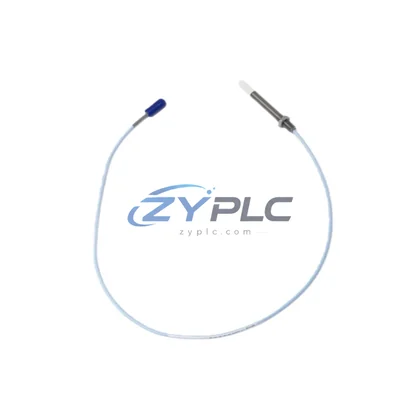
The Bently Nevada 330101-00-36-10-02-00 is a precision eddy-current proximity transducer engineered for seamless integration within the Bently Nevada 3300 Series vibration monitoring architecture. With a 36-inch (914 mm) extension cable, this transducer delivers reliable non-contact displacement and vibration measurement across rotating machinery in demanding industrial environments. Designed for system integration within multi-layer automation systems, it supports consistent signal acquisition from the machine train level through to the control room, enabling operators to maintain full visibility of shaft dynamics, radial vibration, and axial position in real time.
Unlike standalone sensing devices, the 330101-00-36-10-02-00 is conceived as a system component. Its value is fully realized when deployed alongside complementary elements of the 3300 XL monitoring platform — from the proximitor/extension cable assembly to the rack-mounted monitor modules that process and transmit conditioned signals upstream. This document outlines how the transducer fits within a layered automation architecture, how it coordinates with adjacent system components, and why it remains a preferred choice for long-term asset protection strategies in rotating equipment applications.
Product Specification Table
| Parameter |
Specification |
| System Role |
Eddy-Current Proximity Sensing — Vibration & Position Layer |
| Full SKU |
330101-00-36-10-02-00 |
| Series |
Bently Nevada 3300 XL |
| Cable Length |
36 inches (914 mm) Extension Cable |
| Measurement Type |
Non-contact radial vibration, axial position, differential expansion |
| Output Signal |
-18 VDC nominal (standard Bently Nevada proximitor output) |
| Frequency Range |
DC to 10,000 Hz |
| Operating Temperature |
-35°C to +177°C (probe tip) |
| Target Material Compatibility |
Steel, stainless steel, iron-based alloys |
| Communication / Integration |
Analog signal to 3300 XL Monitor Modules; compatible with 3500 Series via signal conditioning |
| Installation Environment |
Turbines, compressors, pumps, motors, gearboxes — oil & gas, power generation, petrochemical |
| system integration |
Full system integration within 3300 XL rack architecture and upstream DCS/SCADA systems |
| Warranty |
warranty terms confirmed during quotation from date of shipment |
| Origin |
United States |
System Compatibility Notes
The 330101-00-36-10-02-00 transducer does not operate in isolation — it is the sensing front-end of a coordinated signal chain that spans multiple system layers. In a typical 3300 XL deployment, the transducer is paired with a Bently Nevada 330130 Proximitor Sensor, which conditions the raw eddy-current signal into a calibrated voltage output. This conditioned signal is then routed to a 3300 XL Monitor Module housed within a standard 19-inch rack enclosure, where it is processed for alarm thresholds, trend logging, and relay output.
At the power layer, the monitoring rack is supplied by a Bently Nevada 3300/20 Power Supply Module, which provides regulated DC power to all installed monitor cards. Redundant power configurations are supported, ensuring that a single power supply failure does not interrupt continuous machinery protection. For facilities requiring higher-density monitoring, the 3500 Series Rack can accept signal inputs from 3300 XL transducer assemblies through appropriate interface modules, enabling a phased migration path without replacing field-installed sensors.
Network and communication integration is achieved through the 3500/92 Communication Gateway Module, which translates monitor data into Modbus RTU, Modbus TCP, or OPC-DA formats for upstream transmission to a DCS (Distributed Control System) or SCADA platform. This allows vibration data from the 330101-00-36-10-02-00 to appear as live process variables alongside temperature, pressure, and flow signals — enabling holistic asset health dashboards at the HMI layer.
At the field wiring level, Bently Nevada armored extension cables and junction boxes protect signal integrity across long cable runs in electrically noisy environments such as motor control centers and switchgear rooms. Terminal blocks and cable glands rated for hazardous area installation (ATEX/IECEx) are selected to match the transducer’s operating zone classification. For machinery trains requiring differential expansion monitoring, the 330101-00-36-10-02-00 is often deployed alongside a 330105 Thrust Position Transducer, providing complementary axial and radial measurement from a single machine casing.
This coordinated architecture — spanning the transducer, proximitor, monitor module, power supply, communication gateway, and HMI — ensures that the 330101-00-36-10-02-00 contributes to a fully integrated, redundancy-capable machinery protection system rather than functioning as a standalone measurement point.
Industrial Application Notes
The 330101-00-36-10-02-00 proximity transducer is deployed across a wide range of process industries where rotating machinery reliability is critical to continuous production. In power generation facilities, it monitors steam turbine shaft vibration and rotor eccentricity, providing early warning of bearing wear, rotor imbalance, and misalignment before these conditions escalate to forced outages. Utilities operating combined-cycle gas turbines rely on 3300 XL transducer assemblies to maintain API 670 compliance across all critical machine trains.
In oil and gas upstream and midstream applications, the transducer is installed on centrifugal compressors, gas turbine-driven pumps, and pipeline booster stations. Its wide operating temperature range and compatibility with hazardous area enclosures make it suitable for offshore platforms and onshore processing facilities where ambient conditions are extreme and maintenance access is limited. The warranty terms confirmed during quotation provides procurement teams with a defined coverage window that aligns with annual maintenance planning cycles.
In petrochemical and refining environments, the 330101-00-36-10-02-00 supports continuous monitoring of cracked gas compressors, reactor feed pumps, and cooling water pumps — machinery categories where unplanned downtime carries significant safety and financial consequences. The transducer’s non-contact measurement principle eliminates mechanical wear at the sensing interface, reducing the frequency of sensor replacement and lowering lifecycle maintenance costs.
For water and wastewater treatment facilities, the transducer is applied to large vertical turbine pumps and blower trains, where shaft position monitoring helps detect cavitation-induced vibration and impeller wear. In mining and minerals processing, it is used on SAG mill drives, slurry pumps, and conveyor drive motors, where high dust loading and vibration levels demand robust, field-proven sensing technology. Across all these applications, the system integration capability of the 330101-00-36-10-02-00 within the 3300 XL architecture ensures that field data reaches the control room with minimal latency and maximum signal fidelity.
Product Compatibility FAQ
Q1: Is the 330101-00-36-10-02-00 compatible with the Bently Nevada 3500 Series rack system?
The 330101-00-36-10-02-00 is a 3300 XL Series transducer and is natively compatible with 3300 XL Proximitor Sensors and Monitor Modules. It can be integrated into a 3500 Series architecture through the use of appropriate signal conditioning interface modules. For direct 3500 rack compatibility, Bently Nevada offers 3500/42M and 3500/45 monitor cards that accept conditioned proximitor outputs. We recommend verifying the specific interface requirements with your system integrator prior to installation to ensure full system integration and alarm functionality.
Q2: What installation and commissioning considerations apply when deploying this transducer in a high-temperature environment?
The 330101-00-36-10-02-00 probe tip is rated for continuous operation up to 177°C, making it suitable for most turbine and compressor bearing housings. During commissioning, the gap voltage should be set to the nominal -18 VDC operating point using a calibrated gap-setting tool, with the target surface cleaned and free of surface irregularities. Extension cable routing should avoid proximity to high-voltage power cables to minimize electromagnetic interference. All cable connections should be made with the system de-energized, and the completed installation should be verified against the Bently Nevada calibration data sheet supplied with the transducer assembly.
Q3: What does the warranty terms confirmed during quotation cover, and how does it support long-term maintenance planning?
The warranty terms confirmed during quotation covers manufacturing defects in materials and workmanship from the date of shipment. It supports maintenance planning by providing a defined coverage window that aligns with annual equipment inspection schedules, allowing facilities to budget for sensor replacement or recalibration at the end of the warranty period. During the warranty period, defective units are replaced or repaired at no additional cost. For facilities maintaining strategic spare inventories, purchasing warranty-covered units ensures that shelf stock is covered against latent defects, reducing the risk of installing a failed sensor during an unplanned outage.