Bently Nevada 330103-00-06-15-02-05: Industrial Data Link for 3300 XL Machine Protection Networks
The Bently Nevada 330103-00-06-15-02-05 is a precision proximity transducer engineered for the 3300 XL Series continuous machinery monitoring platform. Designed to serve as the critical sensing node in rotating machinery protection networks, this transducer captures real-time shaft displacement, vibration amplitude, and radial position data — feeding live signal streams into plant-wide condition monitoring architectures. In smart factory environments where unplanned downtime translates directly to production loss, the 330103-00-06-15-02-05 functions as the first link in a high-integrity industrial data chain: from raw mechanical motion at the shaft, through signal conditioning, across the monitoring network, and into SCADA dashboards and historian systems for continuous analysis.
The 3300 XL proximity transducer system operates on the eddy-current sensing principle, delivering a linear, low-noise analog output signal that is directly compatible with Bently Nevada 3300 XL Proximitor Sensors and the broader System 1 machinery health platform. This signal path enables seamless integration with Bently Nevada 3500 Series Machinery Protection System racks, where the conditioned vibration data is processed against configurable alarm and danger setpoints. When thresholds are exceeded, the 3500 rack communicates trip signals to DCS and PLC controllers — including platforms such as GE Mark VIe turbine control systems and Emerson DeltaV distributed control systems — enabling automated protective shutdown sequences without operator intervention.
Within the plant network topology, the 330103-00-06-15-02-05 transducer feeds into a layered communication architecture. At the field level, analog 4–20 mA and voltage output signals from the Proximitor sensor are routed to the 3500 monitoring rack. The rack’s communication modules then transmit processed vibration vectors, gap voltages, and alarm states over Modbus TCP/IP or OPC-UA protocols to plant historians, SCADA servers, and HMI workstations. This enables operators to monitor shaft centerline plots, orbit diagrams, and trend data in real time from control rooms or remote locations — a capability central to predictive maintenance programs in power generation, petrochemical, and heavy industrial facilities.
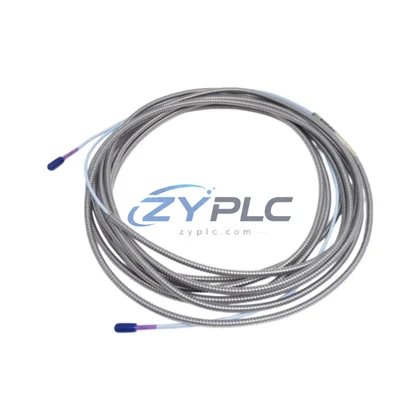
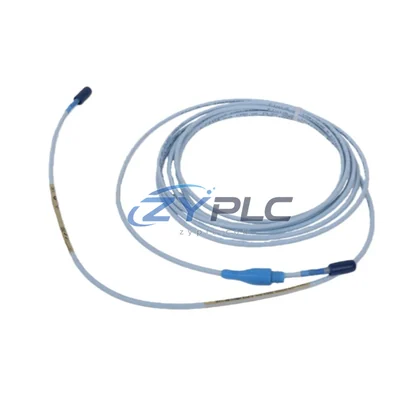
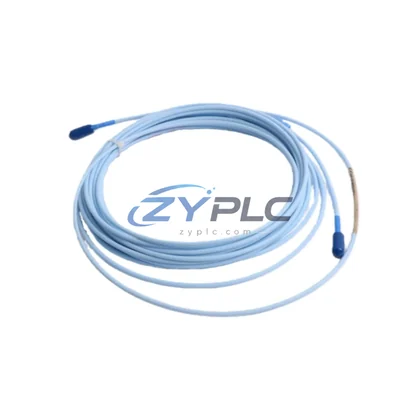
The transducer’s cable assembly — with its defined extension cable length and driver configuration encoded in the full SKU 330103-00-06-15-02-05 — ensures system calibration integrity across the complete signal chain. Pairing this transducer with the correct Bently Nevada 330130 Extension Cable and a matched 330180 Proximitor Sensor is essential for maintaining the ±0.5% linearity specification that the 3300 XL system depends upon for accurate gap measurement. Incorrect cable combinations introduce scale factor errors that propagate through the entire monitoring network, compromising alarm reliability and potentially masking developing faults in critical rotating equipment such as steam turbines, compressors, and pumps.
For facilities implementing IIoT-ready machine monitoring, the data generated by the 330103-00-06-15-02-05 can be aggregated through edge gateway devices — such as the Bently Nevada System 1 software platform or third-party industrial IoT gateways supporting OPC-UA — and pushed to cloud-based analytics platforms for fleet-wide asset health monitoring. This positions the proximity transducer not merely as a sensor, but as a structured data source within a broader digital transformation strategy. Integration with CMMS platforms, remote diagnostic services, and AI-driven anomaly detection tools becomes possible when the transducer data is properly networked and contextualized within the plant’s information architecture.
Every 330103-00-06-15-02-05 unit supplied by ZYPLC undergoes functional verification prior to shipment, confirming output linearity, cable continuity, and connector integrity. Units are sourced from verified supply channels and backed by a warranty terms confirmed during quotation covering manufacturing defects and performance conformance. Global logistics via DHL Express and FedEx International Priority ensure rapid delivery to power plants, refineries, offshore platforms, and industrial facilities worldwide.
Compatibility & Integration Notes
| Parameter |
Specification |
| Product SKU |
330103-00-06-15-02-05 |
| Brand / Series |
Bently Nevada / 3300 XL |
| Sensor Type |
Eddy-Current Proximity Transducer |
| Output Signal |
Analog Voltage (compatible with 3300 XL Proximitor) |
| Protocol Compatibility |
Modbus TCP/IP, OPC-UA (via 3500 rack communication modules) |
| System Integration |
Bently Nevada 3500 MPS, System 1, GE Mark VIe, Emerson DeltaV |
| SCADA / HMI Compatibility |
Wonderware, FactoryTalk, System 1 Operator Interface |
| Network Architecture |
Field-level analog → 3500 rack → Ethernet/IP plant network |
| Measurement Application |
Shaft radial vibration, axial position, shaft centerline |
| Linearity |
±0.5% of full-scale range |
| Warranty |
warranty terms confirmed during quotation — manufacturing defects & performance conformance |
| Shipping |
Global DHL Express / FedEx International Priority |
Connected Automation Data Flow
The 330103-00-06-15-02-05 proximity transducer sits at the origin of a structured industrial data flow that spans from rotating shaft to enterprise asset management system. At the field level, the transducer’s probe tip — positioned within 2.0 mm of the shaft surface — generates a continuous analog voltage signal proportional to the gap distance. This signal travels through the 330130 Extension Cable to the 330180 Proximitor Sensor, where it is conditioned and buffered before being routed to the Bently Nevada 3500/22M Transient Data Interface or the 3500/42M Proximitor Monitor module installed in the 3500 rack chassis.
Within the 3500 rack, the monitor card processes the raw gap voltage into engineering units — micrometers or mils peak-to-peak — and compares live readings against configured Alert and Danger setpoints. When vibration levels approach critical thresholds, the rack’s relay outputs signal the plant DCS or safety PLC to initiate load reduction or protective trip sequences. Simultaneously, the 3500/20 Rack Interface Module transmits structured data packets over Modbus TCP/IP to the plant’s SCADA server, where Wonderware InTouch or FactoryTalk View HMI displays update operator screens with real-time vibration vectors, gap trends, and alarm annunciations.
For facilities running Bently Nevada System 1 software, the 3500 rack data feeds directly into the System 1 historian, enabling long-term trend analysis, orbit plot generation, and automated report creation. System 1 can also interface with third-party CMMS platforms via OPC-UA, pushing work order triggers to maintenance management systems when vibration trends indicate developing bearing wear or rotor imbalance. In IIoT-enabled plants, edge gateways aggregate System 1 data alongside signals from Emerson Rosemount pressure transmitters, Yokogawa temperature sensors, and ABB variable frequency drives — creating a unified machine health dataset accessible from remote diagnostic centers or cloud analytics platforms.
The complete data chain — 330103-00-06-15-02-05 transducer → 330180 Proximitor → 3500/42M monitor → 3500/20 rack interface → plant Ethernet → SCADA/historian → enterprise dashboard — represents the backbone of a modern rotating machinery protection and condition monitoring network, delivering the real-time visibility that predictive maintenance programs depend upon.
Solving Data Isolation in Industrial Sites
Many industrial facilities operating legacy rotating machinery face a common challenge: vibration data from critical assets exists in isolated monitoring systems that cannot communicate with plant-wide SCADA, DCS, or ERP platforms. Standalone vibration monitors display local readings but provide no structured data output, leaving maintenance teams dependent on manual rounds and periodic data downloads rather than continuous, networked monitoring.
The Bently Nevada 3300 XL system — anchored by transducers such as the 330103-00-06-15-02-05 — directly addresses this data isolation problem. By integrating the 3500 rack’s Modbus TCP/IP and OPC-UA communication capabilities into the plant network, vibration data becomes a live, queryable data stream available to any authorized system on the network. SCADA operators gain real-time visibility into machinery health without leaving the control room. Maintenance planners receive automated alerts when vibration trends cross configurable thresholds, enabling condition-based work order generation rather than time-based maintenance schedules.
For multi-train facilities with dozens of rotating machines — compressors, turbines, pumps, fans — the networked 3500 architecture eliminates the need for individual local displays at each machine. A single System 1 server can aggregate data from multiple 3500 racks distributed across the plant, presenting a unified machinery health overview on a single HMI screen. This centralization reduces the cost of monitoring infrastructure, simplifies alarm management, and provides the data density required for AI-driven anomaly detection and remaining useful life prediction models.
Remote diagnostic capability is another key benefit of the networked 3300 XL architecture. With VPN access to the plant network, OEM service engineers and reliability consultants can review live and historical vibration data from off-site locations, accelerating root cause analysis and reducing the need for on-site visits. This remote access model has become essential for facilities in remote locations — offshore platforms, mining operations, and pipeline compressor stations — where specialist expertise is not locally available.
Industrial Connectivity FAQ
Q: What communication protocols does the Bently Nevada 3500 rack support when used with the 330103-00-06-15-02-05 transducer?
A: The 3500 rack supports Modbus TCP/IP and OPC-UA communication via the 3500/20 Rack Interface Module, enabling integration with SCADA systems, DCS platforms, and plant historians. The 330103-00-06-15-02-05 transducer itself outputs an analog voltage signal; protocol conversion occurs at the rack level.
Q: Is the 330103-00-06-15-02-05 compatible with non-Bently Nevada monitoring systems?
A: The transducer’s analog output is compatible with any monitoring system designed to accept the standard Bently Nevada 3300 XL signal range. However, full system performance — including calibrated linearity and alarm accuracy — is guaranteed only when paired with matched 3300 XL Proximitor sensors and 3500 Series monitor cards. Third-party compatibility should be verified against the target system’s input specifications.
Q: How does ZYPLC verify the 330103-00-06-15-02-05 before shipment?
A: Each unit undergoes pre-shipment functional testing covering output signal linearity, cable continuity, connector integrity, and physical inspection. Units are sourced from verified supply channels and ship with a warranty terms confirmed during quotation covering manufacturing defects and performance conformance. Test records are available upon request for critical applications.
Q: Can the 3300 XL system be expanded to monitor additional measurement points without replacing existing infrastructure?
A: Yes. The 3500 rack architecture is modular — additional monitor cards can be installed in existing rack chassis to expand measurement point capacity. Additional 330103-00-06-15-02-05 transducers and matched Proximitor sensors can be added to new measurement locations and integrated into the existing Modbus TCP/IP or OPC-UA network without disrupting active monitoring channels.