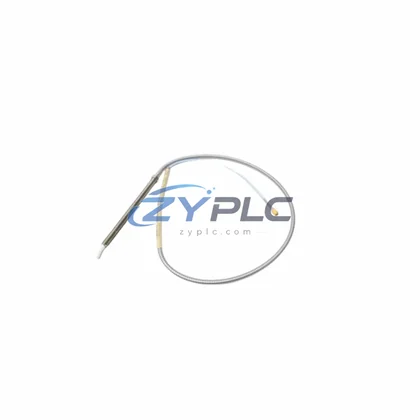
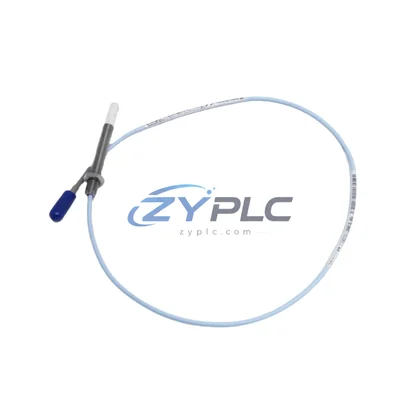
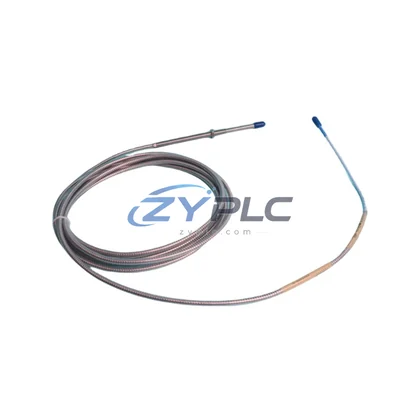
Bently Nevada 330701-00-30-10-01-00: Industrial Data Link for 3300 Series Vibration Monitoring Systems
The Bently Nevada 330701-00-30-10-01-00 is a high-precision eddy-current proximity probe engineered for continuous, real-time vibration and position monitoring within the Bently Nevada 3300 Series machinery protection ecosystem. Designed to serve as the critical sensing node between rotating machinery and the plant-wide data acquisition network, this probe delivers reliable analog signal output that feeds directly into the 3300 Series monitor modules, enabling seamless integration with SCADA platforms, DCS controllers, and industrial historian systems across the smart factory floor.
In modern industrial connectivity architectures, the signal chain begins at the machine shaft. The 330701-00-30-10-01-00 proximity probe detects radial vibration and axial position with sub-micron resolution, converting mechanical displacement into a conditioned voltage signal via the companion 3300 XL 8mm Extension Cable and 3300 XL Proximitor Sensor. This analog signal is then routed to the 3300/16 Monitor or 3300/20 Monitor rack module, where it undergoes analog-to-digital conversion and protocol encapsulation before entering the plant communication backbone.
Once digitized, the vibration data travels through the System 1 Evolution software gateway, which acts as the primary OPC-UA and Modbus TCP bridge between the Bently Nevada hardware layer and upper-level systems. Operators monitoring from a Wonderware InTouch HMI or OSIsoft PI historian receive live shaft displacement values, alarm states, and trend data without latency gaps. The 330701-00-30-10-01-00 probe’s consistent signal quality is fundamental to this data fidelity — any drift or noise at the sensor level propagates through every downstream system.
Compatibility & Integration Notes
| Parameter |
Specification |
| SKU |
330701-00-30-10-01-00 |
| Brand / Series |
Bently Nevada / 3300 Series |
| Sensor Type |
Eddy-Current Proximity Probe |
| Signal Output Protocol |
Analog Voltage (–24 VDC bias, linear range) |
| Communication Interface |
Via 3300 XL Proximitor Sensor to Monitor Module |
| Network Compatibility |
OPC-UA, Modbus TCP (via System 1 Evolution Gateway) |
| SCADA / HMI Integration |
OSIsoft PI, Wonderware, GE iFIX, Emerson DeltaV |
| Probe Length |
30 cm (300 mm) |
| Cable Length |
1.0 m integral cable |
| Thread Size |
8 mm |
| Gap Voltage Range |
–10 VDC to –18 VDC |
| Operating Temperature |
–35°C to +121°C |
| Ingress Protection |
IP67 |
| Warranty |
12 Months |
| Availability |
RFQ Available — shipment arranged after confirmation |
Connected Automation Data Flow
The 330701-00-30-10-01-00 sits at the origin of a multi-layer industrial data flow. At the field level, the probe is paired with the Bently Nevada 3300 XL Proximitor Sensor (330180-91-00), which conditions the raw eddy-current signal and provides the –24 VDC power supply required for stable operation. The conditioned output feeds into the 3300/16 Monitor rack, where each channel is independently processed for gap, 1X, and 2X vibration vectors.
Within the 3300 Series rack, the monitor communicates over the internal TDXnet backplane bus to the 3500/92 Communication Gateway Module, which translates the proprietary Bently Nevada protocol into Modbus RTU or Modbus TCP for integration with Allen-Bradley ControlLogix PLCs or Siemens S7-400 DCS controllers. This gateway step is essential in brownfield plants where legacy control systems cannot natively interpret Bently Nevada’s internal data format.
At the SCADA layer, System 1 Evolution software aggregates vibration vectors, alarm limits, and machine health indices from multiple 3300 Series racks across the plant. The software publishes live data via OPC-UA to Emerson DeltaV, Honeywell Experion PKS, or ABB 800xA distributed control systems, enabling operators to correlate vibration trends with process variables such as flow rate, temperature, and pressure — all on a unified dashboard. Remote diagnostic sessions can be initiated directly from the System 1 client, allowing condition monitoring engineers to review orbit plots and trend data without physical access to the machinery vault.
For edge computing deployments, the vibration data stream from the 330701-00-30-10-01-00 can be routed through a Moxa MGate MB3270 Modbus gateway or a Cisco IE-4000 industrial Ethernet switch before reaching the plant historian. This architecture supports IIoT initiatives where machine health data is forwarded to cloud analytics platforms for predictive maintenance modeling, reducing unplanned downtime across compressor trains, turbines, and pump sets.
Solving Data Isolation in Industrial Sites
One of the most persistent challenges in rotating machinery protection is data isolation — vibration data locked inside proprietary monitor racks that cannot be accessed by the plant’s broader automation and reporting infrastructure. The Bently Nevada 330701-00-30-10-01-00, when deployed within a properly configured 3300 Series system, directly addresses this problem through a structured protocol conversion and network integration approach.
Plants running mixed-vendor environments — where Bently Nevada machinery protection coexists with Rockwell Automation safety PLCs, Yokogawa CENTUM VP DCS, or Schneider Electric EcoStruxure platforms — benefit from the 3500/92 gateway’s ability to bridge proprietary and open protocols. Once vibration data enters the Modbus TCP or OPC-UA domain, it becomes accessible to any SCADA historian, MES platform, or ERP system capable of consuming standard industrial data formats.
Production line transparency is another key outcome. With the 330701-00-30-10-01-00 feeding real-time shaft displacement data into the System 1 Evolution platform, maintenance teams can set dynamic alarm thresholds that automatically trigger work orders in SAP PM or IBM Maximo when vibration amplitude exceeds ISO 10816 limits. This closes the loop between condition monitoring and maintenance execution, eliminating the manual inspection cycles that historically created data gaps and delayed fault response.
System scalability is preserved through the modular architecture of the 3300 Series rack. Additional proximity probe channels — including axial position probes using the 330703-00-30-10-01-00 or speed probes using the 330980-50-05 — can be added to the same rack without disrupting existing network configurations. Each new probe channel inherits the same OPC-UA publication path, ensuring that expanded monitoring coverage does not require reconfiguration of upstream SCADA or historian systems.
Industrial Connectivity FAQ
Q1: What is the communication latency between the 330701-00-30-10-01-00 probe and the SCADA system?
The eddy-current signal from the probe is conditioned by the Proximitor Sensor and processed by the 3300 Series monitor in under 10 milliseconds. The 3500/92 Communication Gateway publishes updated Modbus registers at a configurable scan rate (typically 100–500 ms), and OPC-UA data items are refreshed at the System 1 Evolution server’s polling interval, typically 1 second for historian writes. End-to-end latency from shaft displacement to SCADA display is generally under 2 seconds in standard configurations.
Q2: Is the 330701-00-30-10-01-00 compatible with non-Bently Nevada monitor systems?
The probe outputs a standard eddy-current analog voltage signal (–10 VDC to –18 VDC gap range) that is compatible with any monitor system designed for 8 mm eddy-current probes operating on a –24 VDC power supply. While optimized for the Bently Nevada 3300 and 3500 Series monitors, the probe can be integrated with third-party vibration monitors from Emerson, Metrix, or Wilcoxon Research, provided the monitor’s input specifications match the probe’s output characteristics.
Q3: How does the system maintain network stability during high-vibration alarm events?
The 3300 Series monitor architecture separates the alarm relay output circuit from the communication bus, ensuring that a trip or danger alarm event does not interrupt Modbus or OPC-UA data publication. The 3500/92 gateway maintains its TCP connection independently of alarm state changes, and System 1 Evolution logs all alarm transitions with millisecond timestamps for post-event analysis. This design prevents the data blackouts that can occur in systems where alarm processing and communication share the same processor thread.
Q4: What does the warranty terms confirmed during quotation cover, and how is the product tested before shipment?
Every 330701-00-30-10-01-00 unit supplied by ZYPLC undergoes pre-shipment functional verification, including gap voltage linearity testing across the full measurement range, insulation resistance checks on the integral cable, and connector integrity inspection. The warranty terms confirmed during quotation covers manufacturing defects and functional failures under normal operating conditions. Warranty claims are supported by ZYPLC’s technical team, with replacement units dispatched within 5 business days of confirmed fault diagnosis. Extended warranty and on-site commissioning support are available upon request.