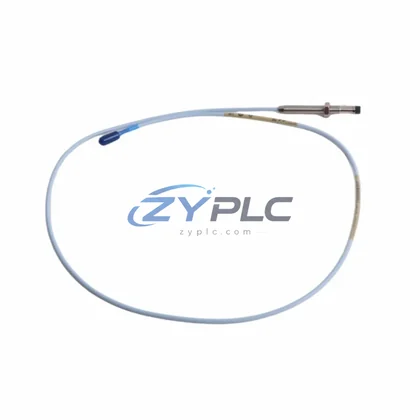
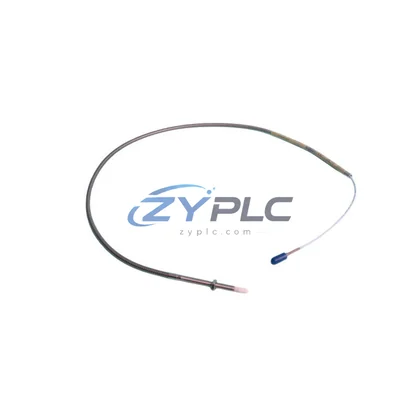
Bently Nevada 330930-060-02-05 Extension Cable for 3300 Series Automation
In modern industrial facilities where uptime and energy efficiency define competitive advantage, the integrity of machine condition monitoring infrastructure is non-negotiable. The Bently Nevada 330930-060-02-05 extension cable is a precision-engineered signal transmission component designed for the Bently Nevada 3300 Series proximity probe system — one of the most widely deployed vibration and position monitoring platforms in rotating machinery applications worldwide.
This extension cable serves as the critical link between the proximity probe and the proximitor/driver module, ensuring low-loss, high-fidelity signal transmission across the measurement chain. In energy-intensive industries such as petrochemical processing, power generation, compressor stations, and turbine control, even marginal signal degradation can lead to false alarms, unplanned shutdowns, or — worse — missed fault detection. The 330930-060-02-05 eliminates these risks by maintaining precise electrical characteristics across its full operating length, enabling the monitoring system to accurately capture shaft vibration, eccentricity, and axial position data in real time.
When integrated with the broader Bently Nevada 3300 Series monitoring architecture — including the 3300/16 proximitor sensor, 3300 XL 8mm proximity probe, and 3300/55 monitor module — this extension cable supports a complete, calibrated measurement loop. The system’s ability to deliver accurate, continuous data to the System 1 condition monitoring software enables predictive maintenance strategies that directly reduce unplanned downtime caused by mechanical inefficiency, bearing degradation, and rotor imbalance.
Product Specification Table
| Parameter |
Specification / Value |
| Part Number |
330930-060-02-05 |
| Brand |
Bently Nevada |
| Series |
3300 Series Proximity System |
| Component Type |
Extension Cable |
| Cable Length |
6.0 m (approx.) |
| Signal Type |
Low-frequency eddy-current proximity signal |
| Compatible Probes |
Bently Nevada 3300 XL 8mm / 11mm Proximity Probes |
| Compatible Drivers |
3300/16 Proximitor Sensor, 3300 Series Driver Modules |
| Operating Temperature |
-35°C to +85°C |
| Application Environment |
Rotating machinery, turbines, compressors, pumps, motors |
| Maintenance Value |
Enables real-time vibration monitoring to reduce mechanical energy loss and prevent unplanned downtime |
| Condition |
New / Tested Surplus |
| Warranty |
warranty terms confirmed during quotation |
| Origin |
United States |
System Compatibility and Application
The 330930-060-02-05 extension cable does not operate in isolation — it is a foundational element within a layered industrial automation and maintenance planning architecture. Understanding how it fits into the broader system reveals its true value in maintenance planning.
At the sensing layer, the Bently Nevada 3300 XL 8mm proximity probe is mounted adjacent to the rotating shaft, generating a continuous eddy-current field. The 330930-060-02-05 extension cable transmits the raw probe signal to the 3300/16 proximitor sensor, which conditions and converts the signal into a calibrated DC voltage proportional to the gap distance. This voltage is then fed into the Bently Nevada 3300/55 dual-channel monitor, which processes vibration amplitude, phase, and position data.
At the control and drive layer, the vibration data is communicated via Modbus RTU or 4–20 mA analog output to the plant’s distributed control system (DCS) or programmable logic controller — such as a Rockwell Automation ControlLogix L73 or Siemens S7-400 PLC — where it informs motor speed adjustments through variable frequency drives (VFDs). When the monitoring system detects elevated vibration levels indicative of bearing wear or rotor imbalance, the control system can automatically reduce motor load via the connected ABB ACS880 variable frequency drive, preventing unplanned downtime from mechanical friction and reducing thermal stress on the motor windings.
At the data and analytics layer, the conditioned signals are aggregated by Bently Nevada System 1 software, which provides trend analysis, alarm management, and predictive maintenance scheduling. This closed-loop architecture — from the 330930-060-02-05 extension cable at the field level to the System 1 dashboard at the supervisory level — enables facilities to shift from reactive to predictive maintenance, a transition that industry data consistently associates with 10–25% reductions in energy consumption related to mechanical inefficiency.
Supporting I/O infrastructure, such as the Bently Nevada 3500/22M transient data interface and 3500/42M proximitor I/O module, further extends the system’s data acquisition capability, allowing simultaneous monitoring of multiple machine trains within a single rack-based architecture. This scalability is essential for large compressor stations or multi-turbine power plants where maintenance planning must be managed at the fleet level, not just the individual machine level.
Maintenance and Replacement Notes
In a typical centrifugal compressor train operating at a petrochemical facility, the rotating shaft may spin at 10,000–15,000 RPM under continuous load. Even a 5% increase in vibration amplitude — often caused by gradual bearing wear or process-induced rotor instability — can translate into a measurable increase in power consumption as the machine works harder to maintain output pressure against growing mechanical resistance.
The 330930-060-02-05 extension cable, by maintaining signal integrity between the proximity probe and the proximitor module, ensures that the 3300 Series monitoring system captures these early-stage anomalies before they escalate. When the System 1 software flags a rising vibration trend, maintenance teams can schedule a targeted intervention — bearing replacement, balance correction, or alignment adjustment — during a planned production window rather than responding to an emergency shutdown.
The operational stability from this approach are compounded across the production line. A compressor operating with optimal rotor balance and bearing condition consumes less electrical energy per unit of compressed gas output. A pump running within its best efficiency point (BEP), confirmed by stable proximity probe readings, draws less current from the motor drive. A turbine generator with well-monitored shaft position maintains tighter clearances, improving thermodynamic efficiency.
Beyond operational stability, the reduction in unplanned downtime directly improves equipment utilization rates. In process industries where a single compressor or turbine shutdown can halt an entire production train, the cost of lost production often dwarfs the cost of the monitoring equipment itself. The 330930-060-02-05, as a stocked, tested, and immediately available component, also reduces the mean time to repair (MTTR) when cable replacement is required — a critical factor in minimizing production losses.
All units supplied by ZYPLC undergo functional testing prior to shipment, verifying electrical continuity, insulation resistance, and connector integrity. This pre-shipment testing protocol ensures that replacement cables perform identically to OEM specifications from the moment they are installed, eliminating the risk of introducing signal errors into a calibrated monitoring loop.
Product Sourcing FAQ
Q1: How does the 330930-060-02-05 extension cable contribute to energy efficiency in rotating machinery applications?
The cable maintains low-loss signal transmission between the proximity probe and the proximitor sensor, ensuring that the 3300 Series monitoring system receives accurate vibration and position data. This accuracy enables early detection of mechanical inefficiencies — such as bearing wear, rotor imbalance, or misalignment — that cause motors and drives to consume excess energy. By enabling predictive maintenance, the cable indirectly supports maintenance planning across the entire machine train.
Q2: Is the 330930-060-02-05 compatible with other Bently Nevada 3300 Series components and third-party control systems?
Yes. The 330930-060-02-05 is designed for use within the Bently Nevada 3300 Series proximity system and is compatible with 3300 XL 8mm and 11mm proximity probes, 3300/16 proximitor sensors, and 3300 Series monitor modules. The analog output signals from the monitoring system are compatible with standard DCS and PLC platforms, including Rockwell Automation, Siemens, and Honeywell control systems, via 4–20 mA or Modbus interfaces.
Q3: What is the recommended replacement procedure, and how does ZYPLC support fast turnaround?
Replacement of the extension cable should follow Bently Nevada’s calibration and verification procedures, including gap voltage verification after installation to confirm the measurement loop is within specification. ZYPLC maintains RFQ-confirmed sourcing of the 330930-060-02-05 and ships tested units with documentation. For urgent requirements, expedited shipping is available. Our technical team can provide guidance on installation and verification procedures upon request.
Q4: What warranty coverage is provided, and what does the pre-shipment testing include?
All 330930-060-02-05 extension cables supplied by ZYPLC are covered by a warranty terms confirmed during quotation from the date of shipment. Pre-shipment testing includes electrical continuity verification, insulation resistance measurement, and connector integrity inspection. Units that do not meet OEM electrical specifications are not shipped. This testing protocol ensures reliable performance from installation and supports the integrity of the customer’s machine monitoring system.