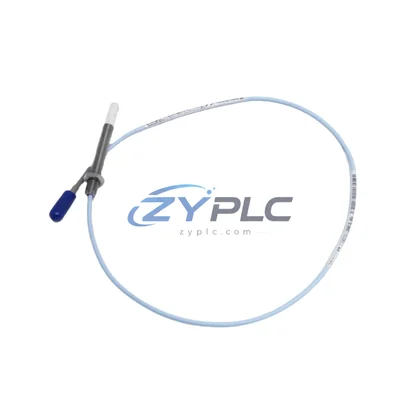
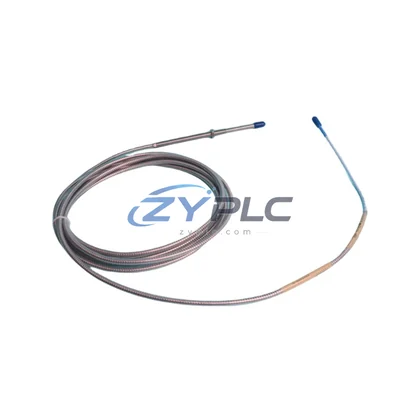
Bently Nevada 990-04-XX-01-05 Industrial Network Interface for 3300 Series: Precision Vibration Data Across Your Smart Factory Data Link
In modern industrial environments, the ability to capture, transmit, and act on vibration data in real time is no longer optional — it is the backbone of predictive maintenance, process transparency, and uninterrupted production. The Bently Nevada 990-04-XX-01-05 vibration transmitter is engineered to serve as a critical node in the industrial data chain, converting raw mechanical vibration signals from rotating equipment into a clean, standardized 4-20mA analog output that integrates seamlessly with distributed control systems, SCADA platforms, PLC controllers, and edge computing gateways.
Designed for the Bently Nevada 3300 Series monitoring architecture, the 990-04-XX-01-05 operates as a precision signal conditioner and transmitter, accepting inputs from proximity probes and eddy-current sensors mounted on turbines, compressors, pumps, and motors. Its output is protocol-agnostic at the analog layer, making it compatible with virtually any industrial control platform — from legacy DCS installations to modern IIoT-enabled smart factory networks.
Compatibility & Integration Notes
| Parameter |
Specification |
| SKU |
990-04-XX-01-05 (MOD: 165335-01) |
| Brand / Series |
Bently Nevada / 3300 Series |
| Output Protocol |
4-20mA Analog (DCS / PLC / SCADA compatible) |
| Communication Interface |
Analog signal loop; gateway-ready for Modbus RTU, HART, Profibus DP |
| Transmission Capability |
Real-time continuous vibration amplitude output |
| Network Compatibility |
DCS, SCADA, PLC, Remote I/O, HMI, Edge Gateway |
| System Application |
Rotating machinery protection, predictive maintenance, smart factory monitoring |
| Input Signal |
Eddy-current proximity probe (3300 XL 8mm / 11mm compatible) |
| Product Type |
Industrial Vibration Transmitter |
| Origin |
United States |
| Warranty |
warranty terms confirmed during quotation |
Connected Automation Data Flow
The 990-04-XX-01-05 sits at the signal acquisition layer of the industrial data chain. Proximity probes — such as those in the Bently Nevada 3300 XL 8mm series — detect shaft displacement and radial vibration at the machine level. The 990-04-XX-01-05 conditions and transmits this signal as a 4-20mA loop current to the next layer of the automation hierarchy.
At the control layer, the analog signal is received by a PLC input module — for example, a Bently Nevada 3500/15 Power Supply rack or a third-party PLC analog input card — where it is digitized and made available to the control logic. In parallel, the signal can be routed to a Bently Nevada 3500/22M Transient Data Interface for high-resolution waveform capture and transient event logging, enabling engineers to correlate vibration spikes with process upsets in real time.
For facilities running a Bently Nevada 3500/42M Proximitor/Seismic Monitor, the 990-04-XX-01-05 complements the rack-based monitoring system by providing a dedicated 4-20mA output channel that can feed remote I/O nodes or SCADA historian servers without burdening the primary protection rack. This parallel data path is essential for plants that require both machine protection and continuous process data logging.
At the network communication layer, a Bently Nevada TDXnet gateway or a compatible Modbus-to-Ethernet converter bridges the analog 4-20mA signal into a digital Modbus RTU or Modbus TCP frame, making the vibration data accessible to SCADA systems such as GE iFIX, Wonderware, or Ignition. HMI panels on the plant floor — including those integrated with the Bently Nevada 3500/92 Communication Gateway — can display live vibration trends, alarm states, and historical data without requiring direct wiring to the protection rack.
In drive-intensive applications, the 990-04-XX-01-05 output can be wired in parallel to a variable frequency drive (VFD) analog input, allowing the drive to modulate motor speed in response to vibration amplitude — a closed-loop strategy that reduces mechanical stress and extends bearing life. Sensor fusion architectures that combine the 990-04-XX-01-05 with a Bently Nevada 1900/65A General Purpose Equipment Monitor enable multi-parameter condition monitoring, correlating vibration data with temperature, speed, and process variables across the same network segment.
For edge computing deployments, the 4-20mA output of the 990-04-XX-01-05 feeds directly into an industrial edge gateway equipped with analog input modules, where machine learning models can perform local anomaly detection before forwarding aggregated results to the cloud or enterprise MES. This architecture supports the Bently Nevada 3500/25 keyphasor module integration for phase-referenced vibration analysis, enabling precise identification of imbalance, misalignment, and resonance conditions across the entire rotating machinery fleet.
Solving Data Isolation in Industrial Sites
One of the most persistent challenges in industrial facilities is the fragmentation of machine health data across incompatible systems. Older vibration monitoring equipment often outputs proprietary signals that cannot be read by modern DCS or SCADA platforms without custom engineering. The 990-04-XX-01-05 addresses this directly by providing a universally accepted 4-20mA output — the lingua franca of industrial instrumentation — that any control system can read without protocol conversion hardware.
For plants transitioning from isolated machine protection systems to integrated smart factory architectures, the 990-04-XX-01-05 serves as the bridge between legacy eddy-current sensor installations and modern digital control networks. By standardizing the vibration signal at the transmitter level, engineering teams can eliminate data silos that previously prevented maintenance teams from correlating vibration trends with production KPIs in their SCADA historian.
Remote monitoring is another area where the 990-04-XX-01-05 delivers measurable value. In unmanned substations, offshore platforms, or remote compressor stations, the 4-20mA signal can be fed into a remote I/O module connected to a cellular or fiber-optic SCADA link, enabling operations centers to monitor critical machinery health from hundreds of kilometers away. Alarm thresholds configured in the SCADA system trigger automatic notifications when vibration levels exceed safe operating limits, reducing the need for on-site inspection and enabling condition-based maintenance scheduling.
Production line transparency is achieved by integrating the 990-04-XX-01-05 data stream into the plant’s MES or ERP system via OPC-UA or Modbus TCP gateways. This allows production managers to view real-time equipment health alongside output rates, quality metrics, and energy consumption — a unified view that supports both operational efficiency and regulatory compliance reporting. System expansion is straightforward: additional 990-04-XX-01-05 transmitters can be added to the analog input network without reconfiguring the SCADA or PLC architecture, making it a scalable solution for phased smart factory rollouts.
Industrial Connectivity FAQ
Q1: What is the communication latency of the 990-04-XX-01-05 output signal?
The 990-04-XX-01-05 provides a continuous 4-20mA analog output with no digital communication latency. The signal update rate is determined by the analog input scan rate of the receiving PLC or DCS module, typically 10-100ms, making it suitable for real-time machine protection and process control applications.
Q2: Is the 990-04-XX-01-05 compatible with Modbus RTU, Profibus DP, or HART protocols?
The 990-04-XX-01-05 natively outputs a 4-20mA analog signal. Protocol conversion to Modbus RTU, Profibus DP, HART, or Ethernet/IP is achieved using a compatible signal converter or gateway module. This makes the transmitter compatible with virtually any industrial fieldbus or industrial Ethernet network when paired with the appropriate interface device.
Q3: How does the 990-04-XX-01-05 support network stability in high-vibration environments?
The transmitter is designed for industrial environments with high electromagnetic interference, temperature variation, and mechanical vibration. Its robust analog output loop maintains signal integrity over long cable runs (up to several hundred meters with proper shielding), and the 4-20mA current loop is inherently immune to voltage drop and common-mode noise — ensuring stable data transmission even in electrically noisy plant environments.
Q4: What does the warranty terms confirmed during quotation cover, and has the unit been tested before shipment?
Every 990-04-XX-01-05 unit supplied by ZYPLC undergoes pre-shipment functional testing to verify output accuracy, signal linearity, and loop integrity. The warranty terms confirmed during quotation covers manufacturing defects and functional failures under normal operating conditions. ZYPLC maintains RFQ-confirmed sourcing of the 990-04-XX-01-05 and related 3300 Series components to support rapid global deployment with short lead times.