Emerson PR9350/04 Proximity Sensor for PR9350
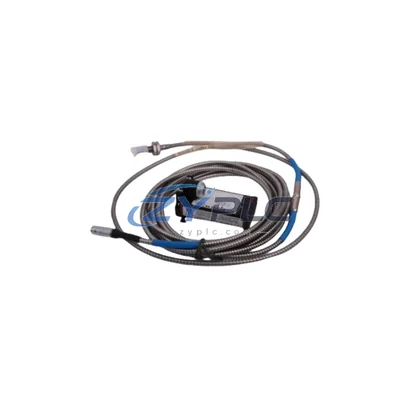
The Emerson PR9350/04 Inductive Proximity Sensor is a precision-engineered component designed to operate as an integral element within the PR9350 series vibration and position monitoring architecture. Rather than functioning as a standalone device, the PR9350/04 is conceived as a system-level asset — one that contributes directly to the signal integrity, measurement consistency, and long-term reliability of the broader control and condition monitoring infrastructure in which it is deployed.
In modern industrial automation environments, the performance of any individual sensor is inseparable from the architecture surrounding it. The PR9350/04 is engineered with this principle at its core. Its inductive sensing technology delivers stable, non-contact detection of metallic targets, making it particularly well-suited for shaft position measurement, speed detection, and proximity-based triggering in rotating machinery applications. When integrated into a complete PR9350 monitoring system, the sensor feeds clean, low-noise signals to downstream signal conditioning modules and monitoring units, ensuring that the control layer receives accurate data for decision-making and protection logic.
Product Specification Table
| Parameter |
Specification |
| System Role |
Inductive Proximity / Position Sensor — PR9350 Series |
| Sensing Technology |
Eddy-current inductive, non-contact |
| Target Compatibility |
Ferrous and non-ferrous metallic targets |
| Output Signal |
Analog voltage / proximity pulse (series-dependent) |
| Supply Voltage |
Typically 18–30 VDC (system-powered via PR9350 driver) |
| Operating Temperature |
–40°C to +120°C (application-dependent) |
| Protection Rating |
IP67 or higher (sealed housing) |
| Communication / Integration |
Hardwired analog signal; system integration with PR9350 monitor modules |
| Mounting |
Threaded body, adjustable tip-to-target gap |
| Warranty |
warranty terms confirmed during quotation — all units tested prior to shipment |
System Compatibility Notes
The PR9350/04 achieves its full potential when deployed within a coordinated system architecture. In a typical rotating machinery protection system, the sensor works in conjunction with the PR9350/01 extension cable and PR9350/02 driver/oscillator unit, which conditions the raw inductive signal into a usable voltage output for the monitoring layer. This signal is then received by a PR9350/10 or PR9350/12 monitor module, which performs gap measurement, vibration amplitude analysis, and alarm threshold evaluation.
At the control layer, the processed data from the PR9350 monitor is typically transmitted to a DeltaV distributed control system (DCS) or a PLC-based safety controller via hardwired 4–20 mA analog outputs or digital relay contacts. In more advanced architectures, FOUNDATION Fieldbus or HART-enabled signal conditioners may be used to integrate the PR9350 measurement chain into a digital process bus, enabling real-time diagnostics and remote configuration from the engineering workstation.
Power distribution to the sensor and its associated driver is typically managed through a PR9350-compatible power supply module or a dedicated 24 VDC instrument power rail within the control cabinet. Proper power conditioning is essential to maintain signal stability, particularly in environments with significant electrical noise from variable frequency drives (VFDs) or high-current switching equipment.
For human-machine interface (HMI) integration, the vibration and position data collected by the PR9350/04 is visualized on Emerson AMS Device Manager or third-party SCADA platforms, providing operators with real-time trend displays, alarm annunciation, and historical data logging. In redundant architectures, dual PR9350/04 sensors may be installed at 90° intervals around the shaft to provide XY vibration measurement, with each channel feeding an independent monitor module to eliminate single points of failure.
Terminal connections within the control cabinet are typically made via DIN-rail mounted terminal blocks compatible with the PR9350 wiring scheme, ensuring clean signal routing and simplified maintenance access. Cable shielding and grounding practices are critical at this layer to prevent ground loops that could corrupt the low-level analog signals produced by the sensor-driver pair.
Industrial Application Notes
The PR9350/04 is widely applied across industries where rotating machinery protection and condition monitoring are critical to operational continuity. In power generation facilities, the sensor monitors turbine shaft displacement and provides early warning of bearing wear or rotor imbalance, enabling predictive maintenance before catastrophic failure occurs. In petrochemical and refinery environments, it is used on compressors, pumps, and agitators operating in hazardous areas, where its sealed housing and robust construction ensure reliable performance under aggressive chemical exposure and high ambient temperatures.
In steel and metallurgical plants, the PR9350/04 monitors rolling mill drive shafts and gearbox output stages, where high radial loads and shock vibration are common. Its fast response time and stable gap measurement make it suitable for high-speed shaft monitoring applications. In water treatment and pumping stations, the sensor is integrated into motor protection systems to detect shaft misalignment and cavitation-induced vibration before pump damage occurs.
For mining and mineral processing operations, the PR9350/04 is deployed on crusher drives, conveyor head pulleys, and slurry pump shafts, where continuous operation and minimal unplanned downtime are essential. Its compatibility with the broader PR9350 monitoring architecture allows maintenance teams to standardize their condition monitoring platform across multiple asset classes, reducing spare parts inventory complexity and training requirements.
Product Compatibility FAQ
Q1: Is the PR9350/04 compatible with third-party monitor modules, or must it be used exclusively within the Emerson PR9350 system?
The PR9350/04 is optimized for use with the Emerson PR9350 driver and monitor modules, which are calibrated to the sensor’s specific inductance and sensitivity characteristics. While the raw analog output may be interfaced with third-party signal conditioners, full system accuracy and alarm calibration are only guaranteed within the native PR9350 architecture. For system integration with non-Emerson monitoring platforms, signal conditioning adapters and recalibration are recommended.
Q2: What installation and commissioning steps are required to ensure correct gap setting and system calibration?
Correct installation requires setting the sensor tip-to-target gap within the manufacturer-specified range (typically 1.0–2.5 mm for standard shaft diameters), verified using a calibrated gap meter. The PR9350/02 driver output voltage must be measured at the specified gap to confirm the system is operating within its linear range. Full system commissioning should include a slow-roll vibration baseline measurement and alarm setpoint verification against the machinery OEM’s vibration limits. All commissioning records should be retained for long-term maintenance reference.
Q3: What does the warranty terms confirmed during quotation cover, and how does ZYPLC support long-term spare parts availability?
All PR9350/04 units supplied by ZYPLC are covered by a warranty terms confirmed during quotation against manufacturing defects and functional failure under normal operating conditions. Prior to shipment, each unit undergoes functional testing to verify sensing distance, output signal linearity, and housing integrity. ZYPLC supports RFQ sourcing for PR9350 series components — including sensors, extension cables, driver modules, and monitor units — to support long-term spare parts programs for plant maintenance teams. For volume procurement, framework agreements and consignment stock arrangements are available upon request.