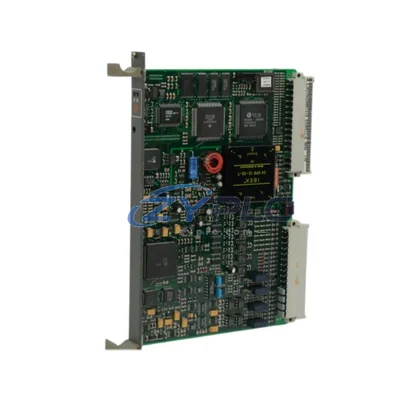
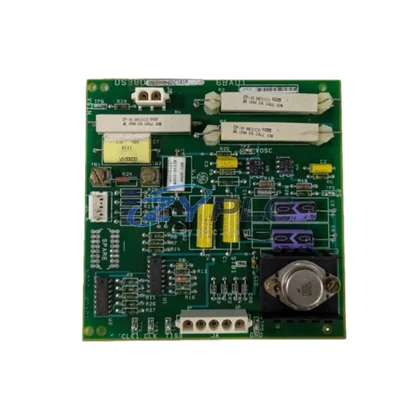
The GE DS200TCQCG1BKG is a high-performance turbine control module designed for the GE Mark V control platform, one of the most widely deployed turbine management systems in heavy industrial environments. In power generation plants, petrochemical facilities, and large-scale manufacturing operations, turbine efficiency directly determines energy cost per output unit. The DS200TCQCG1BKG addresses this challenge at the hardware level — delivering precise closed-loop control over turbine speed, load distribution, and fuel-to-output ratios that collectively reduce downtime risk during both steady-state operation and transient load changes.
Unlike generic replacement modules, the DS200TCQCG1BKG is engineered to integrate seamlessly within the Mark V architecture, communicating over the ARCNET serial bus with companion boards such as the DS200TCQAG1B (Turbine Control Quad Analog Board) and the DS200SDCIG2A (Speed and Dynamics Control Interface). This tight integration eliminates signal latency between the control layer and the drive execution layer, which is a primary source of downtime in poorly synchronized turbine systems.
Product Specification Table
| Parameter |
Specification / Value |
| SKU / Part Number |
DS200TCQCG1BKG |
| Compatible Platform |
GE Mark V Turbine Control System |
| Module Function |
Turbine Control Quad — speed, load, and fuel control |
| Operating Voltage |
24 VDC (via Mark V backplane) |
| Communication Protocol |
ARCNET (Mark V internal bus) |
| Application Environment |
Power generation, oil & gas, petrochemical, heavy industry |
| Maintenance Value |
Reduces fuel overconsumption via precise speed/load feedback loops |
| Control Mode |
Closed-loop PID turbine speed and load regulation |
| Origin |
United States (GE Power Controls) |
| Warranty |
Warranty and support terms confirmed before quote — tested and verified before shipment |
| Availability |
Confirmed via RFQ before quotation |
System Compatibility and Application
Effective turbine maintenance planning is never the result of a single module — it is the outcome of a well-integrated control architecture. The DS200TCQCG1BKG operates as the central control processor within a layered system that spans from field-level sensing to supervisory data acquisition.
At the field sensing layer, turbine shaft speed and vibration data are collected by proximity probes and fed into the DS200TCCBG1BKG (Turbine Control Communication Board), which preprocesses raw signals before passing them to the DS200TCQCG1BKG for closed-loop computation. Simultaneously, exhaust temperature thermocouples interface through the DS200TCDAG1A (Turbine Control Diagnostic Analog Board), providing the thermal feedback necessary for fuel trim adjustments that prevent over-firing — a common source of excess fuel consumption in aging turbine installations.
On the drive regulation side, the Mark V system interfaces with hydraulic servo actuators via the DS200TCEAG1B (Turbine Control Excitation Analog Board), which translates digital control signals from the DS200TCQCG1BKG into precise valve positioning commands. This direct digital-to-hydraulic pathway eliminates the signal degradation that occurs in older analog servo loops, improving valve response time and reducing the overshoot that wastes fuel during load transients.
For power monitoring and energy accounting, the Mark V platform connects to plant-level SCADA systems through the DS200TCPSG1A (Turbine Control Power Supply Board), which maintains stable backplane power to all control modules and ensures that energy measurement data is never corrupted by supply fluctuations. In facilities that have integrated the GE EX2100e Excitation Controller alongside the Mark V, the DS200TCQCG1BKG participates in coordinated generator excitation control, optimizing reactive power output and improving overall plant power factor — a measurable reduction in grid-side energy losses.
At the HMI and supervisory layer, operators interact with turbine energy data through GE Cimplicity or third-party SCADA platforms connected via Modbus TCP or OPC-DA gateways. Real-time visibility into heat rate, specific fuel consumption, and load efficiency ratios allows maintenance teams to identify degradation trends before they translate into measurable energy losses. The DS200TCQCG1BKG’s onboard diagnostics also generate fault codes that feed directly into predictive maintenance workflows, reducing unplanned downtime that would otherwise force inefficient cold-start restart cycles.
In facilities running parallel turbine trains, the DS200TCQBG1B (Turbine Control Quad Board variant) is often deployed alongside the DS200TCQCG1BKG to manage load-sharing between units, ensuring that the most efficient turbine carries the highest proportion of base load while less efficient units are throttled or placed in spinning reserve — a strategy that can reduce fleet-wide fuel consumption by 3–8% depending on load profile.
Maintenance and Replacement Notes
In a combined-cycle power plant operating at partial load, turbine control inefficiency manifests as excess fuel burn, elevated exhaust temperatures, and increased wear on hot-section components. The DS200TCQCG1BKG addresses all three failure modes through its high-resolution speed feedback processing and adaptive PID gain scheduling, which automatically adjusts control aggressiveness based on operating point — applying tighter control at base load and more damped responses during load ramp events to prevent compressor surge.
For industrial cogeneration facilities, where steam extraction for process heat must be balanced against electrical output, the DS200TCQCG1BKG’s load control algorithms maintain extraction pressure within ±0.5% of setpoint, preventing the pressure excursions that force operators to dump steam — a direct unplanned downtime that also reduces process line throughput. Plants that have replaced failed or degraded Mark V control modules with properly tested DS200TCQCG1BKG units have reported measurable reductions in heat rate deviation, with some facilities recovering 1–2% of annual fuel cost simply by restoring control loop integrity.
Maintenance cost reduction is another key energy-adjacent benefit. Because the DS200TCQCG1BKG undergoes full functional testing — including analog I/O calibration verification, ARCNET communication integrity checks, and power supply load testing — before shipment, facilities avoid the hidden costs of installing untested surplus modules that fail during commissioning or early operation. Each unit shipped under our warranty and support terms confirmed before quote has been verified against GE Mark V functional specifications, reducing the risk of repeat maintenance events that consume technician hours and force additional turbine outages.
In refineries and petrochemical plants where turbine-driven compressors run continuously, even a 0.5% improvement in turbine heat rate translates to significant annual operational stability at scale. The DS200TCQCG1BKG, by maintaining precise speed control within the compressor’s optimal efficiency island, prevents the efficiency penalties associated with speed hunting and load oscillation — two phenomena that are directly traceable to degraded or misconfigured turbine control hardware.
Product Sourcing FAQ
Q1: How does the DS200TCQCG1BKG contribute to measurable operational stability in turbine operations?
The module maintains closed-loop control over turbine speed and load with high resolution, minimizing fuel overconsumption caused by speed hunting, load oscillation, and poor transient response. By restoring control loop integrity, facilities typically recover 1–3% of fuel efficiency that is lost when aging or failed control hardware allows setpoint deviation to persist.
Q2: Is the DS200TCQCG1BKG compatible with all GE Mark V configurations?
The DS200TCQCG1BKG is designed for the GE Mark V turbine control platform and communicates via the ARCNET internal bus. It is compatible with standard Mark V panel configurations including TMR (Triple Modular Redundant) and simplex architectures. For Mark VI or Mark VIe systems, different module families apply — contact our technical team to confirm compatibility with your specific panel revision.
Q3: What is the replacement and testing process before shipment?
Every DS200TCQCG1BKG unit undergoes a structured pre-shipment test protocol that includes analog I/O verification, ARCNET communication integrity testing, visual inspection for component-level damage, and power supply load testing. Units that do not pass all test criteria are not shipped. This process ensures that replacement modules perform to specification from the first power-on, avoiding the commissioning delays and repeat outages associated with untested surplus inventory.
Q4: What does the warranty and support terms confirmed before quote cover, and what is the support process?
The warranty and support terms confirmed before quote covers functional failure under normal operating conditions consistent with GE Mark V system specifications. If a unit fails within the warranty period, we provide replacement or repair at no additional cost. Our technical support team is available to assist with installation guidance, fault code interpretation, and compatibility verification throughout the warranty period. Contact us at plc.sales@zyplc.com or +86 19859288691 for warranty claims and technical inquiries.