GE IC697RCM711: Industrial Data Link for Smart Factory Connectivity in Series 90-70 Systems
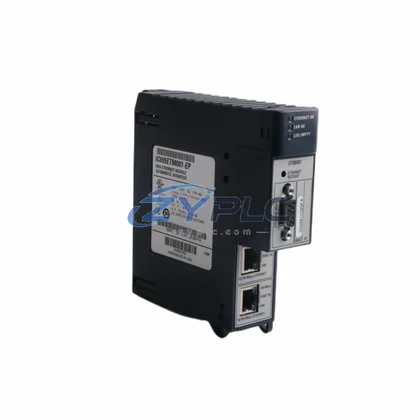
The GE Fanuc IC697RCM711 is a high-reliability Redundancy Communications Module engineered for the GE Series 90-70 PLC platform. Designed to serve as the critical data backbone between field devices and upper-level control systems, the IC697RCM711 enables seamless protocol communication, dual-channel failover, and real-time data exchange across complex industrial network architectures. Whether deployed in continuous process manufacturing, discrete automation, or hybrid smart factory environments, this module delivers the network stability and communication integrity that modern industrial operations demand.
In today’s connected factory, data isolation is one of the most persistent challenges facing automation engineers. The IC697RCM711 addresses this directly by bridging field-level signals from sensors, actuators, and remote I/O nodes with supervisory systems including SCADA platforms, HMI terminals, and MES layers. Its redundant communication architecture ensures that no single point of failure can interrupt the data flow between the Series 90-70 CPU rack and the broader control network.
Compatibility & Integration Notes
| Parameter |
Specification |
| SKU / Part Number |
IC697RCM711 |
| Brand |
GE Fanuc |
| Series |
GE Series 90-70 |
| Module Type |
Redundancy Communications Module |
| Protocol Support |
SRTP (Service Request Transfer Protocol), Genius Bus, SNP/SNPx, Modbus RTU (via gateway) |
| Interface Type |
Dual-channel redundant backplane interface, RS-485 compatible serial port |
| Transmission Capability |
High-speed synchronous data transfer between primary and backup CPU racks |
| Network Compatibility |
GE Series 90-70 rack bus, Ethernet TCP/IP (via paired CMM module), Genius I/O network |
| System Application |
SCADA integration, HMI data acquisition, redundant PLC control, remote I/O management |
| Operating Temperature |
0°C to 60°C (32°F to 140°F) |
| Product Origin |
USA |
| Warranty |
warranty terms confirmed during quotation |
| Availability |
RFQ Available — Ships within 1–3 Business Days |
Connected Automation Data Flow
The IC697RCM711 sits at the heart of a redundant Series 90-70 control architecture, managing the synchronization of memory, I/O state, and program execution data between the primary and standby CPU modules — typically the IC697CPU772 or IC697CPU781. This synchronization occurs continuously over the dedicated redundancy link, ensuring that the standby controller is always ready to assume control within milliseconds of a primary fault.
At the field level, the IC697RCM711 works in concert with Genius Bus Controllers such as the IC697BEM731, which aggregate signals from distributed I/O blocks, smart sensors, and field transmitters across the plant floor. These Genius I/O nodes relay process variables — temperature, pressure, flow, and discrete on/off states — back through the bus to the Series 90-70 CPU, where the IC697RCM711 ensures that both the primary and redundant controllers maintain identical, up-to-date process images.
For communication with upper-level systems, the IC697RCM711 is commonly paired with the IC697CMM711 or IC697CMM742 Ethernet Communications Module, which provides TCP/IP connectivity to SCADA servers running platforms such as iFIX, Wonderware, or Ignition. This pairing allows real-time process data to flow from the Series 90-70 rack directly to historian databases, operator HMI screens, and MES dashboards — enabling plant-wide visibility without compromising the integrity of the redundant control loop.
In drive and motion applications, the IC697RCM711 supports integration with GE AF-600 FP variable frequency drives and servo amplifiers connected via Genius Bus or serial links. Drive status, speed references, fault codes, and energy consumption data are all accessible through the network, enabling predictive maintenance workflows and remote diagnostics from the SCADA layer. Similarly, IC697MDL340 discrete input modules and IC697MDL753 output modules feed real-time I/O data into the redundant control loop managed by the IC697RCM711.
For installations requiring protocol translation between legacy serial devices and modern Ethernet networks, the IC697RCM711 is often deployed alongside edge gateways such as the Moxa MGate MB3180 or equivalent Modbus-to-Ethernet converters, allowing older field instruments to participate in the broader IIoT data ecosystem without requiring hardware replacement. This approach extends the operational life of existing plant assets while enabling the data transparency required for Industry 4.0 initiatives.
Solving Data Isolation in Industrial Sites
One of the most common pain points in legacy automation environments is the coexistence of multiple, incompatible communication protocols across different generations of equipment. A plant may have Series 90-70 PLCs communicating over Genius Bus, newer controllers using Profibus or EtherNet/IP, and field instruments still relying on 4–20 mA analog signals or HART protocol. Without a robust redundancy and communication strategy, these islands of automation operate in isolation — making plant-wide optimization impossible.
The IC697RCM711 directly addresses this challenge within the Series 90-70 ecosystem by ensuring that the redundant control pair always presents a unified, consistent process image to all connected systems. When the primary CPU fails or is taken offline for maintenance, the switchover is transparent to SCADA clients, HMI operators, and downstream control loops — eliminating the data gaps and alarm floods that typically accompany unplanned controller failures.
For remote monitoring and diagnostics, the IC697RCM711’s integration with Ethernet communication modules enables engineers to access controller diagnostics, fault logs, and I/O status from any networked workstation or mobile device — without requiring physical access to the control panel. This capability is particularly valuable in hazardous or geographically distributed installations such as oil and gas facilities, water treatment plants, and power generation sites.
System expansion is equally straightforward. The modular architecture of the Series 90-70 platform allows additional I/O racks, communication modules, and specialty function modules to be added without disrupting the existing redundant control structure. The IC697RCM711 supports this scalability by maintaining communication integrity across expanded rack configurations, ensuring that new devices are immediately visible to both the primary and standby controllers upon commissioning.
Every IC697RCM711 unit supplied by ZYPLC undergoes functional testing prior to shipment, verifying redundancy switchover performance, communication link integrity, and backplane signal quality. Units are shipped with full documentation and are backed by a warranty terms confirmed during quotation, with availability confirmed by RFQ availability ensuring lead times of 1–3 business days for most orders.
Industrial Connectivity FAQ
Q1: What is the typical switchover time for the IC697RCM711 redundancy system?
The IC697RCM711 is designed to achieve bumpless or near-bumpless switchover between the primary and standby Series 90-70 CPU modules. In most configurations, the switchover is completed within one PLC scan cycle, minimizing process disruption and preventing nuisance alarms at the SCADA or HMI level.
Q2: Is the IC697RCM711 compatible with modern SCADA and HMI platforms?
Yes. When paired with a compatible Ethernet Communications Module such as the IC697CMM711, the IC697RCM711 enables SRTP and Modbus TCP connectivity to leading SCADA platforms including Ignition, iFIX, Wonderware, and Citect. Most modern HMI and SCADA drivers natively support GE SRTP, ensuring straightforward integration without custom protocol development.
Q3: Can the IC697RCM711 be used in a mixed-protocol network environment?
The IC697RCM711 itself manages the redundancy communication link between Series 90-70 CPU racks. Protocol translation between Genius Bus, Modbus, and Ethernet TCP/IP is handled by companion communication modules within the same rack. This modular approach allows the Series 90-70 platform to participate in multi-protocol industrial networks without requiring a complete system replacement.
Q4: What quality assurance steps are performed before shipment?
All IC697RCM711 modules supplied by ZYPLC are subject to pre-shipment functional testing, including redundancy link verification, backplane communication checks, and visual inspection for physical damage. Each unit is shipped with a warranty terms confirmed during quotation covering defects in materials and workmanship, and our technical team is available to support installation and commissioning queries.