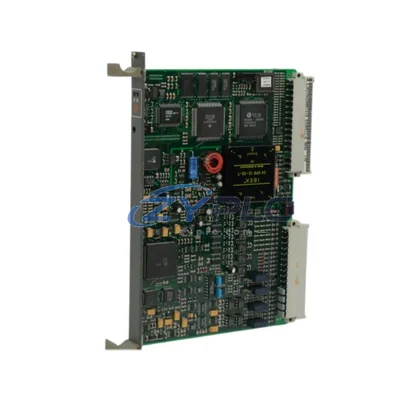
GE MIVII1000E00HI00 Industrial Network Interface for Mark VIe Systems: Precision Data Links for Smart Factory Connectivity
The GE MIVII1000E00HI00 is a high-performance Vibration I/O Pack engineered for the GE Mark VIe turbine control platform, operating within the IS200 Series architecture. Designed to bridge the gap between rotating machinery field sensors and upper-level control and monitoring systems, this module delivers deterministic, real-time vibration data across the industrial network — enabling operators to maintain continuous visibility into critical asset health, reduce downtime, and support the data-driven demands of modern smart factory environments.
In today’s industrial landscape, the ability to move accurate, low-latency data from field devices to SCADA, DCS, and cloud-based analytics platforms is not optional — it is the foundation of operational excellence. The MIVII1000E00HI00 fulfills this role by serving as a dedicated vibration signal acquisition and network communication node within the Mark VIe distributed control architecture, ensuring that every vibration event, bearing temperature excursion, or shaft displacement anomaly is captured, encoded, and transmitted without data loss or protocol mismatch.
Compatibility & Integration Notes
| Attribute |
Specification |
| SKU |
MIVII1000E00HI00 |
| Brand / Series |
GE / IS200 Series (Mark VIe) |
| Module Type |
Vibration I/O Pack — Industrial Communication Module |
| Communication Protocol |
IONet (GE proprietary high-speed I/O network), compatible with PROFINET and Modbus TCP via Mark VIe gateway |
| Interface Type |
Fiber-optic IONet, terminal block field wiring |
| Transmission Capability |
Real-time vibration data acquisition; deterministic scan cycle synchronised with Mark VIe controller |
| Network Compatibility |
Mark VIe IONet backbone; integrates with IS200, IS215, IS220 I/O packs on shared IONet segment |
| System Application |
Gas turbine, steam turbine, compressor train vibration monitoring; SCADA/HMI integration via Mark VIe OPC-DA/UA server |
| Origin |
United States |
| Warranty |
Warranty and support terms confirmed before quote — Tested before shipment, RFQ-based availability, global logistics support |
Connected Automation Data Flow
The MIVII1000E00HI00 sits at the heart of a layered industrial data architecture. At the field level, proximity probes, accelerometers, and velocity transducers feed raw vibration signals directly into the module’s high-impedance analog input channels. These signals are conditioned, digitised, and passed over the GE IONet fiber-optic backbone to the IS200VTURH1B turbine control I/O terminal board, which aggregates multiple I/O pack outputs for the Mark VIe controller.
The Mark VIe controller — typically a IS200ESELH1A Ethernet switch module paired with a IS200TRLYH1B relay output terminal board — processes the incoming vibration vectors in real time, executing alarm logic, trip setpoints, and trend calculations within its deterministic control cycle. This processed data is then published over the plant Ethernet network to GE Cimplicity HMI and GE OSIsoft PI-connected SCADA historians, giving control room operators and remote engineers a live view of machine health without polling delays.
For facilities running mixed-vendor environments, the Mark VIe’s built-in OPC-UA server acts as a protocol gateway, translating IONet-native data into standard industrial formats consumable by third-party SCADA platforms, Siemens WinCC, or Rockwell FactoryTalk systems. Downstream, the vibration data flows into edge analytics nodes — such as the GE Predix Edge gateway — where machine learning models flag bearing wear patterns before they escalate into forced outages.
Within the IS200 ecosystem, the MIVII1000E00HI00 operates alongside complementary modules including the IS200VSVOH1B servo valve output pack, the IS200TTURH1B turbine terminal board, and the IS220PTURH1B turbine protection I/O pack. Together, these components form a tightly integrated control and protection network where vibration, temperature, speed, and position data converge at the Mark VIe controller, enabling coordinated turbine start-up sequences, load ramp management, and emergency shutdown responses — all with sub-millisecond inter-module communication latency over the IONet segment.
Variable frequency drives monitoring compressor auxiliaries, such as the GE AF-600 FP series, also benefit from this data chain: vibration feedback from the MIVII1000E00HI00 can be cross-referenced with drive current signatures to detect mechanical resonance conditions early, allowing maintenance teams to schedule corrective action during planned outages rather than reacting to unplanned trips.
Solving Data Isolation in Industrial Sites
One of the most persistent challenges in legacy turbine and compressor installations is data isolation — where vibration monitoring systems, PLC controllers, and SCADA platforms operate in separate silos with no unified data pathway. The MIVII1000E00HI00 directly addresses this by functioning as a native IONet node within the Mark VIe architecture, eliminating the need for standalone vibration monitoring panels that cannot share data with the plant DCS.
Protocol fragmentation is another common barrier. Older installations may rely on 4–20 mA analog loops or proprietary serial protocols that cannot be directly ingested by modern Ethernet-based SCADA systems. By integrating the MIVII1000E00HI00 into the Mark VIe platform — which natively supports OPC-DA, OPC-UA, and Modbus TCP at the controller level — operators gain a single, standards-compliant data pathway from field sensor to enterprise historian, without requiring additional protocol converters or middleware servers.
Remote monitoring and diagnostics are equally transformed. With vibration data continuously available on the plant OPC-UA server, remote engineers can access real-time and historical trend data through secure VPN connections, enabling condition-based maintenance decisions from any location. Alarm thresholds configured in the Mark VIe controller propagate automatically to connected HMI and SCADA displays, ensuring that no alert is missed regardless of where the operator is stationed.
For facilities planning system expansion — adding new turbine trains, integrating additional compressor strings, or extending the IONet segment to cover new production areas — the MIVII1000E00HI00’s modular design supports incremental scale-out without requiring controller replacement or network redesign. New I/O packs can be added to existing IONet segments, and the Mark VIe controller’s configuration tools automatically recognise and commission new modules, reducing engineering time and commissioning risk.
Every MIVII1000E00HI00 unit supplied by ZYPLC undergoes pre-shipment functional testing, verifying channel accuracy, IONet communication handshake, and alarm output integrity before dispatch. RFQ-based availability ensures short lead times for both planned maintenance replacements and emergency procurement scenarios, Warranty terms are confirmed during quotation.
Industrial Connectivity FAQ
Q1: What communication protocols does the GE MIVII1000E00HI00 support, and how does it integrate with third-party SCADA systems?
The MIVII1000E00HI00 communicates natively over GE’s IONet fiber-optic I/O network within the Mark VIe architecture. Integration with third-party SCADA platforms is achieved through the Mark VIe controller’s OPC-DA and OPC-UA server interfaces, which translate IONet data into standard industrial protocols. Modbus TCP access is also available via the Mark VIe Ethernet gateway, enabling connectivity with Wonderware, Ignition, Siemens WinCC, and other SCADA environments without additional hardware.
Q2: What is the communication latency, and is the data transmission deterministic?
The IONet backbone operates on a deterministic, time-synchronised scan cycle managed by the Mark VIe controller, typically achieving sub-millisecond I/O update rates. This ensures that vibration alarm conditions are detected and acted upon within the controller’s protection response time, which is critical for turbine overspeed and high-vibration trip functions. Network latency to SCADA historian layers is dependent on plant Ethernet infrastructure but does not affect the controller’s protective response.
Q3: Can the MIVII1000E00HI00 be used in mixed-vendor control environments alongside non-GE PLCs or DCS platforms?
Yes, with appropriate gateway configuration. While the module is natively designed for the GE Mark VIe IONet architecture, the Mark VIe controller’s OPC-UA and Modbus TCP interfaces allow vibration data to be shared with non-GE control systems, including Siemens S7, Allen-Bradley ControlLogix, and Emerson DeltaV platforms. For direct integration without a Mark VIe controller, a dedicated protocol gateway would be required.
Q4: What does the warranty and support terms confirmed before quote cover, and what pre-shipment testing is performed?
Each MIVII1000E00HI00 unit is functionally tested prior to shipment, including IONet communication verification, analog input channel calibration checks, and alarm output validation. The warranty and support terms confirmed before quote covers manufacturing defects, communication failures, and component faults under normal operating conditions. ZYPLC maintains Availability confirmed by RFQ inventory of this module to support both planned maintenance schedules and emergency replacement requirements, with global logistics support for expedited delivery.