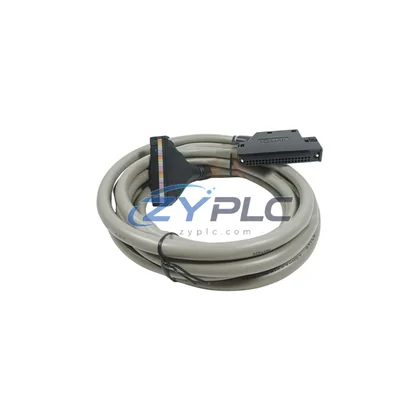
Honeywell 2MLC-E061 Extension Cable for 2MLC: Compatibility and Replacement Notes
In modern industrial automation, the integrity of a control system depends not only on the intelligence of its controllers and the precision of its sensors, but equally on the reliability of every interconnecting component within the signal chain. The Honeywell 2MLC-E061 Limit Switch Extension Cable is engineered specifically for deployment within the 2MLC Series architecture, serving as a critical link between field-mounted limit switches and the control cabinet’s I/O termination layer. When system architects design layered automation platforms — spanning the control layer, I/O layer, network layer, power layer, HMI layer, and actuator layer — the quality and compatibility of extension cabling directly determines signal fidelity, diagnostic accuracy, and long-term maintenance efficiency.
The 2MLC-E061 is not a generic cable assembly. It is a purpose-built extension designed to maintain the electrical and mechanical continuity of the Honeywell 2MLC Series limit switch ecosystem, ensuring that position feedback signals from actuators and mechanical stops are transmitted cleanly to the I/O modules and ultimately to the CPU for real-time processing. In high-cycle manufacturing environments, petrochemical plants, water treatment facilities, and mining operations, even minor signal degradation at the field wiring level can cascade into false trips, unplanned downtime, and costly diagnostic cycles. The 2MLC-E061 eliminates this risk by providing a factory-matched, system-validated interconnect solution.
Product Specification Table
| Parameter |
Specification |
| Part Number |
2MLC-E061 |
| Brand |
Honeywell |
| Series |
2MLC Series |
| Product Type |
Limit Switch Extension Cable |
| System Role |
Field-to-Cabinet Signal Extension, I/O Layer Interconnect |
| Compatible Devices |
Honeywell 2MLC Series Limit Switches |
| Electrical Parameters |
Matched to 2MLC Series electrical ratings; low-resistance conductor path for signal integrity |
| Communication Capability |
Passive signal conductor; supports discrete I/O signal transmission to PLC/DCS I/O modules |
| Installation Environment |
Industrial field environments; compatible with standard control cabinet wiring practices |
| Origin |
United States |
| Warranty |
warranty terms confirmed during quotation |
| system integration |
Designed for system integration within 2MLC Series control architectures |
System Compatibility Notes
The 2MLC-E061 extension cable achieves its full value when understood within the context of a complete, coordinated control system. In a typical 2MLC Series deployment, the limit switch itself — such as the Honeywell 2MLC-E060 or other 2MLC Series actuator-mounted switches — provides discrete position feedback at the machine level. The 2MLC-E061 extends this signal reliably from the field device to the control cabinet’s terminal block or I/O module, where it interfaces with the broader automation architecture.
At the control layer, a Honeywell Safety Manager or a third-party PLC such as a Siemens S7-300/S7-400 series CPU or an Allen-Bradley ControlLogix processor receives the discrete input signal via the I/O module. The I/O layer typically consists of digital input modules — for example, Honeywell Safety Manager I/O cards or equivalent DCS I/O modules — which scan the limit switch state at high frequency to support real-time control logic. The 2MLC-E061 ensures that the signal path between the 2MLC Series switch and these I/O modules remains electrically stable, free from impedance mismatches or connector degradation that could introduce noise or false readings.
At the network layer, the processed I/O data is communicated upstream via industrial protocols such as PROFIBUS DP, Modbus RTU, or EtherNet/IP, depending on the system architecture. Communication gateways or protocol converters may be employed to bridge field-level discrete signals into higher-level SCADA or DCS networks. The power layer — comprising 24VDC power supplies, surge protection modules, and distribution terminal blocks — provides the stable voltage reference required for reliable limit switch operation. Proper cable routing and shielding practices, as supported by the 2MLC-E061’s design, prevent power supply noise from coupling into the signal conductors.
At the HMI layer, operators monitor limit switch states through graphical displays, alarm management systems, and trend historians. Accurate, noise-free signals from the 2MLC-E061 ensure that HMI representations of valve positions, door interlocks, or conveyor end-stops are always current and reliable. At the actuator layer, the limit switch and its extension cable form the final feedback loop, confirming that pneumatic actuators, electric drives, or mechanical stops have reached their commanded positions. In redundant architectures, dual limit switch assemblies with independent 2MLC-E061 extension cables may be routed to separate I/O modules, providing fault-tolerant position feedback that supports SIL-rated safety functions.
Industrial Application Notes
The Honeywell 2MLC-E061 finds application across a broad spectrum of industrial sectors where reliable position feedback is non-negotiable. In discrete manufacturing and automotive assembly lines, limit switches with 2MLC-E061 extension cables confirm the position of robotic end-effectors, fixture clamps, and conveyor diverters, enabling high-speed cycle times without sacrificing safety interlock integrity. In the power generation sector — including thermal, hydro, and renewable energy plants — the 2MLC-E061 supports valve position monitoring on turbine bypass systems, cooling water circuits, and fuel feed lines, where a missed position signal can trigger costly unit trips.
In petrochemical and refinery environments, the extension cable’s robust construction supports deployment in areas subject to vibration, thermal cycling, and chemical exposure. Limit switches on emergency shutdown valves (ESDVs) and blowdown valves rely on the 2MLC-E061 to deliver unambiguous open/closed feedback to the safety instrumented system (SIS), supporting proof test intervals and SIL verification requirements. In water and wastewater treatment facilities, the cable extends limit switch signals from pump station isolation valves and filter press mechanisms to remote I/O panels, reducing field wiring complexity and simplifying commissioning.
Mining and metallurgical operations benefit from the 2MLC-E061’s ability to maintain signal integrity in high-vibration, high-dust environments, where conveyor belt alignment switches, crusher feed gates, and hopper discharge valves require continuous position monitoring. In packaging and material handling systems, the extension cable supports high-cycle limit switch applications on filling machines, labeling stations, and palletizing robots, where connector reliability directly impacts overall equipment effectiveness (OEE). Across all these applications, the 2MLC-E061 contributes to system consistency, reduces unplanned maintenance interventions, and supports the long-term reliability goals of plant engineering teams.
Product Compatibility FAQ
Q1: Is the 2MLC-E061 compatible with all 2MLC Series limit switches, and can it be used in safety-rated (SIL) architectures?
The 2MLC-E061 is designed as a factory-matched extension cable for the Honeywell 2MLC Series limit switch family, ensuring electrical and mechanical compatibility across the series. When used in SIL-rated safety architectures, the cable should be routed and installed in accordance with IEC 61508 and IEC 62061 field wiring guidelines, including appropriate cable segregation, shielding, and termination practices. The warranty terms confirmed during quotation covers manufacturing defects and ensures that the cable meets its specified performance parameters throughout the warranty period.
Q2: How does the 2MLC-E061 support long-term maintenance efficiency in large-scale control systems?
By using a factory-matched, series-specific extension cable, maintenance teams eliminate the variability introduced by field-fabricated cable assemblies. The 2MLC-E061’s standardized connectors and conductor specifications simplify spare parts management, reduce mean time to repair (MTTR) during corrective maintenance, and support predictive maintenance programs by ensuring that cable-related signal anomalies are not misdiagnosed as sensor or I/O module failures. system integration with the 2MLC Series architecture means that replacement cables can be installed without re-calibration or re-parameterization of the connected limit switch.
Q3: What installation and commissioning best practices apply to the 2MLC-E061 in multi-axis or multi-zone control cabinets?
During commissioning, each 2MLC-E061 extension cable should be continuity-tested and insulation-resistance-checked before connection to the I/O module. Cable routing should maintain minimum bend radius requirements and avoid proximity to high-voltage power conductors or variable frequency drive (VFD) output cables to prevent electromagnetic interference. In multi-zone cabinets, cables should be labeled in accordance with the system’s tag numbering convention to facilitate future troubleshooting. The warranty terms confirmed during quotation provides assurance that any cable exhibiting premature failure due to manufacturing defects will be replaced, supporting the commissioning team’s confidence in system handover.