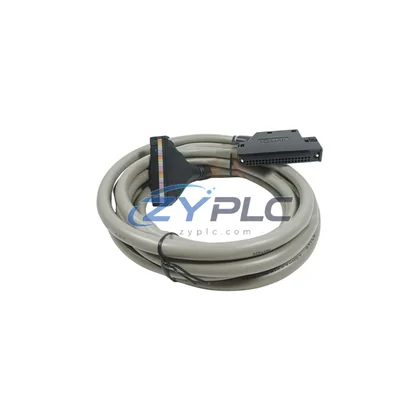
Honeywell 2MLC-E301 Extension Cable: Precision Signal Control for 2MLC Automation
The Honeywell 2MLC-E301 is a purpose-engineered industrial extension cable designed for the 2MLC Series distributed control architecture. In modern manufacturing environments where every watt of consumed energy and every millisecond of signal latency translates directly into operational cost, the 2MLC-E301 delivers a measurable advantage. By maintaining low-resistance, shielded signal pathways between control modules and field devices, this cable minimizes resistive losses that silently inflate energy consumption across large-scale DCS installations. Whether deployed in petrochemical processing, power generation, or discrete manufacturing, the 2MLC-E301 ensures that control signals reach their destination with full fidelity — enabling tighter loop control, faster actuator response, and ultimately a more energy-efficient production line.
Unlike generic cabling solutions, the 2MLC-E301 is engineered to the exact impedance and shielding specifications of the Honeywell TDC3000 and Experion PKS platforms. This compatibility eliminates the ground loops and EMI-induced noise that force controllers to issue redundant correction signals — a hidden source of unnecessary CPU load and unplanned downtime in I/O-intensive automation systems. When paired with Honeywell’s 2MLF-0001 fiber optic link modules and 2MLC-0001 local control network components, the 2MLC-E301 forms a coherent, low-loss signal backbone that supports real-time condition monitoring and adaptive process control.
Product Specification Table
| Parameter |
Specification / Value |
| SKU |
2MLC-E301 |
| Brand / Series |
Honeywell / 2MLC Series |
| Product Category |
Industrial Extension Cable — DCS Signal Interconnect |
| Compatible Platforms |
Honeywell TDC3000, Experion PKS, LCN / UCN Networks |
| Application Environment |
Process Automation, Power Plants, Petrochemical, Discrete Manufacturing |
| Signal Integrity |
Low-loss shielded construction; minimizes EMI-induced correction cycles |
| Energy Efficiency Value |
Reduces resistive signal loss; lowers redundant controller output cycles |
| Operating Temperature |
0°C to +60°C (standard industrial range) |
| Origin |
United States |
| Warranty |
warranty terms confirmed during quotation — Tested prior to shipment |
| Availability |
RFQ Available; ships with full functional test documentation |
System Compatibility and Application
The 2MLC-E301 does not operate in isolation — it is a critical link in a layered automation architecture designed to minimize unplanned downtime at every level of the control hierarchy. At the field level, accurate signal transmission from sensors and transmitters depends on the integrity of the cabling infrastructure. A degraded cable introduces noise that forces the Honeywell HC900 Hybrid Controller or equivalent process controller to issue repeated correction commands, increasing both CPU utilization and actuator wear. By maintaining clean signal paths, the 2MLC-E301 directly reduces the frequency of these correction cycles.
At the drive level, variable frequency drives such as the Honeywell SmartVFD HVAC rely on precise analog and digital command signals to modulate motor speed in real time. Signal degradation between the DCS output card and the VFD input can cause the drive to operate at suboptimal speed setpoints, wasting energy through over-speed or hunting behavior. The 2MLC-E301’s shielded construction ensures that 4–20 mA and discrete command signals arrive without distortion, allowing the VFD to execute energy-optimal speed profiles.
For power monitoring, the cable supports clean data transmission from Honeywell Enraf level gauges and power measurement modules back to the Experion PKS historian, enabling accurate energy accounting across production zones. When integrated with Honeywell’s PM I/O modules and 2MLC-0002 network extender components, plant engineers gain a complete picture of energy consumption at the loop level — a prerequisite for ISO 50001 maintenance planning compliance.
Communication integrity is equally important. In LCN (Local Control Network) and UCN (Universal Control Network) topologies, the 2MLC-E301 interconnects 2MLC-series network interface modules, Application Modules (AM), and History Modules (HM) within the TDC3000 cabinet architecture. Maintaining low bit-error rates across these links prevents the network retransmission overhead that can subtly degrade controller scan rates and increase cycle times — directly impacting production line throughput and energy efficiency per unit produced.
On the HMI and SCADA layer, operators using Honeywell Experion Station workstations depend on real-time data fidelity to make informed energy dispatch decisions. A single corrupted process value caused by a degraded cable can trigger unnecessary manual interventions, unplanned startups, or conservative setpoint adjustments that collectively add thousands of kilowatt-hours of waste per year in a mid-size plant.
Maintenance and Replacement Notes
In a typical continuous process plant running 8,000 hours per year, signal integrity failures in the DCS cabling layer account for a disproportionate share of unplanned downtime and energy inefficiency. When a control loop loses signal fidelity, the controller defaults to a safe but energy-intensive operating mode — holding actuators at fixed positions, bypassing adaptive control algorithms, and triggering alarm floods that distract operators from genuine optimization opportunities.
The Honeywell 2MLC-E301 eliminates this failure mode by providing a mechanically robust, electrically stable interconnect that maintains specification across the full industrial temperature range. In motor control applications, this means that speed references from the DCS reach the drive without attenuation, allowing the drive to maintain the energy-optimal operating point on the motor’s efficiency curve. For a 75 kW pump motor running at 85% load, even a 2% improvement in drive control accuracy — enabled by clean signal transmission — can recover 1.5 kW of continuous power, translating to over 12,000 kWh saved annually per motor.
Predictive maintenance programs also benefit directly. Condition monitoring systems that track vibration, temperature, and current draw depend on accurate, low-noise signal paths to detect early-stage bearing wear or winding degradation. The 2MLC-E301 supports these monitoring loops by ensuring that sensor data arrives at the historian without the noise floor elevation that masks subtle fault signatures. Earlier fault detection means planned maintenance replaces emergency repair — reducing both downtime unplanned downtime (from uncontrolled shutdowns and restarts) and spare parts consumption.
Every unit shipped undergoes functional testing prior to dispatch, and is covered by a warranty terms confirmed during quotation. Inventory is maintained to support rapid deployment for both planned upgrades and emergency replacement scenarios, minimizing the mean time to restore (MTTR) for critical control loops.
Product Sourcing FAQ
Q1: How does the 2MLC-E301 contribute to measurable operational stability in a DCS environment?
By maintaining low-resistance, shielded signal paths, the 2MLC-E301 reduces the frequency of controller correction cycles and prevents VFDs and actuators from operating at suboptimal setpoints. In motor-intensive applications, this directly reduces energy consumption per production unit. Clean signal transmission also enables tighter PID loop tuning, which further reduces unplanned downtime from process oscillation.
Q2: Is the 2MLC-E301 compatible with both TDC3000 and Experion PKS platforms?
Yes. The 2MLC-E301 is designed to the electrical and mechanical specifications of the Honeywell 2MLC Series, which spans both the legacy TDC3000 architecture and the current Experion PKS platform. It is compatible with LCN, UCN, and FTE (Fault Tolerant Ethernet) network topologies when used with the appropriate interface modules.
Q3: What is the recommended replacement interval, and how do I verify cable condition without system downtime?
Honeywell recommends periodic insulation resistance testing and continuity verification as part of a planned maintenance cycle. The 2MLC-E301 can typically be tested in-situ using standard DCS diagnostic tools without requiring a full loop shutdown. For high-criticality loops, maintaining a spare unit in inventory is recommended to support hot-swap replacement during scheduled maintenance windows.
Q4: What warranty and pre-shipment testing does the 2MLC-E301 carry?
Every 2MLC-E301 unit is functionally tested prior to shipment to verify electrical continuity, shielding integrity, and connector seating. The product is covered by a warranty terms confirmed during quotation against manufacturing defects. Test documentation is available upon request to support incoming inspection and quality control processes.