Honeywell 2MLR-DBDFS Network Interface for ControlEdge Systems: Industrial Data Link and Smart Factory Connectivity
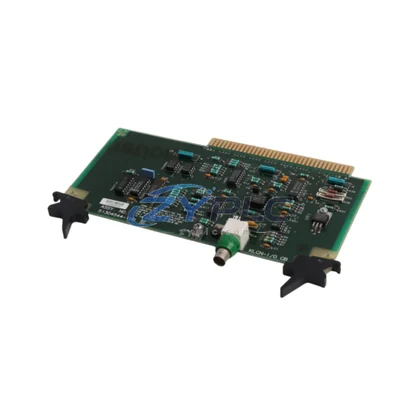
The Honeywell 2MLR-DBDFS is a redundant fiber expansion driver module engineered for high-availability industrial network architectures within the Honeywell ControlEdge distributed control system platform. In modern smart manufacturing environments, seamless data flow between field devices, controllers, remote I/O nodes, and supervisory systems is not a luxury — it is the operational backbone of every productive production line. The 2MLR-DBDFS addresses this need by providing a robust, fiber-optic redundant communication link that ensures continuous, interference-free data transmission across the control network, even in the most electrically noisy industrial environments.
At its core, the 2MLR-DBDFS functions as a critical bridge in the ControlEdge communication architecture. It connects the controller backplane to remote expansion racks via dual fiber paths, eliminating single points of failure that could otherwise cause costly unplanned downtime. The fiber medium itself provides inherent immunity to electromagnetic interference (EMI) and radio frequency interference (RFI), making this module ideal for deployment in heavy industrial sites such as petrochemical plants, power generation facilities, steel mills, and large-scale process manufacturing operations where copper-based communication links are vulnerable to signal degradation.
Compatibility & Integration Notes
| Parameter |
Specification |
| Product SKU |
2MLR-DBDFS |
| Brand / Series |
Honeywell / ControlEdge |
| Module Type |
Redundant Fiber Expansion Driver |
| Communication Medium |
Dual Fiber Optic (Redundant Paths) |
| Interface Type |
Fiber Expansion Bus Interface |
| Protocol Support |
ControlEdge Proprietary Expansion Bus, compatible with FTE (Fault Tolerant Ethernet) architecture |
| Network Compatibility |
Honeywell ControlEdge DCS, Experion PKS integration-ready |
| Redundancy |
Dual-path fiber redundancy for high availability |
| Application Environment |
Process industries, petrochemical, power, utilities, manufacturing |
| EMI/RFI Immunity |
High — fiber optic medium |
| System Expansion |
Supports remote I/O rack extension over fiber |
| Warranty |
Warranty and support terms confirmed before quote — tested before shipment |
Connected Automation Data Flow
Understanding the 2MLR-DBDFS requires viewing it within the full data flow of a ControlEdge-based automation system. At the field level, process sensors — including pressure transmitters, flow meters, temperature elements, and level sensors — feed analog and digital signals into ControlEdge remote I/O modules mounted in expansion racks. These racks communicate back to the primary controller chassis via the 2MLR-DBDFS fiber expansion driver, which carries all I/O data across the fiber link with deterministic, low-latency performance.
Within the controller chassis, the Honeywell ControlEdge HC900 controller or compatible ControlEdge PLC processes the incoming field data, executes control logic, and issues output commands back through the same fiber path to actuators, control valves, and motor starters in the field. The redundant fiber architecture means that if one fiber path experiences a fault — whether due to a cable break, connector degradation, or transceiver failure — the secondary path immediately assumes full communication responsibility without any interruption to the control loop.
At the supervisory level, the ControlEdge system connects upward to Honeywell Experion PKS SCADA and DCS platforms via Fault Tolerant Ethernet (FTE) network infrastructure. Operators monitoring the plant from an Experion Station HMI receive real-time process data, alarm notifications, and trend information that originates from the field devices connected through the 2MLR-DBDFS expansion network. This unbroken data chain — from sensor to controller to SCADA to operator display — is what makes the 2MLR-DBDFS a foundational component rather than a peripheral accessory.
For plants running mixed automation architectures, the ControlEdge platform also supports integration with Modbus RTU and Modbus TCP devices through dedicated communication modules, allowing legacy field instruments and third-party variable frequency drives (VFDs) to participate in the same unified data network. PROFIBUS DP communication modules within the ControlEdge ecosystem further extend connectivity to field devices such as intelligent motor control centers, smart valve positioners, and distributed I/O nodes from multiple vendors. The 2MLR-DBDFS expansion driver ensures that all of this distributed I/O data reaches the controller reliably, regardless of the physical distance between the controller room and the field junction boxes.
In larger plant configurations, multiple remote I/O expansion racks — each connected via its own 2MLR-DBDFS or companion expansion driver modules — can be distributed across different process areas, with fiber runs extending hundreds of meters without signal loss. This architecture supports the kind of plant-wide transparency that modern industrial operations demand: every motor, valve, sensor, and actuator visible and controllable from a central operations center, with data latency measured in milliseconds rather than seconds.
Edge computing nodes and industrial IoT gateways can tap into the ControlEdge data stream to feed analytics platforms, energy management systems, and predictive maintenance applications. By aggregating real-time process data from the 2MLR-DBDFS-connected I/O network, these edge systems can identify patterns of equipment degradation, optimize energy consumption across motor-driven loads, and generate maintenance work orders before failures occur — transforming raw field data into actionable operational intelligence.
Solving Data Isolation in Industrial Sites
One of the most persistent challenges in industrial automation is data isolation — the condition where field devices, controllers, and supervisory systems operate in disconnected silos, preventing operators and engineers from gaining a unified view of plant performance. The Honeywell 2MLR-DBDFS directly addresses this challenge by extending the ControlEdge communication backbone to remote process areas that would otherwise require separate, standalone control systems.
In older plant configurations, remote process areas are often controlled by independent PLCs or standalone controllers that communicate with the central DCS only through hardwired analog signals or slow serial links. This creates protocol fragmentation: each subsystem speaks a different language, and integrating their data into a unified SCADA view requires custom protocol converters, manual data entry, or expensive middleware solutions. The 2MLR-DBDFS eliminates this fragmentation by bringing remote I/O directly into the ControlEdge network fabric, where all data is natively available to the Experion PKS historian, alarm management system, and operator displays.
Remote monitoring and diagnostics are also significantly enhanced by the fiber expansion architecture. Because the 2MLR-DBDFS carries not only process I/O data but also module health and diagnostic information, maintenance engineers can remotely assess the status of expansion racks, identify communication faults, and plan corrective actions without dispatching technicians to remote field locations. This capability reduces maintenance travel time, accelerates fault resolution, and supports the shift from reactive to predictive maintenance strategies.
Production line transparency — the ability to see real-time throughput, quality metrics, and equipment status across the entire plant — depends on reliable, low-latency data collection from every process area. The redundant fiber paths of the 2MLR-DBDFS ensure that data collection is never interrupted by a single cable fault, maintaining the continuous data stream that production management systems, OEE (Overall Equipment Effectiveness) dashboards, and energy monitoring platforms require to deliver accurate, actionable insights.
System scalability is another key advantage. As production capacity expands or process configurations change, additional remote I/O racks can be added to the ControlEdge network by deploying additional expansion driver modules. The fiber-based architecture supports long-distance rack placement without the signal degradation constraints of copper-based expansion buses, giving plant engineers the flexibility to locate I/O hardware where it is most operationally convenient rather than where cable runs are shortest.
Every Honeywell 2MLR-DBDFS unit supplied by ZYPLC undergoes comprehensive functional testing prior to shipment, verifying fiber interface integrity, redundancy switching performance, and backplane communication reliability. Units are shipped with full documentation and are Warranty terms are confirmed during quotation.
Industrial Connectivity FAQ
Q1: What communication latency can be expected through the 2MLR-DBDFS fiber expansion link?
The 2MLR-DBDFS is designed for deterministic, low-latency communication consistent with the ControlEdge expansion bus specification. Fiber optic transmission eliminates the propagation delays associated with electrical signal conditioning in copper-based links, and the redundant architecture ensures that path-switching events — in the event of a primary fiber fault — occur transparently without introducing measurable latency spikes into the control loop. Actual latency figures depend on the ControlEdge controller scan rate and system configuration.
Q2: Is the 2MLR-DBDFS compatible with both ControlEdge and Experion PKS system architectures?
The 2MLR-DBDFS is a ControlEdge platform component and operates within the ControlEdge expansion bus architecture. ControlEdge systems can be integrated with Honeywell Experion PKS at the supervisory network level via FTE (Fault Tolerant Ethernet), allowing process data from 2MLR-DBDFS-connected I/O to be visible within the Experion environment. Direct installation into an Experion PKS chassis is not supported; the module is specific to the ControlEdge hardware platform.
Q3: What testing is performed on the 2MLR-DBDFS before shipment, and what does the warranty cover?
Every 2MLR-DBDFS unit supplied by ZYPLC is functionally tested prior to dispatch. Testing includes verification of both fiber interface channels, redundancy path switching, backplane communication integrity, and module self-diagnostics. The warranty and support terms confirmed before quote covers hardware defects and functional failures under normal operating conditions. Units are shipped with appropriate protective packaging to prevent transit damage.
Q4: Can the 2MLR-DBDFS support system expansion as additional remote I/O racks are added to the plant?
Yes. The fiber expansion architecture supported by the 2MLR-DBDFS is designed for scalability. Additional remote I/O expansion racks can be integrated into the ControlEdge network by deploying additional expansion driver modules, subject to the controller’s maximum I/O capacity and the ControlEdge system configuration limits. Fiber runs can extend over significant distances — far exceeding the practical limits of copper expansion buses — making the 2MLR-DBDFS well suited for geographically distributed process areas within large industrial facilities.