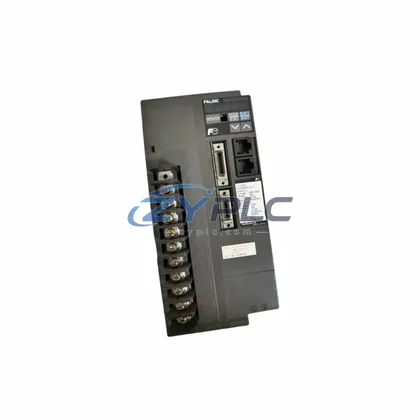
KUKA KSD1-48 EtherCAT Servo Drive for KSD1 Systems: Industrial Data Link and Smart Factory Connectivity
In modern smart manufacturing environments, the ability to maintain seamless, real-time data flow between field-level devices and upper-level control systems is no longer optional — it is the foundation of operational efficiency. The KUKA KSD1-48 EtherCAT Servo Drive, part of the proven KSD1 Series, is engineered to serve as a high-performance motion control and network communication node within complex industrial automation architectures. Whether deployed in robotic welding cells, precision assembly lines, or multi-axis CNC machining centers, the KSD1-48 delivers the real-time responsiveness and protocol-level integration that modern factories demand.
The KSD1-48 operates on the EtherCAT (Ethernet for Control Automation Technology) protocol — one of the fastest and most deterministic fieldbus standards available in industrial automation today. With cycle times in the microsecond range and distributed clock synchronization, EtherCAT enables the KSD1-48 to participate in tightly coordinated multi-axis motion sequences without introducing latency or jitter that could compromise product quality or machine safety. This makes it an ideal drive component for KUKA robot controllers such as the KRC4 and KRC5 platforms, where synchronized servo motion is critical to path accuracy and repeatability.
Compatibility & Integration Notes
| Parameter |
Specification |
| Communication Protocol |
EtherCAT (IEC 61158) |
| Interface Type |
RJ45 EtherCAT IN / OUT |
| Transmission Capability |
100 Mbit/s, full-duplex, real-time deterministic |
| Network Compatibility |
KUKA KRC4, KRC5, EtherCAT Master Controllers |
| System Application |
Robotic servo axis control, multi-axis synchronization, SCADA/HMI integration |
| Supported Variants |
KSD1-08, KSD1-16, KSD1-32, KSD1-48, KSD1-64 |
| Warranty |
Warranty and support terms confirmed before quote – Tested before shipment |
Connected Automation Data Flow
The KSD1-48 does not operate in isolation. Its value is fully realized when understood as a node within a broader industrial data architecture. At the field level, encoder feedback signals from KUKA servo motors — including the KSD1-08 and KSD1-16 variants in smaller-axis configurations — are continuously sampled and transmitted upstream via EtherCAT frames to the robot controller. The KUKA KRC4 controller acts as the EtherCAT master, orchestrating motion commands across all connected drives in real time.
Within the control cabinet, the KSD1-48 interfaces with the KPP (KUKA Power Pack) supply module, which provides the DC bus voltage required for servo operation. The KPP and KSD1 drives share a common DC link, enabling regenerative energy exchange between braking and accelerating axes — a key contributor to system-level energy efficiency. Alongside the KSD1-48, the KSD1-32 and KSD1-64 variants may be deployed on the same EtherCAT segment to handle axes with different torque and speed requirements, all managed through a unified network topology.
At the supervisory level, data from the KRC4 controller is forwarded to SCADA systems and HMI panels via OPC-UA or PROFINET gateways, enabling operators to monitor servo load, cycle counts, temperature trends, and fault codes in real time. Integration with KUKA.WorkVisual software allows engineers to configure EtherCAT network topology, assign drive addresses, and validate communication integrity before commissioning. For facilities running mixed-protocol environments, an industrial EtherCAT-to-PROFIBUS gateway can bridge the KSD1-48’s data stream into legacy Siemens S7 PLC networks, ensuring backward compatibility without sacrificing real-time performance.
Remote I/O modules connected downstream of the KRC4 can relay digital and analog signals from proximity sensors, torque transducers, and safety relays back through the EtherCAT network, giving the KSD1-48 the contextual awareness needed for adaptive motion control. In facilities where edge computing is deployed, an industrial edge gateway can aggregate KSD1 drive telemetry — including current draw, position error, and thermal status — and push this data to cloud-based MES or ERP platforms for predictive maintenance scheduling.
Solving Data Isolation in Industrial Sites
One of the most persistent challenges in industrial automation is the fragmentation of data across incompatible protocols and isolated control islands. A factory may operate KUKA robots on EtherCAT alongside Siemens PLCs on PROFINET, Mitsubishi controllers on CC-Link, and legacy equipment on RS-485 Modbus — each generating valuable operational data that never reaches a unified monitoring platform.
The KSD1-48, by virtue of its native EtherCAT implementation, eliminates the communication bottleneck at the servo drive level. Because EtherCAT supports hot-connect topology and automatic address assignment, adding or replacing a KSD1-48 in a running system does not require network reconfiguration or downtime. This plug-and-operate capability significantly reduces maintenance windows and accelerates fault recovery on high-throughput production lines.
For sites transitioning toward Industry 4.0 architectures, the KSD1-48’s real-time data availability enables production line transparency that was previously unachievable. Cycle time deviations, axis overload events, and communication fault logs can be captured at the drive level and surfaced to SCADA dashboards within milliseconds. This granularity supports root-cause analysis, reduces mean time to repair (MTTR), and provides the data foundation for AI-driven process optimization.
Furthermore, the KSD1 Series’ modular design — spanning the KSD1-08 through KSD1-64 current ratings — allows system integrators to scale drive capacity without changing the network architecture. A line expansion that adds two additional robot axes simply requires installing the appropriate KSD1 variant and registering it on the existing EtherCAT segment, with no changes to the upstream SCADA or HMI configuration.
Every KSD1-48 unit supplied by ZYPLC undergoes full functional testing prior to shipment, including EtherCAT communication verification, servo enable/disable sequencing, and encoder feedback validation. Units are covered by a warranty and support terms confirmed before quote and are available from Availability confirmed by RFQ inventory for rapid global dispatch via DHL or FedEx with full export documentation.
Industrial Connectivity FAQ
Q1: What is the communication latency of the KSD1-48 on an EtherCAT network?
EtherCAT achieves cycle times as low as 100 microseconds with distributed clock synchronization accuracy better than 1 microsecond. In a typical KUKA KRC4 system, the servo cycle runs at 4 ms, providing deterministic, jitter-free motion control across all connected KSD1 drives.
Q2: Is the KSD1-48 compatible with non-KUKA EtherCAT masters?
The KSD1-48 implements the standard EtherCAT slave protocol (CoE – CANopen over EtherCAT). While it is optimized for KUKA KRC4 and KRC5 controllers, it can in principle communicate with any compliant EtherCAT master. However, full functionality — including KUKA-specific motion profiles and safety functions — requires the KUKA controller ecosystem.
Q3: Can the KSD1-48 be integrated into a SCADA or MES system?
Yes. Drive-level data from the KSD1-48 is accessible through the KRC4 controller, which supports OPC-UA and standard industrial Ethernet protocols for upstream SCADA and MES integration. Third-party gateways can also be used to bridge EtherCAT data into PROFINET, Modbus TCP, or other supervisory network protocols.
Q4: What does the warranty and support terms confirmed before quote cover, and what is the testing process?
All KSD1-48 units are tested for EtherCAT communication integrity, power stage functionality, encoder interface operation, and thermal performance before shipment. The warranty and support terms confirmed before quote covers manufacturing defects and functional failures under normal operating conditions. ZYPLC provides replacement or repair support with fast turnaround to minimize production downtime.