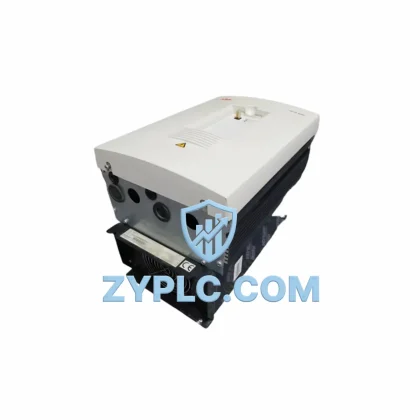
Lust CDB32.008.W2.2.BR Servo Drive for CDB32
The Lust CDB32.008.W2.2.BR is a compact, high-performance servo drive engineered for seamless integration within the CDB32 modular servo system architecture. Designed to operate as a precision motion control node across multi-axis automation platforms, this drive delivers consistent torque regulation, dynamic speed response, and deterministic communication — all critical requirements for modern industrial control system design. Whether deployed in a standalone single-axis configuration or as part of a coordinated multi-drive architecture, the CDB32.008.W2.2.BR ensures system-level coherence from the control layer through to the mechanical execution layer.
In today’s layered automation environments, servo drives are no longer isolated components — they are active participants in a tightly coupled control hierarchy. The CDB32.008.W2.2.BR is built with this architectural reality in mind, supporting upstream integration with programmable logic controllers and downstream coordination with feedback devices, brake resistors, and mechanical actuators. Its design philosophy prioritizes system integration: every parameter, every communication cycle, and every protection function is calibrated to support the broader system rather than operate in isolation.
Product Specification Table
| Attribute |
Specification |
| System Role |
Axis Servo Drive — CDB32 Modular Architecture |
| SKU / Model |
CDB32.008.W2.2.BR |
| Brand |
Lust (LTi Drives) |
| Series |
CDB32 Compact Servo Drive Series |
| Continuous Output Current |
8.0 A |
| Supply Voltage |
3 × 200–240 V AC, 50/60 Hz |
| DC Bus Voltage |
325 V DC (nominal) |
| Brake Chopper |
Integrated (BR variant) |
| Feedback Interface |
Resolver / Incremental Encoder |
| Communication |
CANopen / RS-232 / Optional PROFIBUS |
| Control Mode |
Position, Velocity, Torque |
| Protection Class |
IP20 |
| Operating Temperature |
0 °C to +45 °C |
| Installation |
DIN Rail / Panel Mount |
| Origin |
Germany |
| Warranty |
12-Month Warranty (ZYPLC) |
System Compatibility Notes
The CDB32.008.W2.2.BR achieves its full potential when deployed within a coordinated control architecture. At the control layer, it interfaces directly with motion controllers or PLCs — such as Lust’s own CDA32 application controller or third-party IEC 61131-3 compliant systems — via CANopen DS402 motion profiles. This standardized communication protocol ensures that position commands, velocity references, and fault status are exchanged with deterministic timing, enabling synchronized multi-axis operation without jitter or latency accumulation.
Within the same CDB32 platform, companion drives such as the CDB32.004.W2.2 (4 A axis) and CDB32.006.W2.2 (6 A axis) can be deployed on adjacent axes, sharing the same DC bus rail and communication backbone. This common-bus topology, supported by a centralized CDB32 DC Bus Power Supply Module, reduces overall cabinet footprint and simplifies maintenance planning across the drive train. Regenerative energy from decelerating axes is redistributed across the bus rather than dissipated as heat, improving system efficiency.
For applications requiring higher axis counts or mixed-power configurations, the CDD32 series distributed servo drives can be integrated into the same CANopen network, extending the architecture without requiring a separate communication gateway. Where PROFIBUS DP connectivity is mandated by the plant-level SCADA or DCS, the optional CDB32 PROFIBUS Communication Module slots directly into the drive’s expansion interface, enabling transparent data exchange with Siemens S7 or similar host controllers.
At the feedback layer, the CDB32.008.W2.2.BR supports both resolver-based and incremental encoder feedback, making it compatible with a wide range of Lust-approved servo motors including the MCS series synchronous servo motors. The resolver interface provides absolute single-turn position information without battery backup, a significant advantage in applications where power cycling is frequent or where encoder battery maintenance is operationally impractical.
The integrated brake chopper (BR variant) works in conjunction with an external CDB32 Brake Resistor Module to safely dissipate regenerative energy during rapid deceleration cycles. This is particularly important in vertical axis applications — such as gantry systems, press feeders, or winding machines — where gravitational loads can generate sustained regenerative currents that would otherwise trip the drive’s overvoltage protection.
At the human-machine interface layer, drive parameterization and diagnostics are accessible via the Lust DriveManager software over RS-232, or through a panel-mounted CDB32 Operator Keypad. Both interfaces provide access to the full parameter set, oscilloscope functions, and fault history logs — enabling rapid commissioning and efficient troubleshooting without specialized test equipment.
Industrial Application Notes
The CDB32.008.W2.2.BR is deployed across a broad spectrum of industrial automation sectors. In packaging machinery, it drives servo-controlled film feeders, rotary cutters, and registration systems where sub-millimeter positional accuracy and high cycle rates are non-negotiable. The drive’s fast current loop response — typically under 100 µs — ensures that mechanical disturbances from product variations are corrected before they propagate into positional error.
In printing and converting lines, the CDB32.008.W2.2.BR manages tension-controlled unwind and rewind axes, where torque mode operation and real-time load cell feedback integration are essential for consistent web tension across varying roll diameters. Its CANopen synchronization capability allows it to track a virtual master axis generated by the line controller, maintaining phase coherence across all driven rollers.
Within process control systems in the chemical and pharmaceutical industries, the drive’s deterministic communication and comprehensive fault diagnostics support the stringent traceability and uptime requirements of GMP-regulated environments. Fault codes, operating hours, and parameter change logs can be retrieved remotely via the communication interface, supporting both predictive maintenance programs and regulatory audit trails.
In power generation and energy infrastructure applications, the CDB32.008.W2.2.BR is used in valve actuator control systems where precise positioning and fail-safe brake engagement are critical. The integrated brake chopper and external brake resistor combination ensures that the drive can safely hold axis position during emergency stop sequences, even under full load conditions.
For material handling and intralogistics systems, the drive’s compact DIN rail form factor and wide operating temperature range make it suitable for installation in distributed control cabinets located close to the driven axes, reducing cable lengths and improving signal integrity across the servo feedback loop.
Product Compatibility FAQ
Q1: Is the CDB32.008.W2.2.BR compatible with third-party PLCs and motion controllers via CANopen?
Yes. The CDB32.008.W2.2.BR implements the CANopen DS402 drive profile, which is supported by all major IEC 61131-3 compliant motion controllers from vendors including Beckhoff, Bosch Rexroth, and Schneider Electric. Node address and baud rate are configurable via DIP switch or software parameter, and the drive supports standard NMT state machine management, PDO mapping, and SDO parameter access. No proprietary communication layer is required for third-party integration.
Q2: Can multiple CDB32.008.W2.2.BR drives share a common DC bus, and what are the sizing requirements for the shared power supply?
Yes. The CDB32 architecture supports common DC bus operation, where multiple drives share a single rectifier/power supply module. The shared supply must be sized to cover the peak simultaneous power demand of all connected axes, accounting for regenerative energy recovery from decelerating axes. As a general guideline, the supply rating should be calculated at 70–80% of the sum of individual axis peak power ratings when duty cycles are staggered. ZYPLC’s engineering team can assist with bus sizing calculations for specific multi-axis configurations.
Q3: What does the 12-Month Warranty cover, and what is the process for warranty claims?
The 12-Month Warranty provided by ZYPLC covers manufacturing defects, component failures under normal operating conditions, and firmware-related malfunctions present at the time of delivery. It does not cover damage resulting from incorrect installation, overvoltage events beyond the drive’s rated input range, or unauthorized modifications. To initiate a warranty claim, contact ZYPLC at plc.sales@zyplc.com or +86 19859288691 with the order reference, fault description, and any available fault log data. ZYPLC will arrange inspection, repair, or replacement within the warranty period.
© 2026 ZYPLC. All rights reserved.
Original Source: https://zyplc.com
Contact: +86 19859288691 | plc.sales@zyplc.com