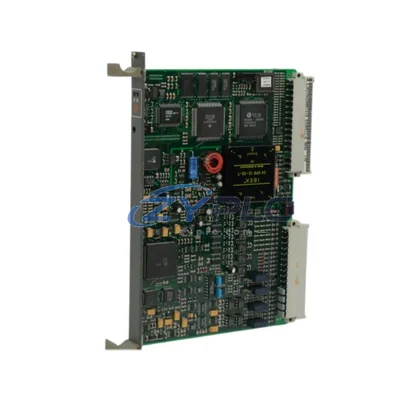
Mitsubishi A1S52B Industrial Network Interface for MELSEC-A Systems: Backbone of Smart Factory Data Links
In modern industrial environments, seamless data flow between field devices, PLC controllers, remote I/O modules, HMI panels, SCADA systems, variable frequency drives, sensors, and upper-level management systems is the foundation of operational transparency. The Mitsubishi A1S52B extension base unit serves as a critical hardware node in the MELSEC-A Series control architecture, enabling engineers to expand the physical and logical reach of their automation networks without compromising signal integrity, communication latency, or system reliability.
The A1S52B provides five module slots that allow the integration of additional I/O modules, communication cards, and specialty function modules directly into the MELSEC-A backplane bus. This expansion capability is essential when a single base unit cannot accommodate the full range of I/O points, analog signal conditioners, or network interface cards required by a complex production line. By extending the system through the A1S52B, engineers maintain a unified data backbone — all modules share the same high-speed internal bus, ensuring deterministic scan times and synchronized data exchange across the entire control node.
Compatibility & Integration Notes
| Parameter |
Specification |
| SKU / Model |
A1S52B |
| Brand |
Mitsubishi Electric |
| Series |
MELSEC-A |
| Slot Count |
5 Module Slots |
| Supported Protocols |
MELSEC-A Bus, CC-Link (via communication module), RS-232C, RS-422 (via A1SJ71UC24-R4) |
| Interface Type |
Backplane Bus Extension |
| Network Compatibility |
MELSEC-A Series PLC Systems, CC-Link Remote I/O Networks |
| System Application |
PLC Expansion, Remote I/O, SCADA Integration, HMI Connectivity |
| Origin |
Japan |
| Warranty |
Warranty and support terms confirmed before quote |
Connected Automation Data Flow
The A1S52B sits at the heart of a layered industrial communication architecture. At the field level, discrete sensors and analog transmitters feed signals into A1SX41 digital input modules and A1S68AD analog-to-digital converter modules mounted in the extension base. These raw signals are processed by the MELSEC-A CPU — typically an A1SCPU or A2SCPU — which executes ladder logic and generates control outputs through A1SY41P transistor output modules installed across the base units.
For network communication, engineers commonly pair the A1S52B with an A1SJ71UC24-R4 serial communication module, enabling RS-232C and RS-422 data exchange with HMI terminals, barcode readers, and third-party SCADA gateways. When the application demands higher-speed, multi-drop networking, a CC-Link master or slave module can be inserted into one of the A1S52B’s slots, connecting the local control node to a broader CC-Link network that may span dozens of remote I/O stations across the production floor.
In multi-base configurations, the A1S52B connects to the main base unit — such as an A1S33B or A1S65B — via an extension cable, extending the I/O capacity while maintaining a single logical PLC node. The A1S61PN or A1S62PN power supply modules provide stable 5 VDC and 24 VDC rails to all modules in the extension base, ensuring consistent operation even under fluctuating plant power conditions. For Ethernet-based SCADA integration, an A1SJ71E71-B2-S3 Ethernet interface module can be mounted in the A1S52B, enabling TCP/IP communication with MES platforms, historian servers, and remote monitoring dashboards. This creates a complete data chain: from sensor signal acquisition at the field level, through PLC processing, across the CC-Link or Ethernet network, and up to the SCADA or MES layer — all anchored by the physical expansion capacity of the A1S52B.
Solving Data Isolation in Industrial Sites
One of the most persistent challenges in legacy and hybrid industrial environments is data isolation — the inability to aggregate, monitor, and act on process data in real time due to incompatible protocols, fragmented network segments, or insufficient I/O capacity. The Mitsubishi A1S52B directly addresses these pain points by providing the physical infrastructure needed to add communication modules, protocol converters, and I/O expanders to an existing MELSEC-A system without replacing the entire control platform.
When a production line requires integration of a new variable frequency drive communicating over RS-485 Modbus, engineers can install a compatible serial communication module into the A1S52B rather than deploying a standalone gateway device. This keeps the data path within the PLC’s native scan cycle, eliminating the latency and reliability risks associated with external protocol converters. Similarly, when SCADA operators require real-time visibility into machine states, alarm conditions, and production counts, the A1S52B’s additional slots accommodate the Ethernet or CC-Link modules needed to bridge the field network to the supervisory layer.
For facilities undergoing phased digital transformation, the A1S52B enables incremental expansion — adding remote diagnostics, energy monitoring, or quality inspection modules one slot at a time — without disrupting ongoing production. This modularity supports production line transparency, reduces unplanned downtime through early fault detection, and provides the network scalability required as smart factory initiatives evolve.
Industrial Connectivity FAQ
Q1: Does the A1S52B introduce additional communication latency into the MELSEC-A system?
No. The A1S52B uses the same high-speed MELSEC-A backplane bus as the main base unit. Module data is exchanged within the PLC’s standard scan cycle, so there is no additional network latency introduced by the extension base itself. Communication latency is determined by the specific communication module installed and the network protocol in use.
Q2: Which communication protocols are supported when modules are installed in the A1S52B?
The A1S52B supports any communication module compatible with the MELSEC-A Series, including RS-232C and RS-422 serial modules (e.g., A1SJ71UC24-R4), CC-Link master/slave modules, and Ethernet interface modules (e.g., A1SJ71E71-B2-S3). Protocol compatibility depends on the specific module selected, not the base unit itself.
Q3: How is network stability ensured in multi-base MELSEC-A configurations?
Network stability is maintained through the A1S61PN or A1S62PN power supply modules, which provide regulated power to all modules in the extension base. Mitsubishi’s MELSEC-A architecture uses a deterministic bus protocol, ensuring consistent module communication even in electrically noisy industrial environments. Proper cable routing and grounding practices further enhance stability.
Q4: What warranty and pre-shipment testing does the A1S52B include?
Every A1S52B unit supplied by ZYPLC undergoes functional verification testing prior to shipment. Warranty terms are confirmed during quotation. Shipment timing is confirmed after RFQ review, testing, and export packing.