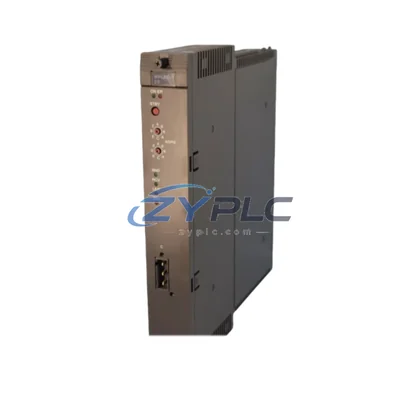
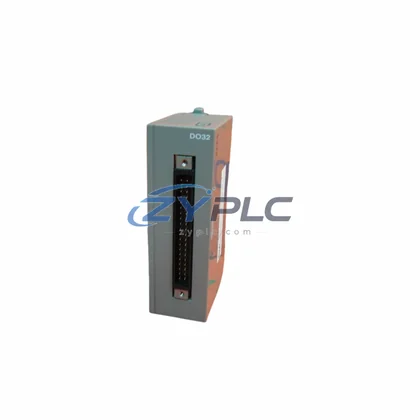
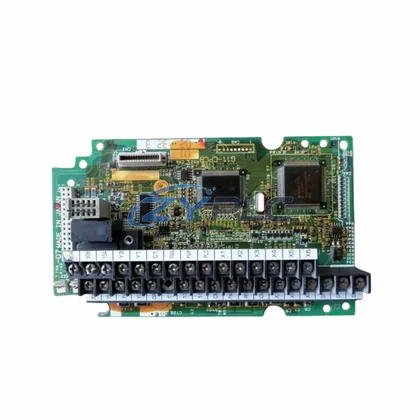
Mitsubishi F2-40ER MELSEC-F Industrial Network Controller for Smart Factory Data Integration
The Mitsubishi F2-40ER is a compact programmable controller from the MELSEC-F series, engineered to serve as a reliable data node within industrial communication networks. Designed for small-to-medium automation cells, this controller bridges the gap between field-level signal acquisition and upper-level monitoring platforms, enabling transparent data flow across production lines. Whether deployed as a standalone station or integrated into a multi-drop RS-422 network, the F2-40ER delivers deterministic control and stable communication essential for modern smart factory architectures.
In a typical industrial connectivity scenario, the F2-40ER collects discrete and analog signals from proximity sensors, photoelectric switches, and temperature transmitters installed on the production floor. These raw signals are processed locally, then transmitted upstream via the built-in RS-422 serial communication port to supervisory systems. When paired with a Mitsubishi FX3U-ENET-ADP Ethernet adapter or an FX3U-485ADP-MB Modbus communication module, the data chain extends seamlessly from the field layer through the control layer to SCADA and MES platforms, eliminating protocol barriers that traditionally create data silos in legacy plants.
The controller supports connection to Mitsubishi GOT2000 series HMI panels, allowing operators to visualize real-time process variables, acknowledge alarms, and adjust setpoints without accessing the PLC program directly. This HMI integration reduces mean time to repair and enhances operational transparency. For facilities running centralized monitoring, the F2-40ER communicates through a Mitsubishi QJ71C24N serial communication module acting as a gateway between the F-series subnet and the Q-series backbone network, ensuring that even legacy MELSEC-F nodes participate in enterprise-wide data collection.
Compatibility & Integration Notes
| Parameter |
Specification |
| Communication Protocol |
RS-422 (Serial), Mitsubishi Computer Link |
| Interface Type |
Built-in RS-422 Port, Mini-DIN Connector |
| Transmission Speed |
Up to 115.2 kbps |
| Network Compatibility |
MELSEC-F Network, CC-Link (via gateway), Modbus RTU (via adapter) |
| I/O Points |
40 Points (24 Inputs / 16 Relay Outputs) |
| System Application |
SCADA, HMI, MES, Remote Diagnostics |
| Warranty |
Warranty and support terms confirmed before quote with Pre-Shipment Testing |
Connected Automation Data Flow
Within a connected automation architecture, the F2-40ER operates as a critical data aggregation point. Field instruments such as Mitsubishi FR-D720S variable frequency drives receive speed commands from the controller while simultaneously reporting fault codes and operating frequencies back through the communication link. This bidirectional data exchange enables predictive maintenance strategies where drive performance degradation triggers automated alerts before catastrophic failure occurs.
On the network infrastructure side, a Mitsubishi QJ61BT11N CC-Link master module can poll multiple F-series controllers across a factory floor, consolidating I/O status from distributed stations into a unified data map. The F2-40ER integrates naturally into this topology as a remote intelligent node, processing local logic while forwarding critical status data to the network master. For facilities requiring Ethernet connectivity, an FX3U-ENET Ethernet module bridges the serial domain to TCP/IP networks, enabling remote programming, monitoring, and diagnostics from engineering workstations located anywhere on the plant network.
Edge computing gateways such as the Mitsubishi MES-IT interface module can harvest production data from the F2-40ER for cloud analytics and digital twin applications. The controller also coordinates with Mitsubishi AJ65SBTB1-32D remote I/O modules to extend its physical reach across long cable runs without signal degradation, maintaining data integrity even in electrically noisy environments typical of welding cells and motor control centers.
Power supply stability is maintained through dedicated Mitsubishi Q61P power supply modules that provide regulated DC voltage to the controller backplane, ensuring uninterrupted operation during voltage sags common in heavy industrial facilities. The combination of robust power conditioning and deterministic serial communication makes the F2-40ER a dependable node in mission-critical production networks.
Solving Data Isolation in Industrial Sites
Many legacy manufacturing facilities suffer from data isolation where individual machines operate as information islands, unable to share process data with neighboring stations or upper-level management systems. The F2-40ER addresses this challenge through its native serial communication capability and compatibility with protocol conversion gateways. By connecting the controller to a Modbus RTU network through an appropriate adapter, facilities can unify disparate equipment brands under a common communication standard without replacing existing hardware.
For production line transparency, the F2-40ER enables cycle time monitoring, reject counting, and OEE calculation at the machine level. This granular data feeds into SCADA systems where production managers gain visibility into bottlenecks, quality trends, and equipment utilization across entire production areas. The controller supports remote diagnostics through its communication port, allowing maintenance engineers to read fault registers, monitor I/O states, and verify program execution from a central control room rather than walking the factory floor.
System expansion is straightforward with the MELSEC-F architecture. Additional I/O capacity is achieved by connecting extension blocks to the base unit, while network expansion involves adding communication adapters to bring new controllers online. This modular approach protects capital investment by allowing incremental upgrades aligned with production growth rather than requiring wholesale system replacement.
Every unit shipped from our facility undergoes comprehensive pre-shipment functional testing including communication port verification, I/O point validation, and memory integrity checks. This ensures that controllers arrive prepared for installation after site verification and commissioning, minimizing project delays and reducing on-site troubleshooting time.
Industrial Connectivity FAQ
What communication latency can I expect with the F2-40ER in a multi-drop RS-422 network?
The F2-40ER achieves scan-synchronous communication with typical response times under 20 milliseconds in a properly configured RS-422 network with up to eight stations. Actual latency depends on baud rate selection, message length, and network traffic loading. For time-critical applications, configuring the communication at 115.2 kbps with optimized polling sequences ensures deterministic data exchange suitable for coordinated motion and synchronized process control.
Is the F2-40ER compatible with modern Ethernet-based SCADA systems?
Yes. While the F2-40ER uses native RS-422 serial communication, it integrates with Ethernet-based SCADA platforms through protocol conversion gateways or Mitsubishi communication modules that bridge serial and TCP/IP domains. This allows the controller to participate in modern IIoT architectures without hardware modification, preserving your existing automation investment while enabling cloud connectivity and remote monitoring capabilities.
How does the warranty and support terms confirmed before quote and pre-shipment testing work?
Every F2-40ER unit undergoes rigorous functional testing before dispatch, including power-up verification, communication port testing, I/O response validation, and memory check. Units are shipped with a warranty and support terms confirmed before quote covering manufacturing defects and functional failures under normal operating conditions. Our technical support team provides remote diagnostic assistance throughout the warranty period to help resolve any integration or communication issues.
Can I expand the F2-40ER network to accommodate future production growth?
Absolutely. The MELSEC-F platform supports modular expansion through extension I/O blocks for additional physical points and communication adapters for network connectivity upgrades. You can add stations to the RS-422 network, introduce gateway modules for CC-Link or Ethernet integration, or deploy remote I/O modules to extend coverage across new production areas without redesigning the existing control architecture.