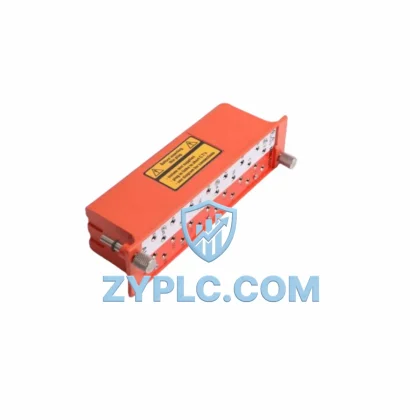
Mitsubishi MR-J3CN1 Servo Connector for MR-J3 Automation
The Mitsubishi MR-J3CN1 is a precision-engineered servo signal connector module designed specifically for the MR-J3 series servo amplifier platform. In modern industrial production environments where energy efficiency, equipment uptime, and process throughput are under constant scrutiny, the integrity of signal transmission between the servo amplifier and the motor encoder is a foundational element of drive performance. The MR-J3CN1 ensures that every feedback pulse from the encoder reaches the MR-J3 amplifier without distortion or loss, enabling the drive to execute precise torque and speed commands that directly reduce unnecessary motor load.
When a servo system operates with degraded or intermittent signal connectivity — often caused by worn or non-OEM connectors — the amplifier compensates by drawing abnormal load, increasing heat generation, and triggering protective fault cycles. Each fault stop represents wasted energy, lost production time, and accelerated mechanical wear. By maintaining a clean, low-resistance signal path, the MR-J3CN1 allows the MR-J3 servo amplifier to sustain its rated efficiency curve, keeping motor losses within design parameters and reducing idle-state power draw during standby phases of the production cycle.
Across multi-axis systems where several MR-J3 amplifiers are coordinated through a MELSERVO motion controller or a MELSEC Q-series PLC, the cumulative effect of optimized signal integrity across all axes translates into measurable reductions in total facility operating load. Production lines running packaging, press, conveyor, or assembly operations benefit from tighter position loop gains, shorter settling times, and reduced overshoot — all of which contribute to faster cycle times without increasing motor load.
Product Specification Table
| Parameter |
Specification / Value |
| SKU / Part Number |
MR-J3CN1 |
| Compatible Series |
Mitsubishi MR-J3 Servo Amplifier Series |
| Product Category |
Servo Connector / Signal Connector |
| Connector Function |
Encoder Signal Interface (CN1 Port) |
| Signal Integrity |
Full OEM-spec shielding and contact resistance |
| Operating Environment |
Industrial automation, motion control, CNC, robotics |
| Maintenance Value |
Eliminates fault-induced unplanned downtime; sustains rated drive efficiency |
| Compatible Systems |
MELSEC Q/L/iQ-R PLC, MELSERVO MR-J3, GOT2000 HMI |
| Origin |
Japan |
| Warranty |
12-Month Warranty |
| Stock Status |
In Stock — Ships after outgoing quality test |
System Compatibility and Application
The MR-J3CN1 operates at the intersection of signal fidelity and drive efficiency within a broader Mitsubishi automation ecosystem. In a typical energy-optimized production cell, the MR-J3CN1 connects the MR-J3-70B or MR-J3-200B servo amplifier to the encoder feedback circuit of the servo motor, forming the closed-loop foundation that allows the amplifier’s regenerative braking function to recover kinetic energy during deceleration phases. This recovered energy is fed back into the DC bus, reducing net power draw from the supply rail.
At the controller level, a MELSEC Q06UDEHCPU or iQ-R series CPU module issues motion commands via SSCNET III/H fiber-optic communication to the MR-J3 amplifiers. The accuracy of these commands depends entirely on clean encoder feedback — which the MR-J3CN1 guarantees. Alongside the servo system, Mitsubishi FR-A800 series variable frequency drives manage induction motor loads such as fans, pumps, and conveyors. When the servo axes and VFD-driven axes share a synchronized motion profile managed by the Q-series controller, the overall line energy profile becomes predictable and schedulable, enabling demand-side maintenance planning strategies.
Power quality and consumption monitoring is handled by Mitsubishi ME96NSR energy meters or third-party power analyzers connected to the MELSEC network via CC-Link IE Field or MODBUS TCP. These instruments capture real-time kWh data per production zone, allowing maintenance engineers to correlate connector-related signal faults with energy anomalies in the historian. GOT2000 series HMI panels display live drive status, fault history, and energy KPIs at the machine level, giving operators immediate visibility into efficiency deviations without requiring SCADA access.
For I/O integration, MELSEC QX40 and QY40P I/O modules handle digital signals from proximity sensors, limit switches, and safety relays that gate servo motion sequences. Proper sequencing — enabled by reliable servo feedback through the MR-J3CN1 — prevents unnecessary servo energization during idle periods, a common source of standby unplanned downtime in multi-station assembly lines. MR-J3-D01 option cards extend the MR-J3 amplifier’s I/O capability for custom safety and interlock logic, further reducing the risk of unplanned stops that consume energy without producing output.
Maintenance and Replacement Notes
In automotive body welding lines, where MR-J3 servo axes control welding gun positioning and part clamping, the MR-J3CN1 maintains the encoder signal quality needed for sub-millimeter repeatability. Positioning errors caused by connector degradation force the amplifier to issue correction pulses, each of which draws additional current. Over a three-shift operation running 6,000 cycles per day, the cumulative energy cost of repeated micro-corrections is significant. Replacing a degraded connector with a genuine MR-J3CN1 restores first-pass positioning accuracy, eliminating correction cycles and reducing per-part operating load.
In food and beverage packaging lines, servo-driven filling heads and capping stations operate at high cycle rates where settling time directly determines throughput. A servo axis that settles 20 milliseconds faster per cycle — due to improved feedback integrity — can increase line speed by 3–5% without any mechanical modification. This throughput gain reduces the energy cost per unit produced, improving the line’s overall energy efficiency ratio (EER). Predictive maintenance programs that monitor MR-J3 amplifier alarm logs can identify CN1 connector degradation early, scheduling replacement during planned downtime rather than reacting to unplanned stops that disrupt energy-optimized production schedules.
For electronics assembly SMT lines, where MR-J3 axes drive pick-and-place gantries, the MR-J3CN1 ensures that the encoder’s high-resolution feedback — typically 131,072 pulses per revolution — is transmitted without noise injection. Noise on the encoder line causes the amplifier to enter fault mode, triggering a full servo-off sequence that requires re-homing and re-synchronization. Each such event wastes 5–15 minutes of production time and the associated energy of restarting the thermal management systems. Stocking genuine MR-J3CN1 connectors as a standard spare part eliminates this failure mode from the maintenance risk register.
Product Sourcing FAQ
Q1: How does the MR-J3CN1 contribute to operational stability in a servo system?
The MR-J3CN1 maintains the signal integrity of the encoder feedback loop between the servo motor and the MR-J3 amplifier. A clean feedback signal allows the amplifier to operate at its designed efficiency point, minimizing abnormal load draw, reducing heat losses, and enabling effective regenerative energy recovery during deceleration. Degraded connectors introduce noise and resistance that force the amplifier to compensate, increasing operating load per cycle.
Q2: Is the MR-J3CN1 compatible with all MR-J3 series amplifier models?
Yes. The MR-J3CN1 is the standard CN1 encoder connector for the MR-J3 series, compatible with models including the MR-J3-10B through MR-J3-700B range. It is also applicable in systems using MR-J3W dual-axis amplifiers where the CN1 interface is used. For MR-J4 or MR-J5 series amplifiers, the corresponding connector part number should be verified against the amplifier’s hardware manual.
Q3: What is the recommended replacement interval and testing procedure?
Mitsubishi recommends inspecting encoder connectors during scheduled preventive maintenance intervals, typically every 12–18 months in high-cycle applications. At ZYPLC, every MR-J3CN1 unit undergoes an outgoing quality inspection before shipment, verifying contact resistance and mechanical retention force. Upon installation, the MR-J3 amplifier’s built-in encoder communication diagnostic (accessible via MR Configurator2) should be used to confirm error-free feedback communication before returning the axis to production.
Q4: What warranty and supply terms apply to the MR-J3CN1?
All MR-J3CN1 units supplied by ZYPLC carry a 12-month warranty covering manufacturing defects and premature contact failure under normal operating conditions. Units are held in inventory for immediate dispatch, with lead times typically under 3 business days for standard orders. For high-volume or blanket purchase orders, contact the ZYPLC sales team to discuss supply agreements that ensure connector availability aligns with your planned maintenance schedule.
© 2026 ZYPLC. All rights reserved.
Original Source: https://zyplc.com
Contact: +86 19859288691 | plc.sales@zyplc.com