Mitsubishi MR-S12-02A-E01: Industrial Data Link and Smart Factory Connectivity for MR-S Series Systems
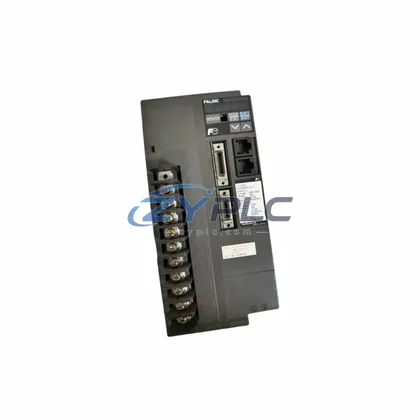
The Mitsubishi MR-S12-02A-E01 is a high-performance SSCNET III servo drive engineered for seamless integration within modern industrial automation architectures. As a core node in the MR-S Series servo system, this unit delivers deterministic, high-speed optical communication across the SSCNET III (Servo System Controller Network III) protocol — enabling real-time synchronization between motion controllers, servo amplifiers, and upper-level control systems. Whether deployed in precision machining centers, automated assembly lines, or multi-axis robotic cells, the MR-S12-02A-E01 serves as a critical data link between field-level actuators and plant-wide SCADA and MES platforms.
Compatibility & Integration Notes
| Parameter |
Specification |
| SKU |
MR-S12-02A-E01 |
| Brand |
Mitsubishi Electric |
| Series |
MR-S Series |
| Communication Protocol |
SSCNET III (Optical High-Speed Serial) |
| Interface Type |
Optical Fiber / SSCNET III Bus |
| Transmission Speed |
Up to 150 Mbps (SSCNET III) |
| Network Compatibility |
Mitsubishi MELSERVO, Q-Series Motion Controllers, iQ-R Platform |
| System Application |
Multi-axis servo control, CNC, robotics, smart factory automation |
| Gateway Function |
SSCNET III to upper-level controller data bridge |
| Origin |
Japan |
| Product Type |
Servo Drive / Industrial Network Interface |
| Warranty |
12 Months |
Connected Automation Data Flow
In a fully integrated smart factory environment, the MR-S12-02A-E01 operates at the intersection of motion control and industrial networking. Signal acquisition begins at the encoder feedback level, where the servo drive captures high-resolution position, velocity, and torque data from connected servo motors. This data is transmitted upstream via the SSCNET III optical bus to a Mitsubishi Q172DCPU or Q173DCPU motion controller, which coordinates multi-axis interpolation and executes real-time trajectory commands.
Within the same control cabinet, the MR-S12-02A-E01 communicates in synchrony with other MR-S Series servo amplifiers — such as the MR-S12-10A-E01 and MR-S12-20A-E01 — forming a daisy-chained SSCNET III network that eliminates the wiring complexity of traditional analog or pulse-train servo systems. The optical fiber medium ensures immunity to electromagnetic interference, a critical advantage in environments with high-frequency inverters and variable frequency drives (VFDs) operating nearby.
At the PLC layer, a Mitsubishi Q06UDEHCPU or iQ-R series RCPU exchanges motion commands and status data with the motion controller over the high-speed backplane bus. Diagnostic data — including servo alarm codes, load ratio, regenerative load, and peak torque — is aggregated and forwarded to a GOT2000 series HMI (such as the GT2710-VTBA) for operator visualization. The HMI displays real-time axis status, fault history, and parameter tuning interfaces, enabling maintenance engineers to respond to anomalies without halting production.
For plant-wide visibility, the servo network data is bridged to a SCADA platform via a Mitsubishi MES Interface Module (QJ71MES96) or an edge gateway device. This gateway translates SSCNET III motion data into OPC-UA or Ethernet/IP packets, making servo performance metrics available to MES, ERP, and cloud analytics systems. Remote I/O modules such as the Mitsubishi QX40 or QY40P extend digital signal coverage to peripheral sensors and actuators — limit switches, proximity sensors, and pneumatic valve banks — feeding additional process data into the unified data stream.
In applications requiring coordinated motion across multiple production cells, the MR-S12-02A-E01 integrates with Mitsubishi’s iQ Platform, where the MELSEC iQ-R series rack hosts both the motion CPU and communication modules for CC-Link IE Field Network. This architecture allows the servo drive’s real-time data to be shared across the factory floor network, supporting predictive maintenance algorithms and OEE (Overall Equipment Effectiveness) dashboards running on SCADA servers.
Solving Data Isolation in Industrial Sites
One of the most persistent challenges in legacy industrial environments is protocol fragmentation — servo drives, PLCs, remote I/O, and HMI systems from different generations often speak incompatible communication languages, creating data silos that prevent unified monitoring and control. The MR-S12-02A-E01 addresses this directly through its native SSCNET III protocol, which provides a standardized, high-bandwidth optical communication backbone that integrates seamlessly with Mitsubishi’s broader automation ecosystem.
For sites transitioning from older SSCNET (copper-based) architectures to SSCNET III, the MR-S12-02A-E01 supports backward-compatible operation modes, reducing the cost and complexity of network upgrades. Its deterministic communication cycle — with scan times as low as 0.444 ms — eliminates the latency variability that plagues Ethernet-based servo networks in high-speed applications, ensuring that position commands and feedback data arrive with microsecond-level precision.
Remote diagnostics capability is a key operational advantage. Through the SSCNET III network, maintenance teams can access servo parameter sets, alarm histories, and real-time load data from a central engineering workstation running Mitsubishi’s MR Configurator2 software — without physically accessing the drive. This reduces mean time to repair (MTTR) and supports condition-based maintenance strategies that minimize unplanned downtime.
For production line transparency, the MR-S12-02A-E01’s data output feeds directly into SCADA dashboards, enabling supervisors to monitor axis utilization, cycle times, and energy consumption across all servo axes simultaneously. When integrated with a Mitsubishi MELSOFT iQ Works engineering environment, system-wide parameter management and network topology visualization become centralized, accelerating commissioning and reducing configuration errors during line changeovers.
Every MR-S12-02A-E01 unit supplied by ZYPLC undergoes pre-shipment functional testing, verifying communication handshake, encoder feedback integrity, and alarm output behavior before dispatch. Units are sourced from verified supply channels and backed by a warranty terms confirmed during quotation, ensuring operational confidence for both new installations and replacement scenarios in existing MR-S Series servo systems.
Industrial Connectivity FAQ
Q1: What is the communication latency of the SSCNET III protocol used by the MR-S12-02A-E01?
SSCNET III operates on a synchronous optical serial bus with a minimum communication cycle of 0.444 ms, providing deterministic, low-latency data exchange between the servo drive and the motion controller. This makes it suitable for high-speed, multi-axis coordinated motion applications where timing precision is critical.
Q2: Is the MR-S12-02A-E01 compatible with Mitsubishi iQ-R and Q-Series motion controllers?
Yes. The MR-S12-02A-E01 is designed for use with Mitsubishi MELSERVO-compatible motion controllers, including the Q172DCPU, Q173DCPU, and iQ-R series motion CPUs. It connects via the SSCNET III optical bus and is fully supported within the MELSOFT MR Configurator2 and iQ Works engineering environments.
Q3: How does the MR-S12-02A-E01 support network stability in electrically noisy industrial environments?
The SSCNET III interface uses optical fiber transmission, which is inherently immune to electromagnetic interference (EMI) from inverters, VFDs, welding equipment, and high-current switching devices. This ensures stable, error-free communication even in demanding factory floor conditions where copper-based networks would experience signal degradation.
Q4: What warranty and pre-shipment testing does ZYPLC provide for the MR-S12-02A-E01?
All MR-S12-02A-E01 units supplied by ZYPLC are covered by a warranty terms confirmed during quotation and undergo pre-shipment functional testing, including communication protocol verification, encoder feedback validation, and alarm output checks. Units are dispatched with full traceability documentation to support quality assurance requirements in regulated manufacturing environments.