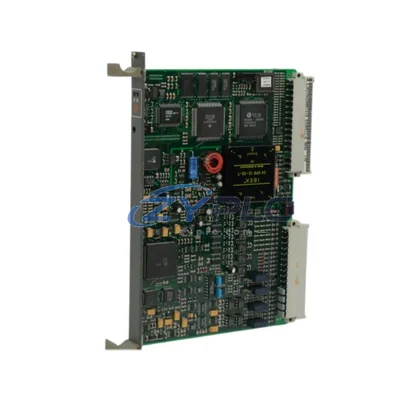
NI PCI-8361 MXI-4 PCI Host Card: High-Speed Industrial Data Link for Smart Factory Connectivity
The NI PCI-8361 is a high-performance MXI-4 Series PCI Host Card engineered by National Instruments to establish a seamless, high-bandwidth communication bridge between a host PC and PXI/PXIe chassis in demanding industrial automation environments. Designed for smart factory deployments where real-time data integrity and deterministic communication are non-negotiable, the PCI-8361 serves as the backbone of a robust industrial data link — connecting field-level devices, PLC controllers, remote I/O modules, HMI panels, SCADA systems, and edge gateways into a unified, transparent network architecture.
In modern industrial sites, data flows from sensors and actuators at the field level upward through protocol conversion layers, network transmission infrastructure, and into supervisory control and monitoring platforms. The NI PCI-8361 occupies a critical node in this chain: it enables the host PC to communicate with NI PXI chassis at MXI-4 bus speeds, effectively extending the PC’s internal bus to remote measurement and control hardware. This architecture eliminates the latency and bandwidth bottlenecks that plague legacy serial or Ethernet-based host interfaces, delivering the deterministic, low-jitter data transfer required for precision industrial measurement, closed-loop control, and real-time SCADA feedback.
Compatibility & Integration Notes
| Parameter |
Specification |
| Product SKU |
PCI-8361 |
| Brand / Manufacturer |
National Instruments (NI) |
| Series |
MXI-4 |
| Interface Type |
PCI Host Card (32-bit, 33/66 MHz) |
| Communication Protocol |
MXI-4 (PCI-based high-speed bus extension) |
| Transmission Capability |
Up to 100 MB/s sustained data throughput |
| Network Compatibility |
PXI, PXIe chassis; NI MXI-4 cable ecosystem |
| System Application |
Data Acquisition, Industrial Automation, SCADA Integration, Real-Time Control |
| Host Interface |
PCI Bus (3.3V / 5V universal) |
| Operating System Support |
Windows, NI Linux Real-Time |
| Software Compatibility |
NI-VISA, NI-DAQmx, LabVIEW, LabWindows/CVI |
| Origin |
United States |
| Warranty |
Warranty and support terms confirmed before quote |
Connected Automation Data Flow
In a typical smart factory deployment, the NI PCI-8361 anchors the data acquisition and control architecture by linking the host workstation directly to a NI PXI-1042 chassis or NI PXIe-1082 chassis via the MXI-4 cable interface. Within the PXI chassis, measurement modules such as the NI PXI-6251 multifunction DAQ card capture analog signals from pressure transducers, temperature sensors, and vibration probes distributed across the production floor. These raw signals are digitized and streamed over the MXI-4 bus through the PCI-8361 into the host PC at sustained throughputs that support multi-channel, high-frequency sampling without data loss.
At the control layer, the host PC running NI LabVIEW Real-Time processes incoming measurement data and issues deterministic control commands back through the PCI-8361 to motion control modules such as the NI PXI-7344 stepper/servo motion controller, coordinating multi-axis positioning systems on automated assembly lines. Simultaneously, digital I/O modules like the NI PXI-6514 relay discrete signals to and from field devices — including proximity switches, solenoid valves, and safety interlocks — ensuring that the control loop remains closed and responsive.
For protocol conversion and upstream SCADA integration, the host PC interfaces with an NI OPC Server or third-party OPC-UA gateway, translating the MXI-4 data stream into standard industrial protocols such as Modbus TCP, PROFINET, or EtherNet/IP. This allows SCADA platforms and HMI panels — including NI InTouch-compatible displays or Wonderware SCADA servers — to visualize real-time process variables, set alarm thresholds, and log historical trends without any proprietary middleware. Remote diagnostic access is further enabled through the host PC’s Ethernet port, allowing engineers to monitor PXI module health, recalibrate sensors, and push firmware updates to NI PXI-4110 programmable DC power supplies or signal conditioning modules from a central control room or off-site location.
Edge computing nodes, such as the NI CompactRIO-9045, can operate in parallel with the PCI-8361-based PXI system, handling local pre-processing and buffering of sensor data before forwarding aggregated results to the SCADA historian. This hybrid architecture — combining the high-bandwidth MXI-4 backbone with distributed edge intelligence — provides the scalability and redundancy demanded by Industry 4.0 production environments, where downtime and data gaps carry significant operational costs.
Solving Data Isolation in Industrial Sites
One of the most persistent challenges in industrial automation is the fragmentation of data across incompatible protocols, proprietary bus architectures, and isolated subsystems. Legacy installations often feature a patchwork of serial RS-232/RS-485 instruments, GPIB test equipment, and Ethernet-connected PLCs that cannot natively exchange data — creating information silos that impede real-time decision-making and predictive maintenance initiatives.
The NI PCI-8361, as the host interface of the MXI-4 ecosystem, directly addresses this fragmentation by providing a single, high-bandwidth conduit through which all PXI-resident measurement and control resources are accessible to the host PC. By consolidating data acquisition, signal generation, motion control, and digital I/O into a unified PXI chassis managed through the PCI-8361, engineers eliminate the need for multiple independent communication channels and the associated synchronization overhead. All subsystems share a common timing and triggering backbone, ensuring that data from disparate sensors and actuators is time-stamped with microsecond accuracy and correlated correctly in the SCADA historian.
For production line transparency, the PCI-8361 enables continuous, uninterrupted streaming of process variables — cycle times, torque readings, temperature profiles, and quality inspection results — into the plant’s MES (Manufacturing Execution System) and ERP platforms. This real-time visibility allows production managers to identify bottlenecks, track OEE (Overall Equipment Effectiveness), and respond to quality deviations before they escalate into scrap or rework events. Remote monitoring capabilities further extend this transparency to multi-site operations, where a central engineering team can access live PXI system data, run remote diagnostics, and perform over-the-network calibration without dispatching field technicians.
System expansion is equally straightforward: additional PXI modules can be inserted into available chassis slots and immediately recognized by the host PC through the PCI-8361 interface, with no changes to the physical network infrastructure. This plug-and-play scalability supports phased automation upgrades — a critical advantage for manufacturers who need to expand measurement and control capacity incrementally without disrupting ongoing production.
Industrial Connectivity FAQ
Q1: What is the maximum data throughput of the NI PCI-8361, and is it sufficient for high-channel-count DAQ applications?
The NI PCI-8361 supports sustained MXI-4 bus throughput of up to 100 MB/s, which is more than adequate for most multi-channel data acquisition scenarios. For applications involving simultaneous high-speed sampling across 16 or more analog input channels at rates exceeding 1 MS/s per channel, the MXI-4 bandwidth ensures that no data is dropped or buffered excessively, maintaining the signal fidelity required for precision industrial measurement.
Q2: Is the NI PCI-8361 compatible with modern SCADA and OPC-UA systems?
Yes. While the PCI-8361 itself operates at the hardware bus level, the NI software ecosystem — including NI-DAQmx, NI-VISA, and LabVIEW — provides OPC-UA server capabilities and third-party SCADA integration through standard industrial protocols. This allows the PXI system managed by the PCI-8361 to publish real-time process data to any OPC-UA compliant SCADA or HMI platform, ensuring seamless interoperability with existing plant automation infrastructure.
Q3: How does the NI PCI-8361 ensure network stability in electrically noisy industrial environments?
The MXI-4 interface uses shielded coaxial cabling with differential signaling, providing inherent immunity to electromagnetic interference (EMI) common in industrial settings with variable frequency drives, high-current switching equipment, and RF sources. The PCI-8361’s hardware design meets industrial EMC standards, and the MXI-4 protocol includes error detection and retransmission mechanisms that maintain data integrity even in the presence of transient electrical noise.
Q4: What warranty and pre-shipment testing does the NI PCI-8361 include?
Every NI PCI-8361 unit supplied by ZYPLC is covered by a warranty and support terms confirmed before quote and undergoes full functional testing prior to shipment. Pre-shipment verification includes MXI-4 bus communication validation, PCI slot compatibility checks, and loopback data integrity tests to confirm that the card performs to NI factory specifications. Availability and shipment timing are confirmed by RFQ, with global logistics support to minimize lead times for urgent industrial projects.
—