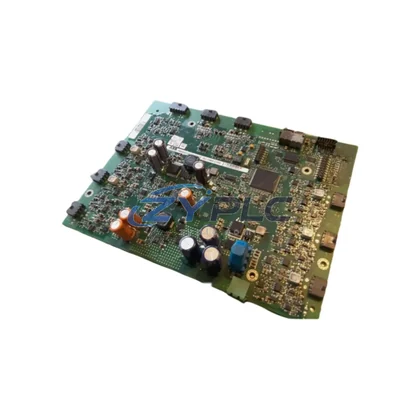
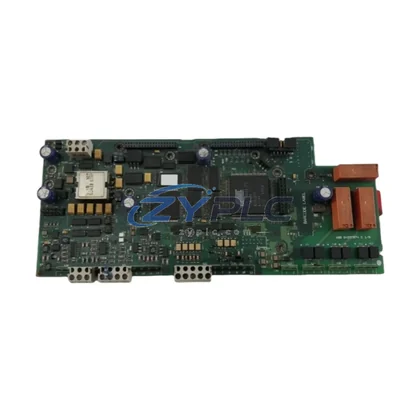
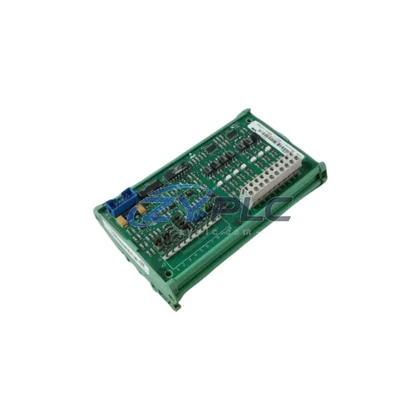
Reliance Electric 57C415 Industrial Network Interface for AutoMax Systems: Bridging the Industrial Data Link
In modern smart factory environments, seamless data flow between field devices, PLC controllers, remote I/O modules, HMI panels, SCADA platforms, variable frequency drives, sensors, and supervisory systems is not optional — it is the backbone of operational efficiency. The Reliance Electric 57C415 controller card is engineered to serve as a critical communication node within the AutoMax distributed control architecture, enabling reliable protocol conversion, real-time data transmission, and network-level integration across complex industrial topologies.
Whether deployed in a continuous process plant, a discrete manufacturing line, or a hybrid automation environment, the 57C415 delivers the connectivity performance that industrial engineers demand: deterministic communication cycles, robust signal integrity, and compatibility with the broader Reliance Electric AutoMax ecosystem. From signal acquisition at the sensor level to data aggregation at the SCADA layer, this module ensures that every node in your control network communicates with precision and without interruption.
Compatibility & Integration Notes
| Attribute |
Specification |
| SKU |
57C415 / 57415-A |
| Brand |
Reliance Electric |
| Series |
AutoMax / 57C Series |
| Product Type |
Controller Card / Communication Module |
| Protocol Support |
AutoMax Network Communication Protocol |
| Interface Type |
Backplane / Network Bus Interface |
| Transmission Capability |
Real-time deterministic data exchange |
| Network Compatibility |
Reliance AutoMax Distributed Control Network |
| System Application |
PLC Control, Remote I/O, Drive Integration, SCADA/HMI |
| Origin |
USA |
| Warranty |
warranty terms confirmed during quotation |
| Shipping |
Global DHL / FedEx Express |
| Testing |
Pre-shipment functional test included |
Connected Automation Data Flow
The Reliance Electric 57C415 sits at the heart of the AutoMax control network, coordinating data exchange across multiple layers of the automation hierarchy. At the field level, process sensors and actuators feed analog and digital signals into the system. These signals are conditioned and routed through remote I/O modules — such as the Reliance Electric 57C420 Analog Output Module and the Reliance Electric 57C430 Digital Output Module — before being passed upstream to the controller layer where the 57C415 manages network arbitration and data scheduling.
Within the AutoMax rack, the 57C415 works in close coordination with the Reliance Electric 57C404C High-Efficiency Control Module and the Reliance Electric 57C404B Communication Module, sharing a common backplane bus that enables low-latency inter-module communication. The Reliance Electric 57C413B Common Memory Module provides shared data storage accessible to all nodes on the network, ensuring that real-time process variables are available to every controller and HMI terminal simultaneously.
For drive-level integration, the 57C415 interfaces with the Reliance Electric 57552-4A Drive Controller and the Reliance Electric 57652 Drive Controller Module, enabling closed-loop speed and torque regulation commands to be issued directly from the SCADA layer without additional protocol conversion hardware. The Reliance Electric UVZC3202 Servo Drive Module and UVZC3407G 3-Phase Drive further extend the network’s reach into motion control applications, where precise positioning data must be synchronized with upstream process logic.
At the operator interface layer, the Reliance Electric 802273-14R Operator Interface Module connects to the AutoMax network to provide real-time visualization of process variables, alarm states, and drive status. The Reliance Electric 0-56936-103 Network Communication Card bridges the AutoMax network to higher-level SCADA and MES systems, completing the data chain from field sensor to enterprise dashboard. System power integrity is maintained by the Reliance Electric RSP21-120-24 Power Supply Module and the 57C493 Power Supply Module, ensuring stable voltage rails across the entire control rack under all load conditions.
Solving Data Isolation in Industrial Sites
One of the most persistent challenges in legacy and hybrid industrial environments is data isolation — the condition where field devices, drives, and controllers operate on incompatible protocols or proprietary networks that cannot exchange information without manual intervention. The Reliance Electric 57C415 directly addresses this challenge within the AutoMax architecture by providing a unified communication backbone that aggregates data from diverse field devices and presents it to SCADA, HMI, and MES systems in a consistent, structured format.
Protocol fragmentation is eliminated at the network layer: the 57C415 manages all AutoMax network transactions, ensuring that analog I/O modules, digital output cards, drive controllers, and operator interfaces share a common communication framework. This eliminates the need for external protocol converters or middleware gateways in AutoMax-native installations, reducing network latency, simplifying diagnostics, and improving overall system reliability.
Remote monitoring and diagnostics are enabled through the AutoMax network’s built-in status reporting capabilities. Fault codes, communication errors, and module health indicators are continuously broadcast across the network, allowing maintenance engineers to identify and resolve issues from a central SCADA workstation without physical access to the control panel. This capability is particularly valuable in large-scale installations where control cabinets may be distributed across multiple production zones or remote facilities.
Production line transparency is achieved by integrating the 57C415 into a layered automation architecture: field data flows upward through the AutoMax network to SCADA and MES platforms, where it is aggregated, analyzed, and presented as actionable production intelligence. System expansion is straightforward — additional I/O modules, drive controllers, and communication cards can be added to the AutoMax rack without disrupting existing network traffic, supporting phased capacity upgrades and future-proofing your automation investment.
Every Reliance Electric 57C415 unit supplied by ZYPLC undergoes pre-shipment functional testing to verify communication integrity, backplane compatibility, and module initialization. All units are backed by a warranty terms confirmed during quotation and shipped via DHL or FedEx Express to destinations worldwide, with full tracking and export documentation provided.
Industrial Connectivity FAQ
Q1: What communication protocol does the Reliance Electric 57C415 support?
The 57C415 operates on the Reliance Electric AutoMax distributed control network protocol, a deterministic, token-passing network architecture designed for real-time industrial automation. It is fully compatible with all AutoMax-series I/O modules, drive controllers, and operator interface devices within the same rack or network segment.
Q2: Is the 57C415 compatible with third-party SCADA and HMI systems?
The 57C415 communicates natively within the AutoMax network. Integration with third-party SCADA or HMI platforms is typically achieved through a dedicated network communication gateway such as the Reliance Electric 0-56936-103 Network Communication Card, which bridges the AutoMax network to standard industrial protocols supported by modern supervisory systems.
Q3: How does ZYPLC ensure network stability and reliability of the 57C415 before shipment?
Each unit undergoes a comprehensive pre-shipment functional test that verifies backplane communication, module initialization, and network arbitration performance. Units that do not meet Reliance Electric’s original performance specifications are not shipped. All tested units are covered by a warranty terms confirmed during quotation from the date of delivery.
Q4: Can the AutoMax system be expanded by adding more 57C-series modules without disrupting existing network operations?
Yes. The AutoMax architecture supports hot-configuration expansion in many rack configurations. Additional modules — including analog I/O cards, digital output modules, drive controllers, and communication adapters — can be integrated into the network with minimal disruption to existing traffic. ZYPLC’s technical team can advise on rack slot availability, power budget, and network addressing for expansion projects.