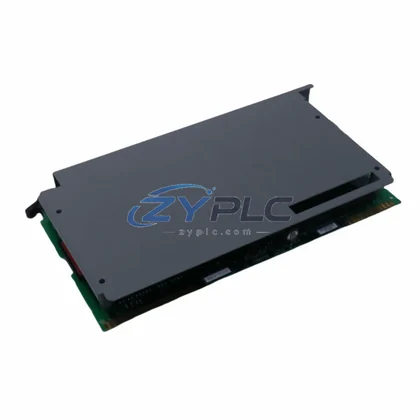
Siemens 6DP1210-8CA Industrial Network Interface for Teleperm M Systems
The Siemens 6DP1210-8CA is a Binary Input/Output Module engineered for the Teleperm M Distributed Control System (DCS) platform — one of Siemens’ most enduring process automation architectures deployed across power generation, chemical processing, oil & gas, and heavy manufacturing facilities worldwide. As industrial sites push toward smarter, more connected operations, the 6DP1210-8CA serves as a critical node in the field-level data chain, bridging physical process signals with the supervisory control layer and enabling real-time visibility across the entire production network.
In modern industrial environments, the integrity of binary signal transmission directly determines the reliability of control decisions. The 6DP1210-8CA handles discrete on/off signals from field devices — limit switches, solenoid valves, motor contactors, and safety interlocks — and routes them through the Teleperm M backplane to the central processing units. This signal path is the foundation of any DCS-based control loop, and the quality of the I/O module determines how accurately the system reflects real plant conditions.
Compatibility & Integration Notes
| Parameter |
Specification |
| SKU / Part Number |
6DP1210-8CA |
| Module Type |
Binary Input/Output (Digital I/O) |
| Platform / Series |
Siemens Teleperm M DCS |
| Protocol Support |
Teleperm M internal bus, SINEC H1 compatible architecture |
| Interface Type |
DCS backplane slot module |
| Signal Compatibility |
24 VDC / 120 VAC discrete binary signals |
| Network Integration |
Compatible with Teleperm M AS230, AS235, AS388 automation stations |
| System Application |
Power plants, chemical DCS, process automation, safety interlock systems |
| Origin |
Germany |
| Warranty |
Warranty and support terms confirmed before quote — tested before shipment |
Connected Automation Data Flow
The 6DP1210-8CA does not operate in isolation — it is part of a tightly integrated data flow that spans from field instrumentation to the SCADA supervisory layer. Understanding this chain is essential for engineers designing or maintaining Teleperm M-based systems.
At the field level, binary signals originate from devices such as pressure switches, flow switches, and position sensors. These signals are wired into the 6DP1210-8CA’s input channels, where they are conditioned and digitized for transmission across the Teleperm M internal bus. The module works in concert with the Siemens AS235 automation station, which serves as the central processing unit for control logic execution. The AS235 reads the binary states from the 6DP1210-8CA and uses them to trigger control outputs — opening valves, starting pumps, or activating alarms — through companion output modules such as the 6DP1232-8CA digital output module.
For analog process variables running alongside binary signals, the 6DP1611-8CA analog input module handles 4–20 mA transmitter signals, feeding temperature, pressure, and flow data into the same Teleperm M backplane. This parallel data stream allows the AS235 to make compound control decisions based on both discrete and continuous process values simultaneously.
Communication between the Teleperm M DCS and the plant’s SCADA system is typically handled through a Siemens SINEC H1 industrial Ethernet gateway or a dedicated OPC server interface. This connection allows operators at the WinCC SCADA workstation to monitor binary I/O states in real time, acknowledge alarms, and review historical event logs — all without interrupting the control loop running on the AS235.
For remote I/O expansion in distributed plant areas, the Teleperm M architecture supports remote bus extensions using 6DP1900-series remote I/O couplers, which allow 6DP1210-8CA modules to be installed in field cabinets far from the central control room while maintaining synchronous data exchange with the automation station. This capability is particularly valuable in large-footprint facilities such as power stations or refinery units where field devices may be hundreds of meters from the DCS cabinet.
At the drive level, variable frequency drives such as the Siemens SINAMICS G120 receive start/stop and direction commands through binary output signals originating from the 6DP1210-8CA chain, enabling coordinated motor control across conveyor systems, pump stations, and compressor trains. The binary feedback signals from the drive’s status outputs — run confirmation, fault relay, ready signal — are returned to the 6DP1210-8CA inputs, closing the control loop and providing the AS235 with real-time drive status for alarm management and interlock logic.
For facilities integrating edge computing or IIoT data collection, an industrial edge gateway connected to the SINEC H1 network can subscribe to Teleperm M data tags and forward them to cloud analytics platforms, enabling predictive maintenance models based on binary event frequency and pattern analysis. This architecture extends the value of the 6DP1210-8CA beyond simple on/off control into the domain of data-driven operational intelligence.
Solving Data Isolation in Industrial Sites
One of the most persistent challenges in legacy DCS environments is data isolation — the condition where field-level binary events are captured by the I/O module but never effectively communicated to maintenance teams, production planners, or energy managers. The 6DP1210-8CA, when properly integrated within the Teleperm M architecture, directly addresses this problem.
Protocol fragmentation is a common barrier. Older plant sections may use hardwired relay logic or proprietary fieldbus segments that cannot communicate natively with modern SCADA or MES systems. By consolidating binary signals through the 6DP1210-8CA and the Teleperm M backplane, all discrete events are normalized into a single data model that can be accessed via OPC-DA or OPC-UA interfaces, eliminating the need for parallel data collection systems and reducing the risk of conflicting process states between control and monitoring layers.
Remote monitoring is another area where the 6DP1210-8CA delivers measurable value. In facilities where maintenance personnel cannot be physically present at every field cabinet, the ability to monitor binary I/O states remotely through WinCC or a third-party SCADA platform reduces response time to equipment faults. When a motor contactor fails to close or a limit switch reports an unexpected state, the alarm is immediately visible at the operator workstation, allowing rapid diagnosis without a physical site walk.
Production line transparency improves significantly when binary event data is logged with timestamps and made available for analysis. Cycle time analysis, equipment utilization tracking, and downtime root cause investigation all depend on accurate binary event records. The 6DP1210-8CA’s integration with the Teleperm M event logging system ensures that every state change is captured with millisecond-level resolution, providing the data foundation for continuous improvement programs.
System expansion is straightforward within the Teleperm M framework. Additional 6DP1210-8CA modules can be added to existing racks as process requirements grow, without requiring changes to the communication architecture or SCADA configuration. This modularity protects the capital investment in the existing DCS infrastructure while accommodating new field devices, additional safety interlocks, or expanded monitoring points as the plant evolves.
Every 6DP1210-8CA unit supplied by ZYPLC undergoes functional testing prior to shipment, verifying channel integrity, bus communication, and signal response. Units are sourced from verified supply channels and Warranty terms are confirmed during quotation.
Industrial Connectivity FAQ
Q1: What communication protocols does the 6DP1210-8CA support?
The 6DP1210-8CA communicates via the Teleperm M internal DCS backplane bus. At the system level, the Teleperm M platform supports SINEC H1 industrial Ethernet for SCADA integration and can interface with OPC servers for data exchange with WinCC, third-party HMI systems, and MES platforms. The module itself does not require separate protocol configuration — it operates natively within the Teleperm M rack architecture.
Q2: Is the 6DP1210-8CA compatible with current Siemens automation systems?
The 6DP1210-8CA is designed specifically for the Teleperm M DCS platform, including AS230, AS235, and AS388 automation stations. It is not directly interchangeable with SIMATIC S7 or PCS 7 I/O modules. For facilities migrating from Teleperm M to PCS 7, Siemens offers migration kits, but the 6DP1210-8CA remains the correct replacement for existing Teleperm M installations requiring like-for-like module substitution.
Q3: What is the testing and quality assurance process before shipment?
All 6DP1210-8CA units supplied by ZYPLC are functionally tested prior to dispatch. Testing covers input channel response, output switching, backplane bus communication, and power consumption verification. Units that do not meet original Siemens performance specifications are not shipped. A warranty and support terms confirmed before quote is provided from the date of shipment, covering functional defects under normal operating conditions.
Q4: How quickly can the 6DP1210-8CA be delivered, and is RFQ availability?
ZYPLC supports RFQ-based sourcing of the 6DP1210-8CA to support both scheduled maintenance and urgent replacement needs. Standard orders are processed and dispatched within 1–3 business days. International shipments are handled via DHL, FedEx, or UPS with full tracking. For large-quantity orders or long-term supply agreements, contact the ZYPLC sales team to discuss availability and lead times.